

45-Minute Claude Architect Certification Cram Session
- Mark Kendall
- 11 minutes ago
- 7 min read

The agentic flow is what happens when Claude reasons across steps, tools, skills, repo context, markdown files, MCP servers, commands, and validations. The API is the lower-level control surface: your code decides what gets sent, what comes back, what tool gets called, what JSON is required, what gets retried, and what system owns the result.
Here is the 45-minute “guy like you before the test” session I would run.
45-Minute Claude Architect Certification Cram Session
Minute 0–5: Reset the architecture mindset
Do not think of Claude as “a chatbot.”
Think of Claude as a reasoning engine inside an engineered system.
For the test, every question probably wants you to know which layer you are operating in:
Layer
What it means
Prompt
The instruction you give Claude
Context
The information Claude has available
Tool
Something Claude can request your app to execute
MCP
A standard way to expose external systems/tools/context
Agent
Claude plus goals, tools, memory/context, and loop control
Claude Code
Claude operating inside a repo/dev workflow
API
Your application calling Claude directly
Guardrails
Schema, validation, permissions, retries, observability
Evaluation
Measuring whether the system worked
The exam mindset is probably: Can you design reliable Claude systems, not just use Claude interactively?
Minute 5–12: The five big exam domains
1. Agentic Architecture & Orchestration
An agent is not magic. It is usually:
Goal
+ Instructions
+ Context
+ Tools
+ Reasoning loop
+ Validation
+ Stop condition
+ Observability
The key architectural question is:
Who controls the loop?
Sometimes Claude controls tool choice. Sometimes your application controls the steps. Sometimes Claude Code controls the repo workflow. Sometimes an orchestrator coordinates multiple smaller agents.
For enterprise systems, do not build one giant genius agent. Build smaller controlled agents:
Planner Agent
→ Implementation Agent
→ Test Agent
→ Reviewer Agent
→ Release/Evidence Agent
That is safer, more observable, and easier to debug.
2. Tool Design & MCP Integration
A tool is not “Claude doing something.”
A tool is Claude asking your application to do something, usually with structured arguments.
Claude decides:
I need to call get_customer_order_status with order_id=12345
Your app executes:
Call database / API / service
Return result to Claude
Then Claude reasons over the returned result.
The important part: Claude does not directly own your production system. Your app does.
MCP is a standard connector pattern that lets Claude access external systems like files, GitHub, Jira, Confluence, databases, search, internal tools, and so on. Anthropic’s docs describe tool use as Claude returning a structured tool request that your application executes, and MCP as a way to connect Claude to remote MCP servers directly from the Messages API.
Exam phrase to remember:
Tools expose capabilities. MCP exposes capabilities in a standardized way. The application remains responsible for execution, permissions, validation, and security.
3. Claude Code Configuration & Workflows
Claude Code is the repo-aware development operating model.
The important pieces:
/commands
skills
hooks
subagents
repo context
tests
git workflow
CI/CD
For your world, this maps beautifully to Intent-Driven Engineering:
→ plan.md
→ tasks.md
→ implementation
→ tests
→ evidence
→ pull request
Claude Code is not just “write me code.” The right architecture is:
Understand repo
Understand standards
Read intent
Create plan
Break into tasks
Implement small pieces
Run tests
Fix failures
Produce evidence
Open PR
That is exactly your strength: boxes, flows, responsibilities, handoffs, and evidence.
4. Prompt Engineering & Structured Output
Prompting for the exam is not about clever wording.
It is about controlling behavior.
Good prompt structure:
Role
Objective
Context
Constraints
Output format
Acceptance criteria
Failure behavior
For production, do not just say:
Return JSON.
Use structured outputs or tool schemas where possible. Anthropic’s docs say structured outputs are used when you need Claude to return valid JSON matching a schema, and tool definitions use input schemas so Claude can produce structured tool calls.
Certification principle:
The more production-critical the workflow, the less you rely on vibes and the more you rely on schemas, validations, retries, and tests.
5. Context Management & Reliability
Context is the fuel. Bad context equals bad output.
You need to know the difference between:
Context Type
Example
Static instructions
CLAUDE.md, standards, coding rules
User request
“Build this feature”
Repo context
Files, APIs, tests, dependencies
Retrieved context
Jira, Confluence, docs, Figma, logs
Tool result context
Results returned by APIs/tools
Memory/session context
Prior decisions, assumptions
Output context
Plans, markdown files, evidence
Reliability comes from managing what Claude sees and when.
Bad pattern:
Dump everything into context and hope.
Good pattern:
Retrieve only what is relevant.
Summarize large sources.
Preserve key decisions.
Validate outputs.
Keep an evidence trail.
The 15-Minute API Section You Need
This is the bonus section I would add for you because it is where your architecture jumps from “using Claude Code” to “building Claude-powered systems.”
What “using the API” really means
Yes, it means your software calls Anthropic and gets Claude’s response.
A simple Claude API flow looks like this:
Your app
→ sends request to Anthropic Messages API
→ Claude responds
→ your app parses response
→ your app stores/displays/uses result
The Messages API is the main request/response structure for calling Claude with system prompts, messages, model selection, max tokens, and other controls.
Basic conceptual example:
from anthropic import Anthropic
client = Anthropic()
response = client.messages.create(
model="claude-sonnet-4-5",
max_tokens=1000,
system="You are an enterprise architecture assistant.",
messages=[
{
"role": "user",
"content": "Create an API design for a customer onboarding service."
}
]
)
print(response.content[0].text)
That is the simplest form.
But the real power is not “ask Claude a question.”
The real power is:
Your app controls the workflow.
Claude reasons inside the workflow.
Your system validates the result.
API vs Agentic Flow
Here is the difference:
Pattern
Who controls the work?
Best for
Direct API call
Your app
Summaries, extraction, classification, generation
Tool use
Claude selects tools, app executes them
Dynamic workflows
Agentic loop
Claude repeatedly reasons and acts
Multi-step tasks
Claude Code
Claude works inside repo/dev flow
Coding, tests, PRs
MCP
External context/tools exposed cleanly
Enterprise integrations
For certification, you should be able to explain this:
The API is the foundation. Agentic workflows are built on top of API calls, tool calls, context management, and orchestration logic.
How You Should Personally Think About APIs
You should not think:
I need to become a low-level API programmer.
You should think:
I need to architect Claude-powered services.
For you, the API becomes the engine behind things like:
Intent intake
Intent refinement
Feature decomposition
API design
Test generation
Architecture review
Risk scoring
Simulation
Evidence generation
Delivery scorecards
Example:
User enters feature intent
→ API call to Claude creates refined intent.md
→ API call creates plan.md
→ API call creates task breakdown
→ Tool/MCP pulls Jira/Confluence/repo context
→ Claude produces implementation strategy
→ Claude Code executes in repo
→ API creates executive summary/evidence report
That is the bridge between your markdown intent files and real enterprise automation.
Markdown files are the human-readable contract.
The API is how you automate the contract.
What “Writing APIs” Means in This Context
There are two meanings, and you need both.
1. Writing normal business APIs
Example:
POST /customers
GET /customers/{id}
POST /orders
GET /orders/{id}/status
This is traditional API design.
You care about:
Resources
Methods
Request body
Response body
Status codes
Authentication
Authorization
Validation
Error handling
Rate limits
Observability
Versioning
A good API endpoint has a contract:
POST /intents/refine
Request:
projectName: string
rawIntent: string
constraints: string[]
Response:
intentId: string
refinedIntentMarkdown: string
assumptions: string[]
risks: string[]
nextSteps: string[]
That is just clean software engineering.
2. Writing Claude-powered APIs
This is where your app exposes an endpoint, but Claude powers part of the result.
Example:
POST /intents/refine
Behind the scenes:
API receives raw intent
→ validates request
→ builds Claude prompt
→ calls Anthropic API
→ validates Claude response
→ stores result
→ returns structured response
That is how you turn IDE into a product.
You are no longer just using Claude Code manually. You are building a system where Claude becomes a service inside your architecture.
Simple Claude-Powered API Pattern
Frontend
→ Your Backend API
→ Claude Messages API
→ Validation Layer
→ Database
→ Frontend Result
Example architecture:
React UI
|
v
FastAPI / Node API
|
v
Prompt Builder
|
v
Anthropic Messages API
|
v
Response Validator
|
v
Postgres / S3 / GitHub
|
v
User sees refined intent
This is the pattern you should master.
The Exam Answer Pattern
When asked how to design a Claude-powered workflow, answer like this:
1. Define the user goal.
2. Identify required context.
3. Decide whether this is direct API, tool use, MCP, Claude Code, or agentic orchestration.
4. Define schemas and tool contracts.
5. Control permissions and execution outside the model.
6. Validate output.
7. Add retries/fallbacks.
8. Log decisions and evidence.
9. Evaluate against success criteria.
That answer will probably beat 80% of people.
Your Personal 45-Minute Final Review Script
Here is the version I would literally have you say out loud before the test:
Claude is a reasoning engine.
The API is how my software calls that reasoning engine.
Tools are structured requests Claude can make, but my application executes them.
MCP is the standardized way to expose tools and context.
Claude Code is the repo-aware engineering workflow.
Skills and commands package repeatable behavior.
Hooks enforce workflow automation.
Subagents divide responsibility.
Markdown files capture intent, plans, tasks, evidence, and decisions.
Schemas and structured outputs improve reliability.
The application owns security, permissions, validation, retries, and observability.
Good architecture is not one giant agent. It is a controlled system of context, tools, APIs, agents, validation, and evidence.
That is the whole certification in one breath.
What I Would Tell You to Focus On
You probably already understand the agentic side because you have been living it through IDE, Claude Code, skills, agents, MCP, repo workflows, and markdown files.
The area to sharpen is this:
How do I turn those workflows into APIs and products?
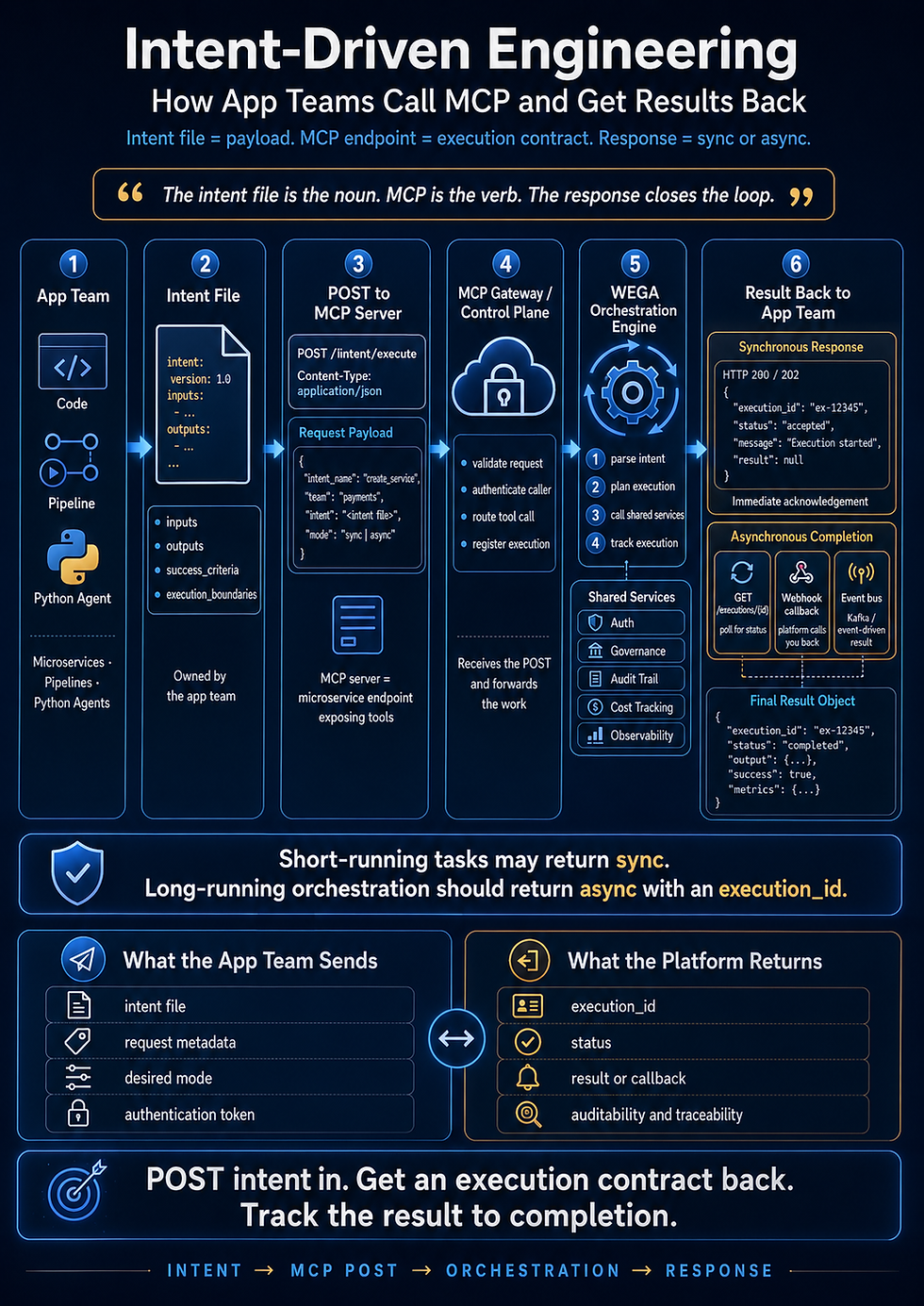
That means designing endpoints like:
POST /intents/refine
POST /plans/generate
POST /tasks/decompose
POST /architecture/review
POST /tests/generate
POST /evidence/create
POST /delivery/scorecard
Each one becomes:
Input contract
Prompt/context builder
Claude API call
Structured response
Validation
Persistence
Return value
That is where your Intent-Driven Engineering becomes not just a practice, but a platform.
Comments