

A Better Way to Think About Enterprise AI

A Better Way to Think About Enterprise AI
The AI conversation still spends too much time asking:
Which model should we use?
Claude? GPT? Gemini? A specialized scientific model?
That matters, but it is not the best place to start.
A better question is:
What artifact are we asking the AI system to produce, and what evidence tells us that artifact is acceptable?
That changes the architecture immediately.
Instead of:
Prompt → Response
we start thinking:
Intent → Artifact → Evidence
Or, more fully:
Intent → Inputs → Models + Agents + Tools → Artifact → Validation → Evidence
The model is no longer the center of the system. It is one component used to produce a trustworthy result.
AI is moving toward artifact creation
A recent research paper, “Agentic Artifact Creation: Systems, Evaluation, Principles, and Opportunities,” studied 259 works involving AI agents creating complex deliverables.
The important idea is that AI systems should not simply generate content. They should construct artifacts, inspect results, verify them, correct problems and revalidate.
That looks more like:
Intent → Construct → Verify → Repair → Revalidate
The paper also makes an important point: using another language model to judge the first model may not provide truly independent evidence. The verifier can share the same weaknesses as the generator.
Generation is not validation.
Read the paper:
Anthropic is heading the same direction
Anthropic increasingly talks about Claude outputs as artifacts.
An artifact might be:
software
a report
an analysis
a research paper
an application
a plan
an algorithm
a visualization
a regulatory document
That becomes especially important with Claude Science.
Claude Science is designed to work across scientific tools, code, computational environments, databases and specialized agents.
Anthropic also emphasizes auditable artifacts.
Instead of simply producing a scientific figure or analysis, the system can retain supporting information such as:
code + computational history + explanation + source material
That changes the question from:
“Did the AI give us a good answer?”
to:
“Can we prove where this artifact came from and why we should trust it?”
Claude Science:
Anthropic Science:
What artifacts are we actually producing?
In software engineering:
Artifact: production code
Evidence: tests, build, coverage, security and architecture validation
In science:
Artifact: analysis, model, dataset or hypothesis
Evidence: calculations, source data, citations, statistics and reproducibility
In regulatory work:
Artifact: submission documentation
Evidence: approved records, traceability and compliance checks
In enterprise automation:
Artifact: completed business transaction
Evidence: state changes, approvals, policies and audit logs
That means software is still an important outcome, but it is no longer the only outcome.
Sometimes the artifact is knowledge.
Sometimes it is an algorithm.
Sometimes it is evidence.
And once a successful AI-assisted process becomes repeatable, software often becomes the mechanism that operationalizes it.
Evidence becomes the engineering discipline
Anthropic’s work on AI agent evaluations reinforces the same point.
Agents may use multiple tools, perform many steps and alter systems along the way.
So evaluation cannot simply ask whether the final answer sounds correct.
We need evidence.
Did the code compile?
Did the tests pass?
Did the calculations reproduce?
Were the correct sources used?
Did the system remain within its permissions?
Did a human approve the high-risk decision?
Anthropic’s agent-evaluation guidance:
The principle is simple:
Do not ask AI merely to produce something. Decide what evidence will allow you to accept what it produces.
What this means for enterprise AI
Large organizations may have dozens of teams using AI for completely different purposes.
One group wants software.
Another wants research.
Another wants regulatory documentation.
Another wants scientific analysis.
Another wants automation.
The enterprise AI platform therefore should not be built around one model or one type of output.
It should provide reusable capabilities for transforming intent into trustworthy artifacts.
That includes models, agents, tools, enterprise data, MCP, skills, identity, permissions, validation, observability, human approval and evidence.
The business owns the intent.
The AI system creates the artifact.
The architecture establishes the evidence.
A simpler architectural question
Before asking:
Which model should we use?
Ask:
What artifact are we trying to create?
Then:
What capabilities are required to create it?
And finally:
What evidence proves that we should accept it?
That principle applies whether the output is software, scientific research, an algorithm, a regulatory document or an autonomous workflow.
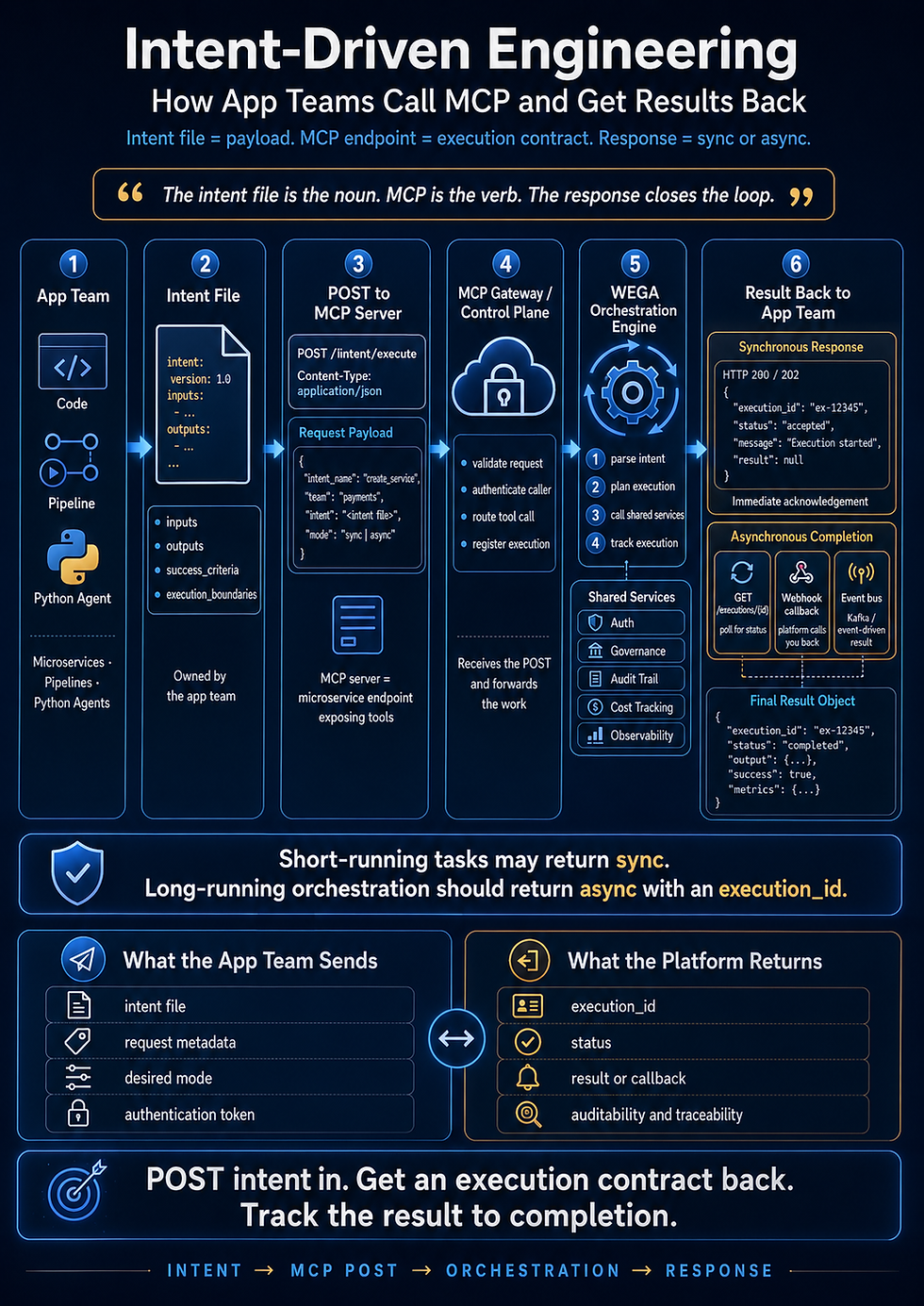
It also fits naturally with Intent-Driven Engineering:
Intent
Inputs
Outputs
Success Criteria
The artifact is the concrete output.
The evidence proves the success criteria.
So perhaps the simplest AI architecture pattern is:
Intent → Artifact → Evidence
And perhaps one of the most important questions we can ask before deploying AI is:
What artifact are we asking the AI system to produce, and what evidence tells us that artifact is acceptable?
If we cannot answer that question, we probably are not ready to automate the work.
References
Agentic Artifact Creation
Claude Science
Anthropic Science
Anthropic Agent Evaluations
Related
Comments