

Accenture Is Moving Toward Intent-Driven Engineering — They Just Don’t Call It That
- Mark Kendall
- 3 days ago
- 6 min read

Accenture Is Moving Toward Intent-Driven Engineering — They Just Don’t Call It That
AI-native engineering, agentic software delivery, reusable agents, evaluation harnesses, governance and business outcomes are converging on a familiar idea: define what needs to happen before asking AI to build it.
Something interesting is happening inside one of the world’s largest technology consulting companies.
Accenture is aggressively building an AI-native software engineering capability. Its current engineering roles describe production multi-agent architectures, AI-assisted development across the SDLC, evaluation harnesses, context engineering, reusable accelerators, governance, observability and measurable business outcomes.
Accenture doesn’t call this Intent-Driven Engineering.
But look closely at where the architecture is heading.
The similarities are difficult to ignore.
Software engineering is moving above the code
For decades, the fundamental unit of software development was code.
A developer received a requirement, interpreted it and translated that requirement into software.
Generative AI changed that relationship.
The developer can increasingly describe what needs to happen while AI systems perform larger portions of implementation, testing, debugging and review.
Accenture describes its next generation of engineers as people who use AI as a core part of how they work rather than an add-on. Its engineers are expected to use AI throughout the software lifecycle while remaining responsible for determining whether AI-generated output is production ready.
That changes the engineering problem.
When AI can increasingly determine how to build something, humans need to become substantially better at defining what should be built, why, under what constraints, and how success will be measured.
That is the central idea behind Intent-Driven Engineering.
What Accenture is building
Accenture’s public material points toward several major capabilities.
Its AI-native engineering organization is building production-grade agentic systems involving multi-agent orchestration, RAG, policy-based routing, tool invocation, memory management, evaluation harnesses and lifecycle observability.
Its engineers are also expected to create reusable patterns, accelerators and playbooks that can move from one engagement to another.
That’s significant.
The objective isn’t simply:
Give every developer an AI coding assistant.
It is increasingly:
Create a repeatable engineering system around AI.
And that distinction matters.
Then comes AI Refinery
Accenture is taking the concept beyond individual engineering teams with AI Refinery.
Accenture AI Refinery announcement
Accenture’s AI Refinery includes an agent builder and preconfigured industry agents.
The company has described business users creating and modifying teams of agents based on changing business requirements while retaining governance and guardrails.
Its Distiller framework takes the architecture deeper, providing capabilities covering agent memory, multi-agent collaboration, workflow management, evaluation, governance, observability and interoperability.
This isn’t simply AI-assisted programming anymore.
It’s an enterprise execution architecture.
And once enterprises build execution architectures like this, an important question emerges:
What drives the agents?
My answer is: intent.
Where Intent-Driven Engineering fits
Intent-Driven Engineering begins one level higher.
Instead of starting with:
Prompt → AI → Code
or even:
Specification → Agent → Code
the process starts with the desired business outcome.
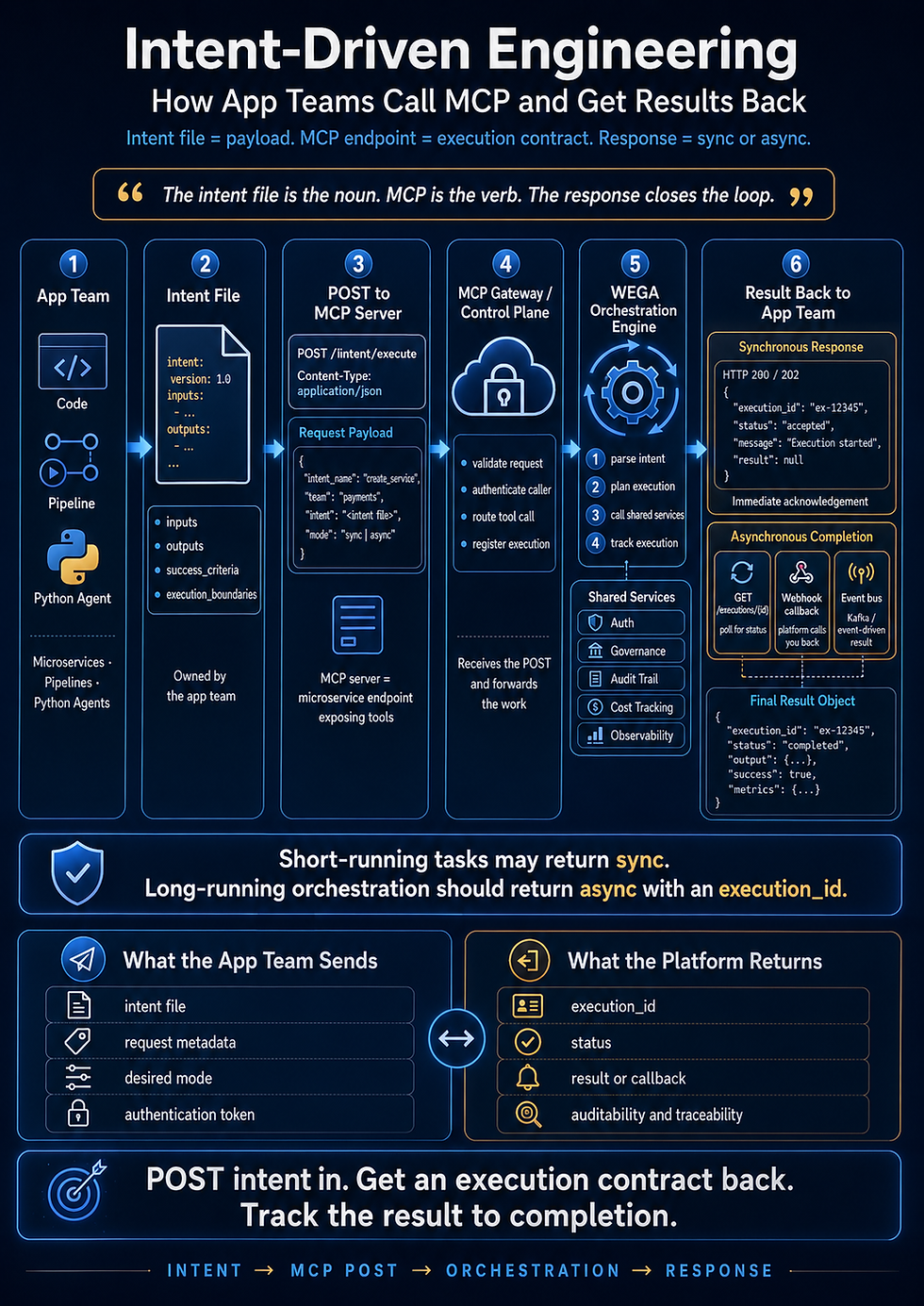
A simplified IDE lifecycle looks like this:
Business Intent
↓
Structured Intent Artifact
↓
Enterprise Context / MCP
↓
Planning & Reasoning
↓
Specialist Agents
↓
Implementation
↓
Validation
↓
Testing
↓
Pull Request
↓
Deployment
↓
Observability
↓
Feedback into Intent
The intent artifact isn’t merely another prompt.
It establishes things such as the desired outcome, acceptance criteria, constraints, architecture boundaries, dependencies, relevant enterprise context and what is explicitly outside the scope of the change.
The AI execution system then has a bounded problem to solve.
Spec-Driven vs. Intent-Driven
This distinction becomes increasingly important as AI engineering matures.
A specification generally answers:
What exactly should we build?
Intent answers a broader question:
What outcome are we trying to achieve, why does it matter, what constraints govern it, and how will we know we succeeded?
Specifications aren’t eliminated by Intent-Driven Engineering.
They’re downstream artifacts.
An intent can generate a plan.
A plan can generate specifications.
Specifications can drive agents.
Agents can generate implementations.
That gives us:
Intent → Context → Plan → Specification → Agents → Software
rather than treating the specification as the beginning of the engineering lifecycle.
The Accenture model and IDE side-by-side
Capability
Accenture’s public direction
Intent-Driven Engineering
Starting point
Business use cases/workflows
Business intent/outcome
Definition
Requirements/workflows
Structured intent artifact
Context
RAG/context engineering
MCP + enterprise context
Planning
Agentic reasoning
Planning agent
Execution
Multi-agent orchestration
Specialist agents
Development
AI-native engineering
Repo-aware implementation
Quality
Evaluation harnesses
Acceptance criteria + validation
Reuse
Accelerators/playbooks
Skills/agents/templates
Governance
Policies/guardrails
Intent + policy + CI governance
Operations
Lifecycle observability
Observability → intent feedback
Measurement
Accuracy, safety, cost, ROI
Outcome + engineering metrics
These aren’t identical methodologies.
But they are clearly moving toward many of the same architectural principles.
Accenture specifically emphasizes production systems rather than prototypes, reusable architectures rather than one-off implementations, and metrics covering accuracy, latency, safety and cost effectiveness.
The developer’s role changes
This may be the biggest implication.
In the traditional model:
Requirement → Developer → Code
In the emerging model:
Intent → Engineer → AI Engineering System → Software
The engineer doesn’t disappear.
The engineer moves up the abstraction stack.
Instead of spending the majority of engineering effort manually translating requirements into syntax, engineers increasingly direct systems that can perform portions of that translation.
The valuable skills therefore shift toward architecture, decomposition, context management, constraints, acceptance criteria, evaluation, security, governance and outcome verification.
Accenture’s hiring provides an interesting real-world signal here. Its AI-native roles emphasize engineers capable of owning production outcomes, building reusable architectures, managing agent orchestration and evaluating AI systems—not merely generating code.
Don’t build another coding assistant
This is where I believe enterprises can easily make the wrong investment.
Claude Code, Cursor, GitHub Copilot and other AI engineering systems are rapidly becoming extremely capable implementation engines.
Enterprises don’t necessarily need to build another one.
The larger opportunity is creating the operating model surrounding those engines.
That means establishing a repeatable pathway from:
Business Intent → Engineering Intent → Context → AI Execution → Verification → Business Outcome
The underlying model or coding tool can change.
The operating model survives.
That’s particularly important for large enterprises because today’s preferred model almost certainly won’t be the last model they deploy.
Accenture itself emphasizes multi-provider architectures incorporating Anthropic, OpenAI, Google and open-source models.
Intent therefore becomes an abstraction layer above the model.
Intent is the control plane
This leads to perhaps the simplest description of Intent-Driven Engineering:
Agents are the execution layer. Intent is the control plane.
AI can write code.
Agents can call tools.
MCP and retrieval systems can provide context.
Evaluation systems can determine whether outputs meet requirements.
CI/CD can deliver the resulting software.
Observability can tell us what happened.
But something still has to define what outcome all of those systems are supposed to produce.
That’s intent.
Accenture doesn’t need to call it Intent-Driven Engineering
And that’s really the point.
This isn’t an argument that Accenture has adopted a methodology called Intent-Driven Engineering. I found no evidence that it has.
The evidence supports something more interesting.
Accenture is investing heavily in many of the capabilities that make an intent-driven operating model practical:
AI-native engineering. Agent orchestration. Context engineering. Evaluation. Reusable engineering patterns. Governance. Observability. Business outcomes.
AI Refinery takes that architecture beyond coding into networks of specialized agents encoded with business workflows and industry expertise. Accenture said it had already supported more than 2,000 generative-AI projects when it introduced its industry-focused AI Refinery offering in January 2025.
The pieces are converging.
The next battle isn’t about who writes the code
Claude, GPT, Gemini and whatever comes next will continue getting better at implementation.
That means competitive advantage moves somewhere else.
It moves toward organizations that can most effectively define outcomes, assemble trusted context, constrain AI behavior, orchestrate execution, verify results and continuously improve the process.
That’s why I believe the next evolution of software engineering won’t simply be AI-assisted development.
It will be engineering systems in which humans increasingly define intent, while AI systems increasingly execute the implementation required to satisfy it.
Accenture may call that AI-Native Software Engineering.
Others may call pieces of it agentic engineering, spec-driven development, or AI-powered SDLC.
I call the operating model above all of them:
Intent-Driven Engineering
Define the outcome. Provide the context. Establish the constraints. Let AI execute. Verify the result.
And if companies the size of Accenture are building the infrastructure necessary to operate this way at enterprise scale, that’s a pretty significant indication of where software engineering is headed.
Comments