
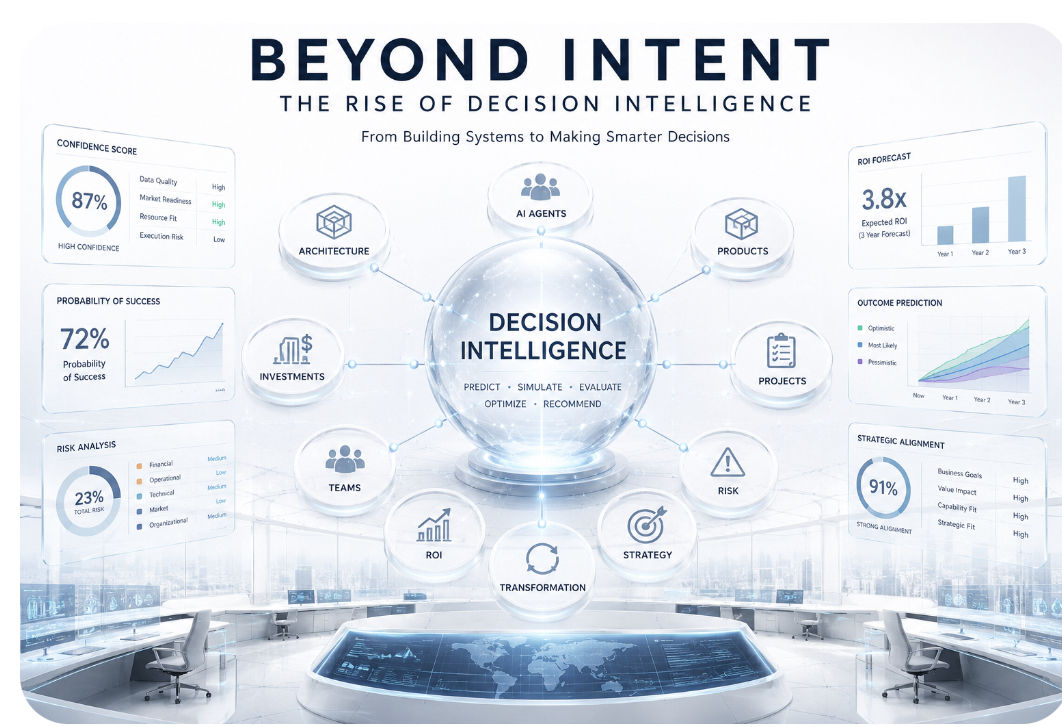
Beyond Intent: The Rise of Decision Intelligence
- Mark Kendall
- 15 hours ago
- 3 min read

Beyond Intent: The Rise of Decision Intelligence
For the last several years, the technology industry has focused on one primary objective: accelerating execution.
We built cloud-native platforms to deploy faster. We adopted agile delivery models to increase velocity. We embraced AI copilots, autonomous agents, and software factories to generate code, automate workflows, and reduce development effort.
The results have been extraordinary.
Organizations can now build applications faster than at any point in history. Multi-agent systems are becoming practical. AI is transforming software development, operations, support, and business processes across nearly every industry.
Yet despite these advances, one challenge remains largely unchanged.
Enterprises still struggle to determine which initiatives deserve investment before significant time, money, and resources are committed.
The most expensive failures in business are rarely caused by poor execution.
They are caused by pursuing the wrong initiative.
The wrong modernization effort.
The wrong architecture.
The wrong product strategy.
The wrong transformation.
The wrong investment.
For decades, organizations have relied on presentations, assumptions, historical experience, and executive judgment to make decisions worth millions—or even billions—of dollars. Only after substantial investment do they discover whether those decisions will produce the intended outcomes.
In an era defined by artificial intelligence, this approach is becoming increasingly difficult to justify.
The next evolution is not about building smarter systems.
It is about making smarter decisions.
As enterprises continue to invest in AI, agents, automation, and digital transformation, a new category is beginning to emerge: Decision Intelligence.
Decision Intelligence represents a shift from execution-focused thinking to outcome-focused thinking.
Rather than asking:
“Can we build this?”
Organizations begin asking:
“Should we build this?”
This distinction changes everything.
Before launching a transformation initiative, leaders should understand the probability of success.
Before funding an AI program, they should understand expected ROI, adoption risks, organizational readiness, and operational impact.
Before approving a major architectural investment, they should understand scalability risks, implementation complexity, business alignment, and long-term value.
The future enterprise will not rely solely on reporting systems that explain what happened yesterday.
It will depend on intelligent platforms capable of predicting what is likely to happen tomorrow.
Imagine an enterprise control center that continuously evaluates strategic initiatives before and during execution.
A platform that simulates future scenarios.
Identifies emerging risks.
Predicts potential outcomes.
Calculates confidence scores.
Estimates expected returns.
Recommends alternative courses of action.
And continuously learns from real-world results.
This concept is not new to industries such as energy, aviation, logistics, and manufacturing. Operational control centers have long been used to monitor performance, predict failures, optimize investments, and improve outcomes.
Enterprise decision-making is following the same path.
The next generation of enterprise platforms will provide visibility far beyond applications and infrastructure.
They will evaluate products.
Programs.
Portfolios.
Architectures.
Transformations.
Investments.
Teams.
Business capabilities.
Strategic initiatives.
The organizations that succeed over the next decade will not necessarily be those that deploy the most AI agents or generate the most code.
They will be the organizations that consistently make better decisions.
The competitive advantage of the future will not be execution alone.
Execution is becoming increasingly automated.
The true differentiator will be confidence.
Confidence that an initiative will deliver value.
Confidence that an investment will achieve its objectives.
Confidence that resources are being directed toward the highest-impact opportunities.
For years, technology leaders have focused on improving how enterprises build.
The next challenge is improving how enterprises decide.
The age of software intelligence has begun.
The age of Decision Intelligence is next.Author: Mark Kendall
Series: Beyond Intent
Category: Decision Intelligence | Enterprise Transformation | AI Strategy | Future of Engineering
Comments