
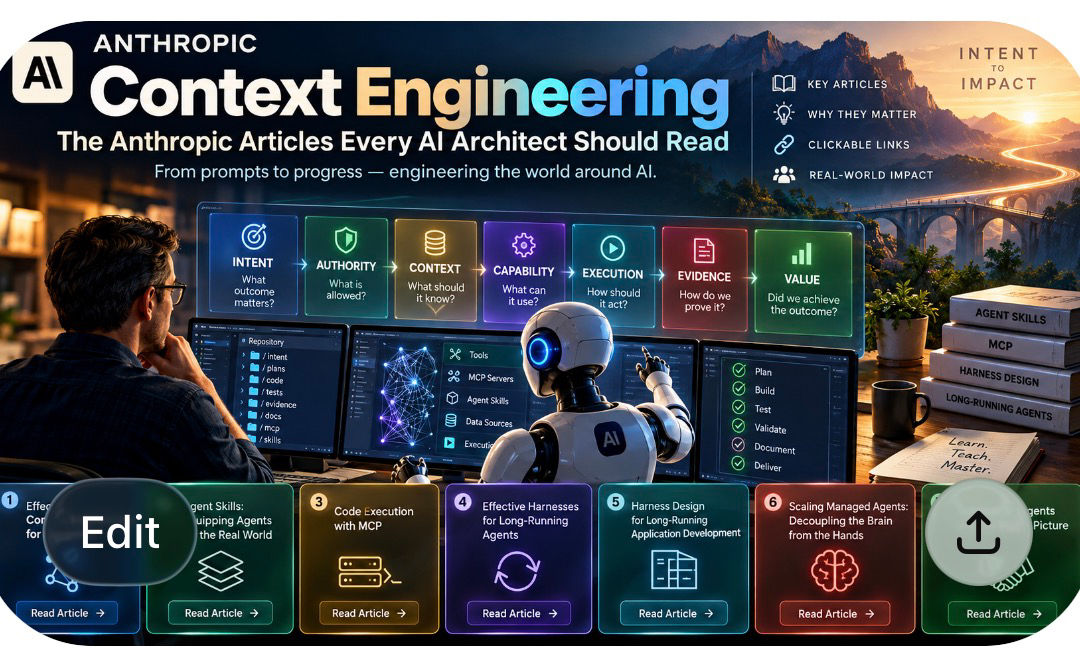
Context Engineering: The Anthropic Articles Every AI Architect Should Read

Context Engineering: The Anthropic Articles Every AI Architect Should Read
For the last few years, much of the AI conversation has centered on prompt engineering.
Write a better prompt.
Give the model better instructions.
Add more detail.
Tell it exactly what you want.
That is changing.
Anthropic has published a remarkably strong collection of articles around a much bigger idea:
Context Engineering.
And if you are building AI agents, enterprise AI platforms, agentic workflows, MCP servers, AI-enabled software, or AI coding systems, these articles are worth reading.
This is not marketing material.
Some of it gets pretty deep.
But taken together, these articles provide one of the clearest pictures I have seen of where AI engineering is going.
What Is Context Engineering?
Anthropic describes context engineering as the broader problem of determining what information should be available to a model at the moment it needs to make a decision.
That is much bigger than writing a prompt.
The context surrounding an agent can include:
instructions
user intent
previous work
files
repository state
tools
MCP servers
APIs
Agent Skills
memory
retrieved information
execution results
tests
system rules
permissions
evidence
The question becomes:
What does this agent need to know, see, access, and use right now to accomplish the intended outcome?
That is an architecture problem.
And that is why people building serious AI systems should care.
1. Effective Context Engineering for AI Agents
This is where I would start.
Anthropic makes an important distinction: building with language models is becoming less about finding the perfect words for a prompt and more about determining the right configuration of context for the desired behavior. (Anthropic)
Read it here:
Why you should care
Context is finite.
Throwing everything you know into an enormous prompt is not a scalable architecture.
An effective agent needs the right information, not necessarily the most information.
That changes how we think about AI applications.
Instead of:
Prompt → Model → Answer
we increasingly get:
Intent → Context → Capabilities → Reasoning → Execution → Evidence
That is a significant architectural shift.
2. Equipping Agents for the Real World with Agent Skills
This article moves context engineering into something very practical.
Anthropic’s Agent Skills package instructions, scripts, and supporting resources into reusable capabilities that an agent can discover and load when needed. (Anthropic)
Read it here:
Why you should care
You should not have to put every possible instruction into every prompt.
An agent should be able to discover capabilities when they become relevant.
Think of a skill almost like onboarding an employee.
You do not explain the entire corporation every morning.
You give the employee access to the procedures, knowledge, and tools needed for the job they are performing.
That is progressive disclosure.
And I believe it will become an important pattern for enterprise AI.
Interestingly, the concept has moved beyond Claude itself. Anthropic announced on October 22, 2026 that it is donating Agent Skills to the Agentic AI Foundation as an open standard. (Anthropic)
3. Code Execution with MCP: Building More Efficient Agents
If you work with MCP, read this one.
A common mistake is assuming that every tool definition and every tool result needs to flow directly through the model.
It doesn’t.
Anthropic describes using code execution alongside MCP so agents can discover tools as needed, manipulate information outside the model and return only the useful results to the model’s context. (Anthropic)
Why you should care
Imagine retrieving a spreadsheet containing 10,000 rows.
One approach is:
Send 10,000 rows into the model.
Another is:
Process the 10,000 rows, identify the five that matter, and give those five to the model.
That is context engineering.
It can improve efficiency, reduce unnecessary model context and create better boundaries around sensitive information.
MCP therefore isn’t merely about connecting an AI model to tools.
It can become part of the context architecture surrounding an agent.
4. Effective Harnesses for Long-Running Agents
This article is particularly important for anyone who believes autonomous agents are going to perform meaningful software or business work.
Anthropic faced a basic problem.
Complex jobs can span multiple context windows.
The next agent session may not inherently know what happened during the previous one.
Their approach used an initializer plus agents making incremental progress while leaving durable artifacts behind for subsequent sessions. (Anthropic)
Why you should care
This is where the repository, filesystem and persistent artifacts become extremely important.
A serious agentic system cannot depend entirely on chat history.
The work itself needs to carry context forward.
That might include:
plans
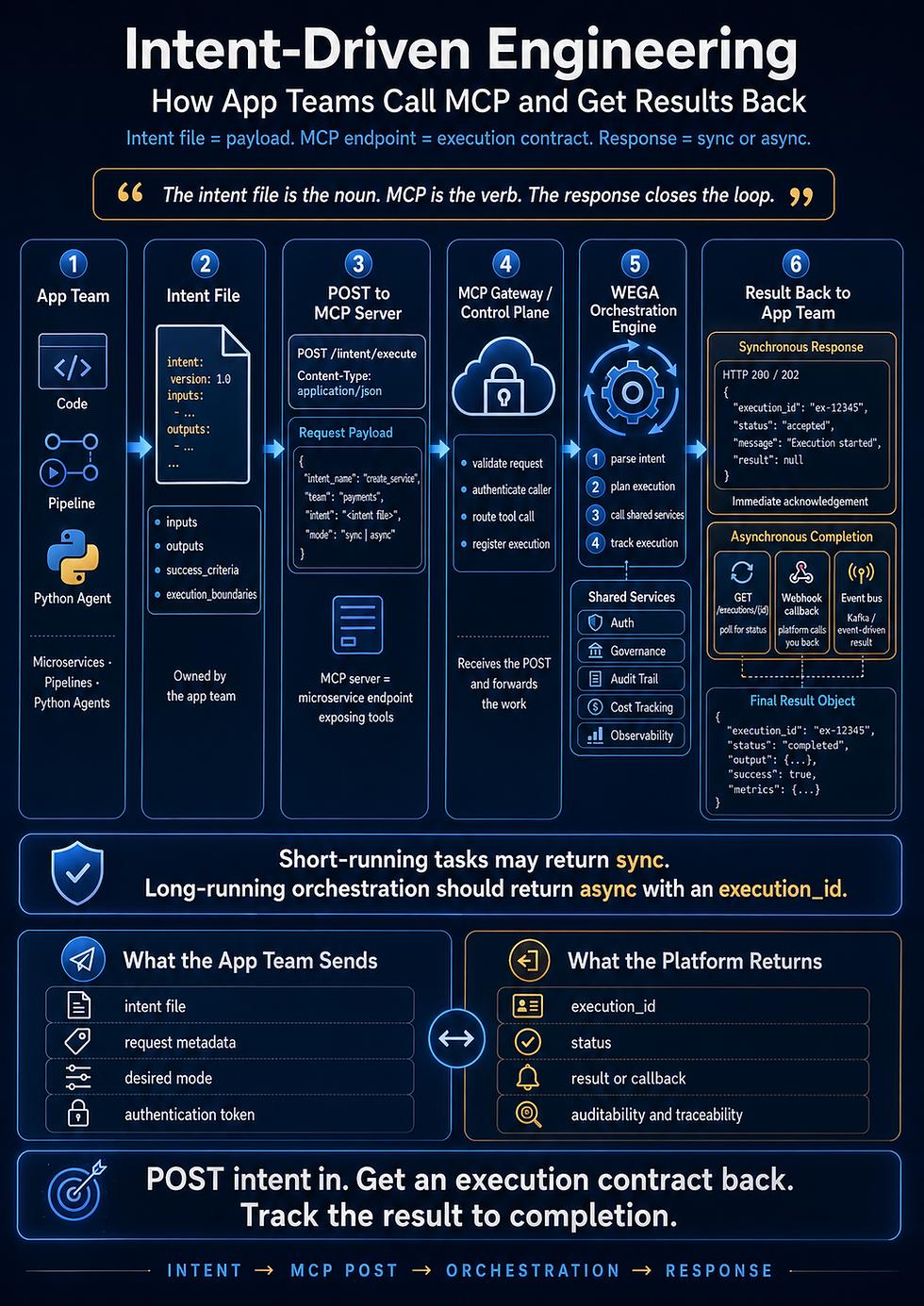
intent files
code
state
tests
decisions
evidence
progress records
outstanding work
The repository starts becoming part of the agent’s memory.
That is a much more durable engineering model than trying to maintain one enormous conversation.
5. Harness Design for Long-Running Application Development
Anthropic goes even further in this March 2026 article.
The important word here is harness.
The model is only part of an AI engineering system.
The surrounding environment can determine how effectively that intelligence gets turned into useful work.
Anthropic reports that prompt engineering and harness design improved performance substantially, but eventually reached ceilings that required new engineering approaches. (Anthropic)
Why you should care
We have spent enormous amounts of time discussing which AI model is smartest.
Claude.
GPT.
Gemini.
Whatever comes next.
But enterprises don’t deploy a model.
They deploy a system around a model.
The harness controls things such as:
available tools
context
execution
state
permissions
retries
verification
human intervention
evidence
As models improve, harness design may increasingly determine whether those models produce reliable enterprise results.
6. Scaling Managed Agents: Decoupling the Brain from the Hands
I love the title of this article because it describes a major architectural idea in six words:
Decouple the brain from the hands.
Anthropic makes another important observation: harnesses frequently encode assumptions about what today’s model cannot do.
But models improve.
Yesterday’s required workaround can become tomorrow’s unnecessary baggage. (Anthropic)
Why you should care
Enterprise architecture should not be tightly coupled to one model generation.
Your interfaces should survive changes underneath them.
The model may change.
The orchestration engine may change.
The agent framework may change.
The context mechanism may change.
But the enterprise still has the same fundamental requirements:
Intent. Authority. Capability. Execution. Evidence. Value.
Stable interfaces around changing intelligence will matter enormously.
7. There Is an Even Bigger Lesson Here
Another Anthropic article describes an agent as more than simply a model.
Its behavior depends on the combination of the model, the harness, its tools and the environment in which it operates. (Anthropic)
That is a powerful enterprise architecture concept.
Because the future probably isn’t:
Buy the smartest model.
It is:
Build the best system around increasingly intelligent models.
And those are very different strategies.
Prompt Engineering Isn’t Dead
None of this means prompts no longer matter.
They absolutely do.
But prompting is becoming one part of a larger discipline.
A useful way to think about the progression is:
Prompt Engineering
How should I ask?
↓
Intent Engineering
What outcome actually matters?
↓
Context Engineering
What should the agent know right now?
↓
Capability Engineering
What can the agent use?
↓
Agent Engineering
How should it reason and act?
↓
Evidence Engineering
How do we prove the result?
That is much closer to engineering than simply writing clever prompts.
Why Enterprise Architects Should Pay Attention
This is where these Anthropic articles become especially important.
Enterprise AI will involve far more than model selection.
Architects will need to think about:
Intent — What are we trying to accomplish?
Authority — What is this agent allowed to do?
Context — What should it know?
Capabilities — Which MCP servers, skills, APIs, data and tools may it use?
Execution — Where and how does the work run?
Evidence — How do we validate what happened?
Value — Did the system produce the business outcome we intended?
That is an enterprise AI architecture.
And context engineering runs through almost every layer.
Where to Find the Entire Anthropic Collection
Anthropic maintains a topic page collecting its Context Engineering material:
I would bookmark it.
Don’t try to read everything in one sitting.
Start with Effective Context Engineering for AI Agents.
Then read Agent Skills.
Then read Code Execution with MCP.
Then move into the long-running agent and harness articles.
Taken together, they tell a much bigger story.
AI engineering is moving beyond asking models better questions.
We are beginning to engineer the world around the intelligence.
And I think that is where some of the most interesting engineering work of the next several years is going to happen.
Mark Kendall
AI Architect | Intent-Driven Engineering | RepoGenics
Learn. Teach. Master.
The goal isn’t to tell AI how to think. The goal is to give it the right intent, context, capabilities and boundaries — and then require evidence that the job was done..
Comments