

CrewAI for Enterprise Agentic Workflows: An Architecture That Holds Up

CrewAI for Enterprise Agentic Workflows: An Architecture That Holds Up
Most agentic AI demos fall apart the moment they meet a real enterprise. There’s no governance, no audit trail, and no clear point where a human says “yes” or “stop.” The architecture below shows how CrewAI can be structured so that agents do real work inside the guardrails a regulated organization actually needs.
It Starts With Intent, Not Agents
The top of the stack isn’t technology. It’s business use cases like document review, evidence coordination, shared services, and workflow automation, paired with two layers that define the rules of the game.
Human Intent & Boundaries captures goals, success criteria, guardrails, and approval points before any agent runs. Governance & Risk sets security, compliance, audit, and access control. Together they answer the question every executive asks first: what is this system allowed to do?
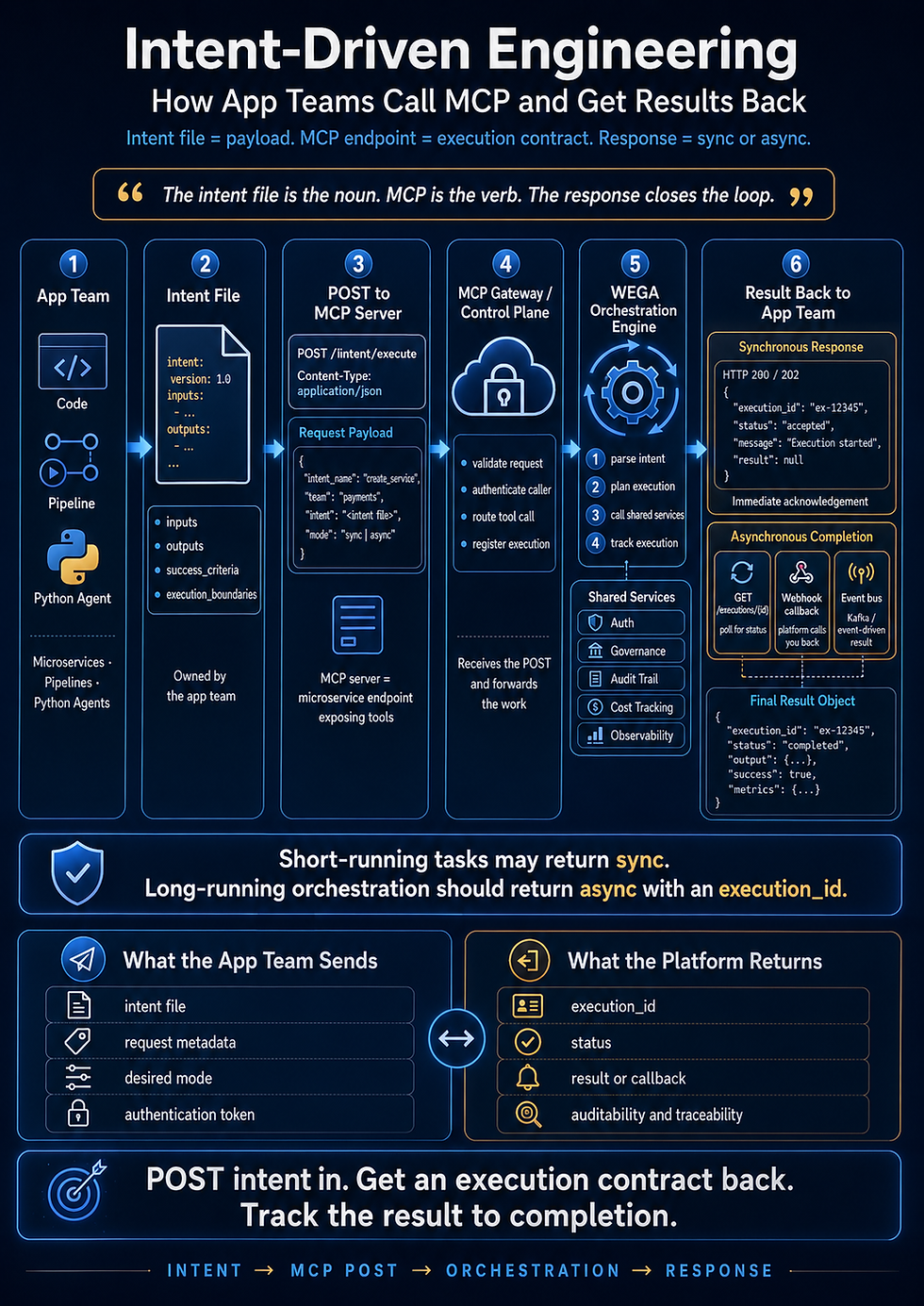
This is the core principle of Intent-Driven Engineering. When intent is explicit, agents become predictable.
The Orchestration Layer
CrewAI provides three building blocks. Flows handle routing, branching, retries, and stop conditions. Crews enable multi-agent collaboration. Tasks break work into sequenced units.
Inside, specialized agents hand work down a pipeline: Analyst → Architect → Developer → Reviewer. When a problem demands it, the crew can fan out into parallel specialists. Throughout, a Human-in-the-Loop channel lets people review, approve, or escalate at defined checkpoints.
Grounded in the Enterprise
Agents draw on three foundations. Enterprise tools connect through MCP and APIs to IT systems, databases, content repositories, and business applications. Knowledge and context come from enterprise documents, policies, and domain expertise. Models and runtime supply the LLMs, Python services, and agent execution environment.
Deterministic Validation: The Trust Layer
This is where most agentic systems fall short. Every agent output passes through deterministic validation: rules, tests, policy checks, structured outputs, and evidence capture. AI reasons; deterministic controls verify.
The results are durable artifacts (reports, plans, code, data), full observability (logs, metrics, traces), and a complete audit trail of decisions, evidence, and approvals.
Why This Is Legitimate Enterprise Architecture
The design balances four forces. Agentic reasoning applies where judgment is needed. Deterministic controls apply where certainty is required. Human oversight governs regulated decisions. A composable runtime lets it scale across the enterprise.
Where It Fits Best
This pattern is strongest for multi-step knowledge work, role-based collaboration, and governed agentic workflows, anywhere the work is too complex for a single prompt and too important to run without oversight.
The takeaway is simple: enterprise agentic AI isn’t about giving agents more freedom. It’s about giving them clear intent, firm boundaries, and verifiable outputs.
Want me to put this in a file, or tighten it to a 250-word version?
Comments