
Enterprises Don’t Buy AI Capability — They Buy Outcomes
- Mark Kendall
- Feb 10
- 3 min read

No Thank You: Why AI Value Isn’t About Agents, Autonomy, or Maturity Models
I’ll start by saying this clearly and respectfully:
the popular AI maturity diagrams floating around right now are not wrong.
They’re clean. They’re logical. They’re technically accurate.
And yes—some of the people promoting them are making a lot more money than I ever will.
Good for them.
But I’m not in the hype business.
I’m in the reality business.
And reality inside enterprises looks very different from LinkedIn diagrams.
So… no thank you.
Not because the technology is bad—but because this framing is not how AI value actually gets created, approved, or sustained in the real world.
Enterprises Don’t Buy AI Capability — They Buy Outcomes
Executives do not wake up asking for:
“Agentic AI”
“Autonomous workflows”
“End-to-end orchestration”
They wake up asking:
Why costs aren’t going down
Why cycle times are still long
Why headcount keeps growing
Why revenue leaks still exist
Why risk keeps increasing
AI only matters when it moves one of those needles.
If your AI proposal cannot be explained in terms of:
Eliminated work
Reduced risk
Accelerated throughput
New revenue capture
…it doesn’t survive budgeting season.
That’s not cynicism.
That’s operating reality.
The Real Gap Isn’t Intelligence — It’s Ownership
Most AI discussions jump straight from:
“AI can generate content”
to
“AI can act autonomously”
That leap skips the hardest part.
The missing layer is operational ownership.
Executives immediately ask:
Who owns the outcome?
Who’s accountable when it fails?
What’s the blast radius?
Can we audit decisions?
Can we turn it off instantly?
Where does liability sit?
Until those questions are answered, autonomy doesn’t scale.
It stalls in pilots, proofs-of-concept, and “innovation theater.”
What Consultants
Should
Be Talking to Executives About
If you’re in consulting, architecture, or advisory work, stop leading with tools and start leading with economics.
Here’s what actually resonates:
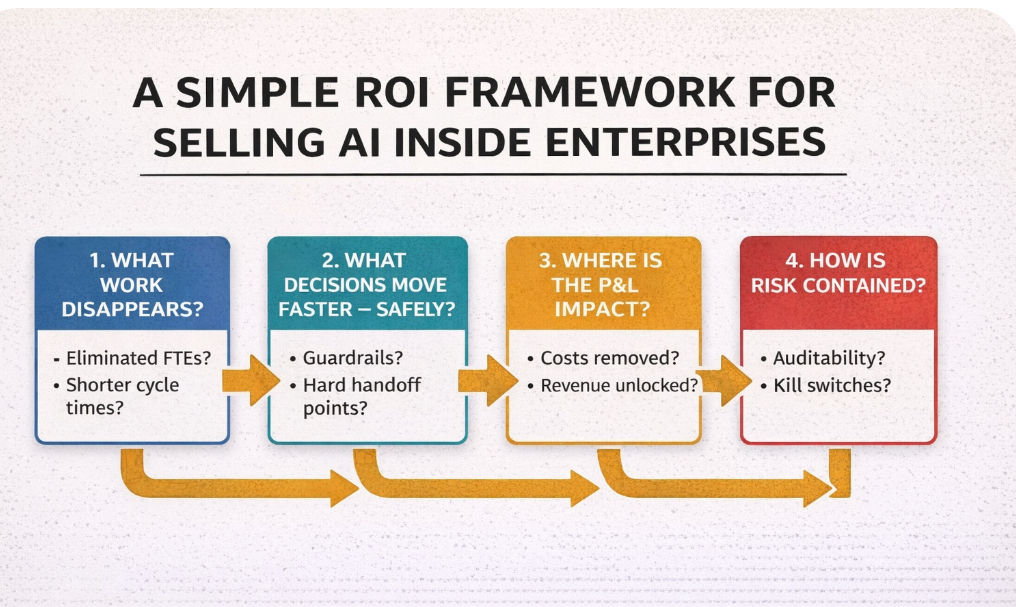
1. What Work Disappears?
Not “what gets automated.”
What no longer needs to exist:
Manual reconciliation
Repetitive triage
Human-in-the-loop approval for low-risk decisions
Duplicate reporting
Reactive firefighting
If the work doesn’t disappear, the ROI is cosmetic.
2. What Decisions Move Faster — Safely?
Autonomy is not about freedom.
It’s about bounded decision-making.
Executives care about:
Reduced decision latency
Clear escalation thresholds
Defined confidence levels
Explicit handoff points
Autonomy with guardrails sells.
Autonomy without them does not.
3. Where Is the P&L Impact?
Every AI initiative must map to one of three places:
Cost removed
Revenue unlocked
Risk reduced
If you can’t point to a line item—even indirectly—you don’t have a business case. You have a demo.
4. How Is Risk Contained?
Real AI systems need:
Kill switches
Audit logs
Confidence scoring
Human override paths
Blast-radius limits
This isn’t slowing AI down.
This is what lets it exist in production.
The Learn → Teach → Master Reality Check
Here’s the uncomfortable truth:
Most organizations don’t need “agentic AI” yet.
They need reliable, owned, outcome-driven automation.
The real maturity path looks less sexy—but far more profitable:
Eliminate obvious waste
Reduce human decision load
Codify guardrails
Assign ownership
Measure outcomes
Then—and only then—increase autonomy
That’s how AI becomes infrastructure instead of hype.
Final Thought
I’m not here to sell anything.
This site is free. This thinking is free.
You can chase the hype cycle if you want—many people do very well doing that.
But if your goal is real AI adoption, real executive trust, and real ROI, then stop selling intelligence…
…and start selling outcomes, ownership, and economics.
That’s how AI actually wins.
Comments