

Escaping the Sandbox: Where Developer Creativity Fits Inside Intent-Driven Engineering

Escaping the Sandbox: Where Developer Creativity Fits Inside Intent-Driven Engineering
There’s a danger starting to appear in enterprise AI engineering.
Everybody got excited about agents.
Then governance showed up.
Then plugins.
Then hooks.
Then policy engines.
Then execution guardrails.
Then “approved patterns.”
Then 47 bootstrap files before a developer can even write a line of business logic.
And suddenly the engineering team feels trapped inside a giant compliance maze.
That is the exact moment where many organizations accidentally recreate the worst parts of heavyweight enterprise architecture.
Too much control.
Too much ceremony.
Too little movement.
The goal of Intent-Driven Engineering was never to imprison developers inside a sandbox.
The goal was to create safe autonomy.
The Real Purpose of Guardrails
Guardrails are supposed to protect:
Security boundaries
Compliance requirements
Production stability
Shared infrastructure
Enterprise interoperability
Observability
Cost governance
Data protection
They are not supposed to dictate every implementation detail of a feature.
That distinction matters enormously.
A healthy platform says:
“Here are the enterprise boundaries.”
An unhealthy platform says:
“Here is exactly how you must think.”
That second model kills innovation.
The Bootstrap Phase vs The Creative Phase
This is the part many organizations miss.
The 47 files are not your feature.
They are the runway.
They are the paved roads.
The telemetry.
The governance.
The authentication.
The deployment hooks.
The observability standards.
The shared execution environment.
That setup exists so developers do not have to rebuild enterprise plumbing every single sprint.
Once the bootstrap exists, the developer should transition into what matters:
Solving business problems
Creating capabilities
Experimenting safely
Building workflows
Improving outcomes
Shipping value
The mistake happens when governance layers continue controlling the developer after the runway is complete.
Where Intent Actually Fits
Intent is the escape hatch from over-engineering.
Instead of forcing developers to wire together endless abstractions manually:
sub-agents
callback chains
plugin hierarchies
orchestration graphs
YAML forests
policy spaghetti
…the developer declares:
desired outcome
constraints
execution boundaries
success criteria
required integrations
risk tolerances
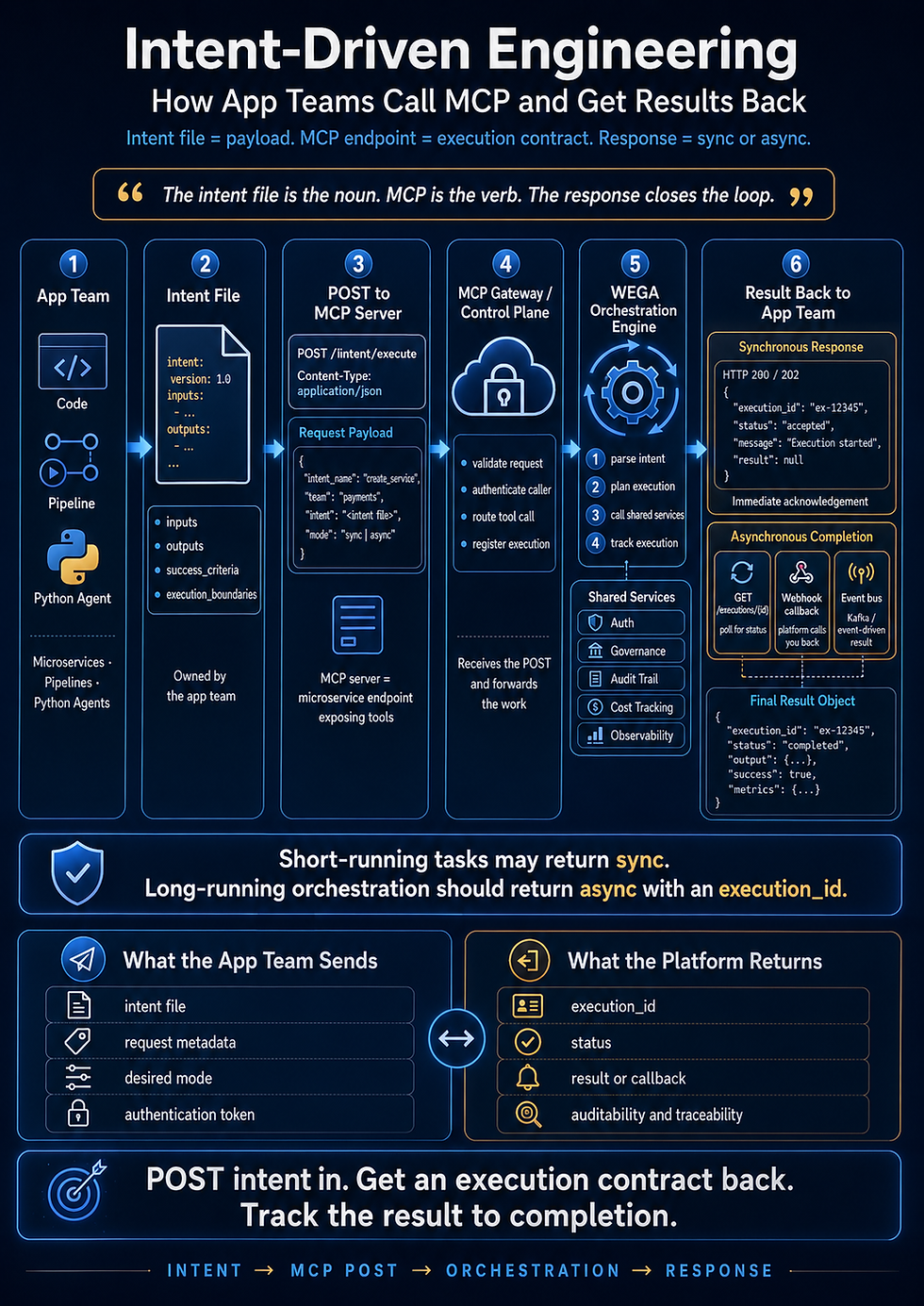
Example:
intent:
name: customer-order-validation
inputs:
- order_payload
- customer_profile
outputs:
- validated_order
- risk_score
success_criteria:
- validation_under_2_seconds
- fraud_confidence_above_90_percent
execution_boundaries:
- no_pii_logging
- approved_payment_services_only
Now the platform handles:
orchestration
plugins
agent routing
retries
telemetry
compliance hooks
runtime policies
The developer focuses on intent and business capability.
That is freedom.
The Key Architectural Principle
The enterprise owns the platform boundaries.
The feature team owns the intent.
That separation is critical.
Platform Team Responsibilities
The shared platform governs:
security
identity
deployment
runtime policies
observability
cost controls
plugin certification
approved infrastructure
auditability
Feature Team Responsibilities
The feature team governs:
feature behavior
business workflows
experimentation
orchestration choices
prompts
execution paths
domain logic
success metrics
customer outcomes
That means developers still have room to innovate.
They are simply innovating inside safe enterprise lanes.
Intent Should Reduce Complexity — Not Increase It
If your intent system requires:
dozens of boilerplate files
giant configuration trees
manual orchestration everywhere
endless plugin registrations
deeply nested abstractions
…then the platform has failed.
The developer should not be thinking about:
agent wiring
runtime choreography
policy plumbing
infrastructure coordination
The developer should be thinking:
“What outcome am I trying to achieve?”
That is the entire philosophical shift.
The Best Enterprise Platforms Become Invisible
The best platforms disappear into the background.
Developers stop fighting infrastructure.
They stop reinventing governance.
They stop rebuilding observability.
They stop arguing over deployment standards.
The platform fades away.
And the engineering team starts building capabilities faster than ever.
That is the real maturity curve of Intent-Driven Engineering.
Not more files.
Not more abstractions.
Not more governance.
More velocity with safer autonomy.
The Future Model
The future enterprise developer experience will likely look like this:
Shared Enterprise Layer
identity
runtime governance
observability
certified plugins
approved MCP connectors
deployment standards
telemetry
security policies
Team Intent Layer
business capabilities
feature orchestration
execution goals
domain workflows
experimentation
customer outcomes
Autonomous Execution Layer
agents
runtimes
orchestration engines
plugin systems
execution compilers
dynamic routing
optimization engines
The enterprise governs the edges.
The developer governs the intent.
The runtime governs the execution.
That balance is where innovation scales.
Final Thought
If developers feel trapped, the platform has gone too far.
Intent-Driven Engineering is not about forcing humans into stricter abstractions.
It is about removing unnecessary abstraction burden from humans entirely.
The moment developers spend more time satisfying the framework than solving the problem, the system needs to be simplified.
Because the real goal was never control.
The real goal was trusted autonomy.
And that changes everything.
Comments