
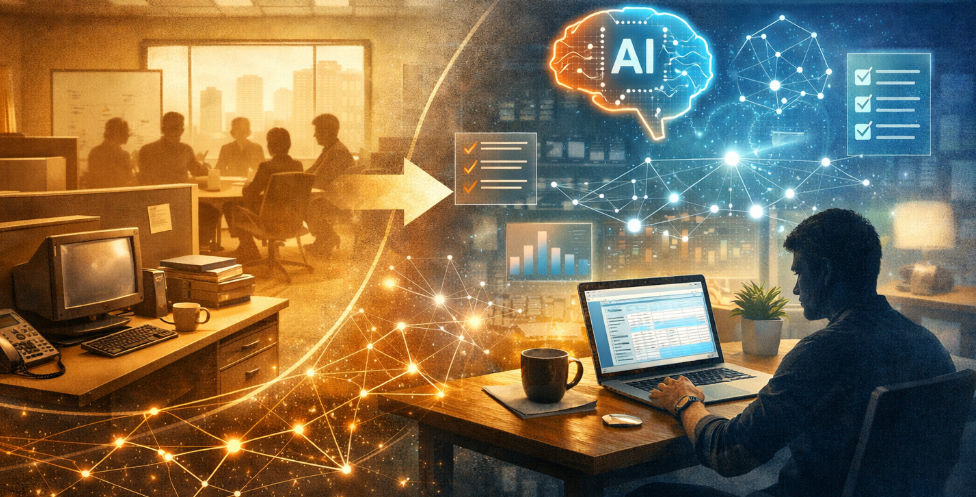
From Cubicles to Cognition: How AI Quietly Changed the Nature of Work
- Mark Kendall
- 5 hours ago
- 3 min read

From Cubicles to Cognition: How AI Quietly Changed the Nature of Work
For many of us who have been in technology for decades, work used to have a very specific shape.
You drove to an office.
You badged in.
You sat at a desk that belonged to the company.
You used hardware the company owned.
You consumed electricity the company paid for.
Work was physical, even when it was digital.
Then came broadband.
Then collaboration tools.
Then cloud.
Then COVID.
Then remote work.
And now — AI.
We didn’t just change tools.
We changed the structure of labor itself.
What Work Used to Look Like
The traditional knowledge workflow was linear:
Make a to-do list
Execute the tasks
Produce the artifact
Submit for review
Effort and output were tightly coupled.
The work was the doing.
Productivity meant typing, building, drafting, calculating.
The human was the primary execution engine.
What Work Looks Like Now
Today, something subtle — and profound — has changed.
The workflow increasingly looks like this:
Define the intent
Use AI to generate a first draft or working model
Review, refine, validate
Deliver
The “execution layer” has compressed.
The time between intent and artifact has shrunk dramatically.
We are no longer spending most of our time producing first drafts.
We are spending our time:
Framing the problem
Setting constraints
Evaluating quality
Integrating across systems
Ensuring accountability
That is not less work.
It is different work.
The Office Didn’t Just Close — It Dissolved
Remote work accelerated another shift.
Many professionals now:
Work from home
Use their own internet
Often use their own hardware
Pay their own utility costs
The company provides platforms and systems.
The individual provides environment and cognition.
The worker is no longer a seat in a building.
They are a node in a distributed network.
That structural shift was already underway.
AI simply amplified it.
Why AI Feels Threatening
AI feels threatening for one primary reason:
If it can generate output, what is left for humans?
The fear assumes that output generation is the core value.
But in mature engineering environments, it never truly was.
The real value has always been:
Judgment
Pattern recognition
Tradeoff analysis
Risk awareness
Accountability
System thinking
AI can generate text.
It cannot carry responsibility.
AI can propose code.
It cannot own production incidents.
AI can draft architecture.
It cannot defend it to executives.
The human role is not disappearing.
It is moving upward.
The Shift From Executor to Orchestrator
Historically, we were builders of artifacts.
Increasingly, we are orchestrators of systems.
The most effective professionals are becoming:
Prompt designers
Constraint definers
Signal filters
Quality controllers
Integrators across disciplines
This is not the removal of the engineer.
It is the elevation of the engineer.
Why This Is Popular
AI adoption is accelerating because it removes friction.
It compresses:
Intent → Draft
Draft → Iteration
Iteration → Delivery
Organizations move faster.
Individuals regain cognitive leverage.
Teams reduce repetitive strain.
Used well, AI increases velocity without decreasing standards.
Used poorly, it increases noise.
That distinction is where leadership matters.
Why You Shouldn’t Be Afraid of It
Fear is natural.
But fear assumes replacement.
Replacement happens when someone only executes instructions.
AI struggles where ambiguity lives.
It struggles with:
Context spanning years
Political nuance
Organizational memory
Ethical tradeoffs
Long-term architectural consequences
Experienced professionals carry lived pattern recognition.
That is not trivial data.
That is distilled judgment.
AI enhances that judgment.
It does not replicate it.
The Real Responsibility
The real question is not:
“Will AI replace engineers?”
The real question is:
“Will engineers evolve fast enough to operate at the orchestration layer?”
Those who cling to execution-only identity may struggle.
Those who embrace:
Intent clarity
Governance
Systems thinking
Quality stewardship
will become more valuable, not less.
A Personal Reflection
For many of us who never thought we would even get into this industry — let alone lead inside it — this moment feels surreal.
The tools have changed.
The buildings have changed.
The workflows have changed.
But the mission hasn’t:
Build systems.
Improve clarity.
Reduce noise.
Help people do better work.
AI is simply the newest tool in that mission.
It is not the master.
It is the amplifier.
And the professionals who understand how to guide amplification responsibly will define the next era of engineering.
Comments