

From Developer to AI Architect: The Autonomous Architectural Workbench
- Mark Kendall
- 50 minutes ago
- 10 min read

From Developer to AI Architect: The Autonomous Architectural Workbench
The next generation of architects will not draw every diagram, write every specification, or manually inspect every implementation. They will define intent, establish guardrails, orchestrate intelligence, and prove that the resulting architecture works.
There is a moment happening in software engineering right now that is bigger than better code generation.
Developers are beginning to realize that AI can write substantial amounts of code. Architects are beginning to realize something even more important:
AI can participate in architecture itself.
It can analyze a repository. It can understand requirements. It can examine existing patterns. It can propose architectures. It can produce high-level and low-level designs. It can reason about APIs, security, infrastructure, integration, deployment, cost, and reliability.
And increasingly, it can turn those architectural decisions into working software.
That creates an entirely new kind of workbench.
I call it the AI-Native Architectural Workbench.
And the objective is not simply AI-assisted architecture.
The destination is:
Intent-Driven. Autonomous. Governed. Delivered.
The Journey Starts With Autonomy
Traditional architecture usually begins with a business need.
That remains important, but AI changes the question.
Instead of asking:
“What documents does the architect need to create?”
we can begin asking:
“What outcome can the architectural system autonomously produce from this intent?”
That is a fundamentally different starting point.
The human establishes the mission.
The system helps execute it.
An architectural engagement might begin with:
business vision and goals
problems and opportunities
stakeholder requirements
enterprise standards
constraints and guardrails
existing systems and repositories
required outcomes
success criteria
Those are not merely documents for an AI to summarize.
They become context for execution.
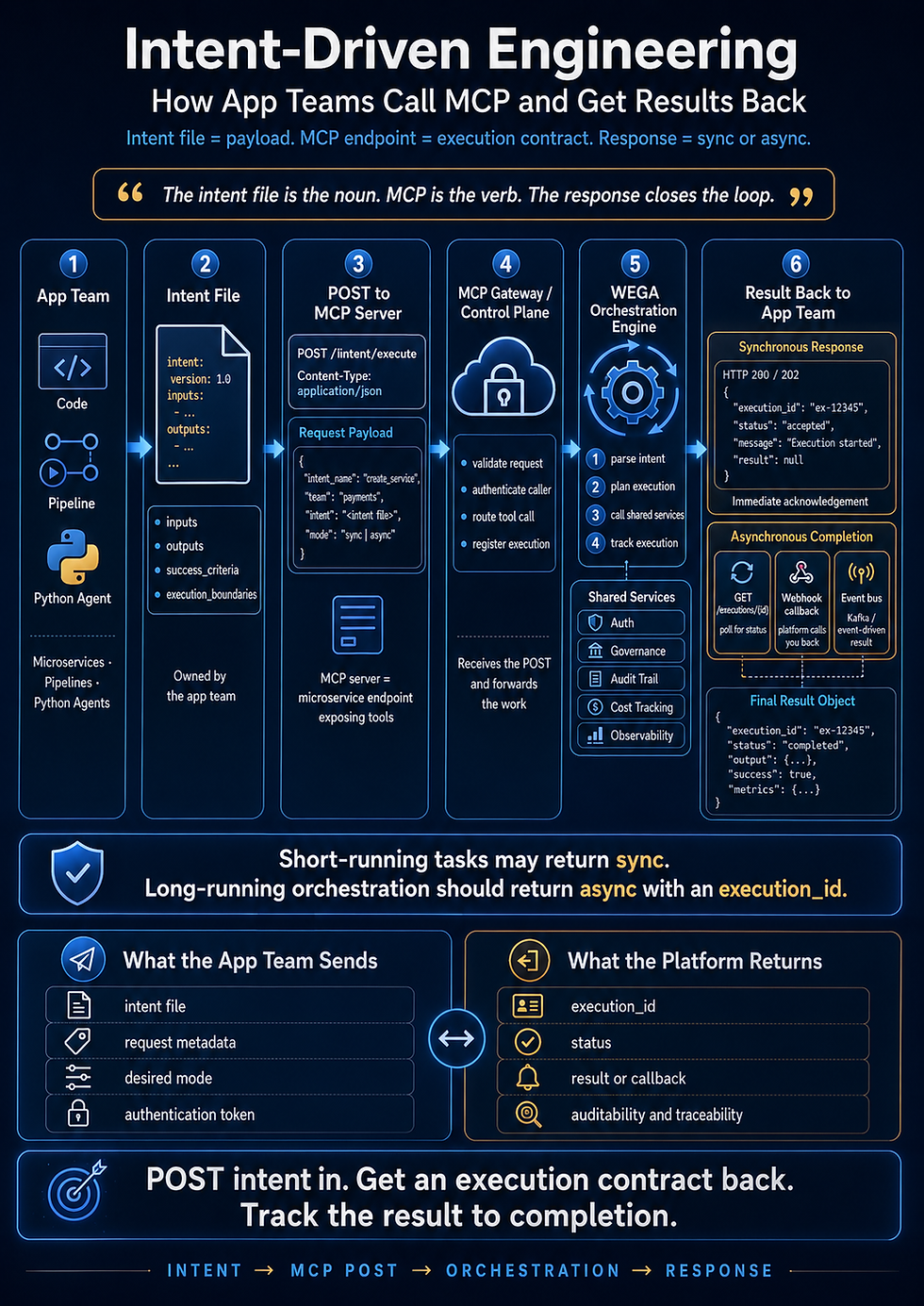
That leads directly to the most important artifact in the workbench.
Architectural Intent
Before agents, before diagrams, before Terraform and before APIs, establish the intent.
An architectural intent should answer several deceptively simple questions:
What are we trying to accomplish?
What information should the system use?
What constraints must it respect?
What must it produce?
How will we know the result is acceptable?
A practical intent can therefore contain:
Intent / Goal
The architectural outcome that must be achieved.
Inputs / Context
Requirements, repositories, existing architecture, enterprise standards, business information and relevant evidence.
Constraints
Technology restrictions, security requirements, compliance obligations, cost boundaries and architectural guardrails.
Required Outputs
HLD, LLD, ADRs, APIs, diagrams, infrastructure definitions, security architecture or whatever this particular engagement actually requires.
Success Criteria
The conditions that must be demonstrably true when the work is finished.
This is an important distinction.
We aren’t giving AI a giant procedural script telling it every move to make.
We are defining what must be true.
That allows capable AI systems to remain goal-oriented while architecture provides the necessary boundaries.
The Architect Becomes the Orchestrator
This changes the architect’s role.
The architect doesn’t disappear.
The architect moves up the abstraction stack.
Instead of manually performing every activity, the architect increasingly becomes responsible for:
Intent → Decisions → Delegation → Governance → Validation
The architectural orchestrator can decompose the objective, determine which capabilities are required, invoke specialized expertise where appropriate, aggregate the findings, validate the architecture and determine whether the objective has actually been achieved.
But there is an important warning here.
Do not turn every architectural capability into an agent.
It is tempting.
We can create a:
Business Analyst Agent
Solution Architect Agent
Enterprise Architect Agent
Security Architect Agent
Cloud Architect Agent
Data Architect Agent
Network Architect Agent
Integration Architect Agent
DevOps Architect Agent
Documentation Agent
Soon we have recreated an entire corporate organization chart inside an AI system.
That doesn’t necessarily make the architecture better.
It can instead create more context windows, more handoffs, greater latency, greater cost and more places for information to become distorted.
The objective isn’t to create the largest possible multi-agent system.
The objective is to create the minimum sufficient architecture required to accomplish the goal reliably.
Skills Before Agents
This is one of the most important lessons for aspiring AI architects.
A large percentage of what initially looks like an “agent” is actually knowledge.
Consider:
“How does our organization create an HLD?”
“What is our approved AWS architecture?”
“How do we design Kafka integrations?”
“What does our security organization require?”
“How should ADRs be written?”
“What are our API conventions?”
“How do we design a production-ready microservice?”
Those are often better represented as Skills.
A Skill packages reusable organizational knowledge and procedures so that a capable general-purpose agent can apply them when necessary.
Anthropic describes Agent Skills similarly: packaged instructions, scripts and resources can provide agents with domain-specific procedural knowledge, with information progressively loaded as needed rather than forcing everything into the context window at once. (Anthropic)
That is a powerful architectural pattern.
Instead of building ten permanent agents, we might have one capable architectural system equipped with skills such as:
Architecture Standards Skill
HLD/LLD Skill
Integration Architecture Skill
API Design Skill
Security Architecture Skill
Cloud Architecture Skill
ADR Skill
Observability Skill
Cost and Reliability Skill
Documentation Skill
Now expertise becomes reusable organizational infrastructure.
When Do We Actually Need an Agent?
Agents still matter.
But they should exist for a reason.
A specialized agent becomes valuable when we need things such as:
Isolation
A security review can operate independently and challenge the proposed architecture.
Specialization
A complex threat model or performance analysis may benefit from dedicated instructions, context and tools.
Parallelism
Security, cost and integration analysis might execute simultaneously.
Independent reasoning
Sometimes we deliberately want another reasoning context to evaluate the work rather than simply extending the original reasoning chain.
That produces a much cleaner rule:
Use Skills for reusable knowledge. Use agents when specialization, isolation or parallel reasoning provides real value.
That single distinction can eliminate enormous amounts of unnecessary agent complexity.
Tools Connect Architecture to Reality
Architecture cannot live entirely inside the model.
Eventually the system must interact with the real engineering environment.
That is where Tools enter the architecture.
Tools might provide access to:
GitHub or GitLab.
Jira and Confluence.
Cloud platforms.
Databases.
Kubernetes.
Terraform.
CI/CD systems.
Observability platforms.
Diagramming systems.
Security scanners.
Enterprise APIs.
MCP servers.
The distinction is useful:
Skills teach the AI how we do something. Tools allow the AI to actually do something.
Anthropic’s current Claude Code material reflects this same evolution: Claude Code can operate against repositories and development tooling, while MCP, hooks, skills and subagents extend it into broader engineering workflows. (Anthropic)
This is where an architectural workbench stops being an intelligent document generator.
It becomes an execution environment.
Contracts: The Missing Piece in Many Agent Architectures
Once work crosses boundaries, context becomes architecture.
Suppose an architecture analysis produces 30,000 tokens of discussion.
Does the security reviewer need all 30,000?
Probably not.
It may need something like:
components
interfaces
trust_boundaries
data_classifications
authentication_model
external_dependencies
architectural_decisions
known_risks
source_evidence
That is a context contract.
Instead of dumping conversation history from one worker into another, we deliberately pass the minimum sufficient context required for the next task.
This matters enormously.
Every boundary between agents, tools and workflow stages should make us ask:
What information does the next participant actually need to perform its job correctly?
Not everything we know.
Not the complete conversation.
Not every document we’ve retrieved.
The minimum sufficient context.
This makes systems cheaper, faster, more predictable and easier to validate.
Hooks: Some Things Cannot Be Suggestions
Goal-oriented execution is powerful.
But enterprise architecture contains requirements that cannot depend upon the model remembering to do them.
Security may be mandatory.
Tests may be mandatory.
Architecture decisions may require traceability.
Certain infrastructure configurations may be prohibited.
Sensitive data may never be sent somewhere.
Deployment may require particular validation.
Those belong in deterministic enforcement mechanisms.
In an AI-native workbench, I think of these as governance hooks.
For example:
No architecture package closes without security validation.
No implementation is accepted without required tests.
No production infrastructure is generated outside approved patterns.
Every significant architectural decision requires an ADR.
Required evidence must exist before the workflow reports success.
Anthropic’s own Claude Code materials describe hooks as deterministic automation that can run at defined lifecycle points, including testing and linting behaviors. (Anthropic)
That leads to another powerful distinction:
Intent tells the system what should happen. Hooks enforce what cannot be optional.
Validation Changes Everything
Generation is easy.
Proof is harder.
An AI system can generate a beautiful architecture diagram that is completely wrong.
It can create Terraform that looks professional but doesn’t deploy.
It can generate an API contract inconsistent with the implementation.
It can produce an ADR rationalizing a decision nobody actually made.
So the final phase cannot simply be:
Generate.
It must be:
Validate and produce evidence.
That may mean:
automated tests
architecture reviews
schema validation
security scans
policy checks
infrastructure validation
traceability checks
repository analysis
integration tests
deployment verification
evidence collection
The autonomous loop therefore becomes:
Understand → Plan → Execute → Observe → Validate → Correct → Prove
The system should continue until the success criteria are satisfied or a defined stop condition requires human intervention.
That is much closer to engineering than prompting.
The Architectural Package
Now we arrive at the output of the workbench.
Not a chat response.
Not a giant Markdown file.
An architectural package.
Depending upon the project, that package might contain seven major categories.
High-Level Design — HLD
The system-level view.
It describes the major components, services, technologies, boundaries, interactions and data flows.
Think:
What are we building and how does the system fit together?
Low-Level Design — LLD
The implementation-level architecture.
Interfaces, schemas, classes, modules, data structures, algorithms, configurations and detailed component behavior.
Think:
How exactly will these pieces be built?
Architecture Decision Records — ADRs
Important decisions should retain their reasoning.
An ADR can capture:
Decision → Context → Alternatives → Rationale → Consequences
That gives future developers something invaluable:
why.
Diagrams
Different questions require different views.
The package might generate:
context diagrams
container/component diagrams
sequence diagrams
deployment diagrams
data-flow diagrams
state diagrams
Architecture becomes navigable rather than buried in prose.
APIs and Integration
The workbench can define:
API contracts
schemas
events
message structures
integration flows
dependencies
examples
failure behavior
This is where architecture starts becoming directly executable by engineering teams.
Infrastructure as Code and Deployment
Architecture can increasingly continue all the way into:
Terraform
CloudFormation
Kubernetes manifests
Helm charts
CI/CD definitions
environment configurations
The line between architecture and implementation begins to blur.
Security
Security cannot be an appendix.
The package should address:
threat models
trust boundaries
authentication
authorization
IAM
encryption
data protection
secrets
network controls
compliance requirements
And those decisions should be validated rather than merely documented.
Where Claude Code Fits
This architectural pattern isn’t dependent upon one AI product.
Claude Code, ChatGPT, Gemini and future agentic systems can all participate in this model.
The architecture should outlive the tool.
That said, Claude Code currently provides an especially interesting environment for developers exploring this transition because it works directly with repositories and development tools rather than operating only as a conversational assistant. Anthropic describes it as operating at the project level: reading codebases, planning multi-file work, executing changes, running tests and iterating on failures. (Anthropic)
Its ecosystem also provides many of the primitives needed to experiment with this architecture:
CLAUDE.md → repository/project context
Skills → reusable expertise
Subagents → delegated reasoning
Hooks → deterministic enforcement
MCP → governed access to external capabilities
Tools → actions
Plan/agentic execution → goal-oriented work
That doesn’t mean every architecture organization should standardize on Claude Code.
It means developers can use environments like this today to begin learning what tomorrow’s architectural operating model looks like.
The Roadmap From Developer to AI Architect
So how does a developer actually become an AI architect?
I would not start by studying fifty agent frameworks.
I would build upward.
Stage 1 — Learn to Direct AI
Stop thinking exclusively in prompts.
Learn to specify:
Goal + Context + Constraints + Outputs + Success Criteria
Learn the difference between asking AI a question and delegating an outcome.
Stage 2 — Learn Context Engineering
Understand context windows.
Learn what information belongs in context.
Learn what doesn’t.
Learn retrieval.
Learn context passing.
Learn structured handoffs.
Learn why giving an agent everything can sometimes make it perform worse rather than better.
Stage 3 — Learn Skills
Capture repeatable organizational knowledge.
If you repeatedly explain the same procedure to AI, that knowledge probably belongs somewhere reusable.
Turn tribal knowledge into executable knowledge.
Stage 4 — Learn Tools
Connect reasoning to action.
Repositories.
APIs.
Databases.
Cloud.
CI/CD.
MCP.
Observability.
AI becomes dramatically more useful when it can safely interact with the systems where work actually occurs.
Stage 5 — Learn Agentic Patterns
Only now start introducing delegation.
Understand:
goal-oriented execution
procedural execution
coordinator-worker
parallel workers
evaluator/reviewer
iterative loops
subagents
tool restrictions
context isolation
And constantly ask:
Why does this need another agent?
If there isn’t a good answer, don’t create one.
Stage 6 — Learn Governance
This is where AI engineering becomes enterprise architecture.
Permissions.
Hooks.
Policies.
Approval boundaries.
Security.
Observability.
Auditability.
Human escalation.
Stop conditions.
Governance determines how much autonomy an enterprise can safely allow.
Stage 7 — Learn Validation
Never confuse generation with completion.
Ask:
What evidence proves this worked?
That question may be one of the most important habits an AI architect can develop.
Stage 8 — Orchestrate the Whole System
Finally, combine everything:
AUTONOMOUS GOAL
↓
ARCHITECTURAL INTENT
↓
ARCHITECT ORCHESTRATOR
↓
SKILLS ↔ SPECIALIZED AGENTS ↔ TOOLS
↓
CONTEXT CONTRACTS
↓
GOVERNANCE HOOKS
↓
VALIDATION + EVIDENCE
↓
ARCHITECTURAL PACKAGE
↓
HLD | LLD | ADR | DIAGRAMS
APIs | IaC | DEPLOYMENT | SECURITY
At that point you are no longer simply using AI to write code.
You are architecting systems in which humans and AI collaborate to produce engineering outcomes.
That is AI architecture.
Learn. Teach. Master.
This is why I believe so strongly in the progression:
Learn. Teach. Master.
Mastery doesn’t mean passing a certification on the first attempt.
It doesn’t mean memorizing every feature.
And it certainly doesn’t mean reaching some point where there is nothing left to learn.
Mastery is iterative.
You learn something.
You try it.
You discover where your understanding is weak.
You go deeper.
You explain it to somebody else.
Explaining it exposes another gap.
You build something.
The implementation exposes another gap.
Then you learn again.
Learn → Apply → Fail → Understand → Teach → Refine → Master
And then the cycle begins again.
Interestingly, recent Anthropic research based on roughly 400,000 Claude Code sessions found that human expertise still matters: people tend to make more of the planning decisions while Claude makes more execution decisions, and greater domain expertise correlates with higher success. (Anthropic)
That is encouraging.
The future does not belong simply to whoever has the most powerful AI.
It belongs to people who know what to ask it to accomplish, what context to provide, what boundaries to establish, what decisions require human judgment, and what evidence proves the result.
The Architect Isn’t Disappearing
The architect’s old workload may disappear.
Manually drawing every box.
Writing every first draft.
Searching every repository.
Copying architecture standards into documents.
Building repetitive scaffolding.
Updating diagrams by hand.
Chasing implementation teams to determine whether reality still matches the design.
AI can absorb increasing amounts of that mechanical work.
But something more valuable remains.
Intent.
Judgment.
Tradeoffs.
Governance.
Systems thinking.
Business alignment.
Decision-making.
And perhaps most importantly:
knowing what good looks like.
That is why I don’t see the AI-native architectural workbench as replacing architects.
I see it as giving good architects extraordinary leverage.
The developer who learns these ideas isn’t merely learning another coding assistant.
They’re learning how software organizations themselves may operate in an agentic world.
And that is the roadmap:
Don’t just learn how to use AI.
Learn how to architect the environment in which AI works.
Intent-Driven. Autonomous. Governed. Delivered.
That’s the AI-native architectural workbench.
And for many developers, it may also be the road from developer → AI engineer → AI architect → master.
For the Claude Code portions, I grounded this in Anthropic’s current descriptions of Skills, hooks, MCP, subagents, context management, and project-level agentic execution rather than treating those capabilities as hypothetical.
Claude Code official site
Comments