

From Prompt Chaos to Intent-Driven Engineering: Why This Shift Was Inevitable Intro
- Mark Kendall
- 3 days ago
- 4 min read

From Prompt Chaos to Intent-Driven Engineering: Why This Shift Was Inevitable
Intro
Most teams didn’t plan to build fragile AI systems.
They started with excitement—tools like ChatGPT, GitHub Copilot, and Claude made it possible to generate code, content, and ideas in seconds. For a moment, it felt like a breakthrough.
But fast forward a few months, and a different reality started to emerge:
Outputs were inconsistent
Context was lost between steps
Debugging became harder, not easier
Systems behaved unpredictably under pressure
What looked like acceleration started to feel like controlled chaos.
This article explains:
What actually went wrong
Why prompt-based systems break at scale
And why Intent-Driven Engineering is not a trend—but a necessary evolution
What Is Intent-Driven Engineering?
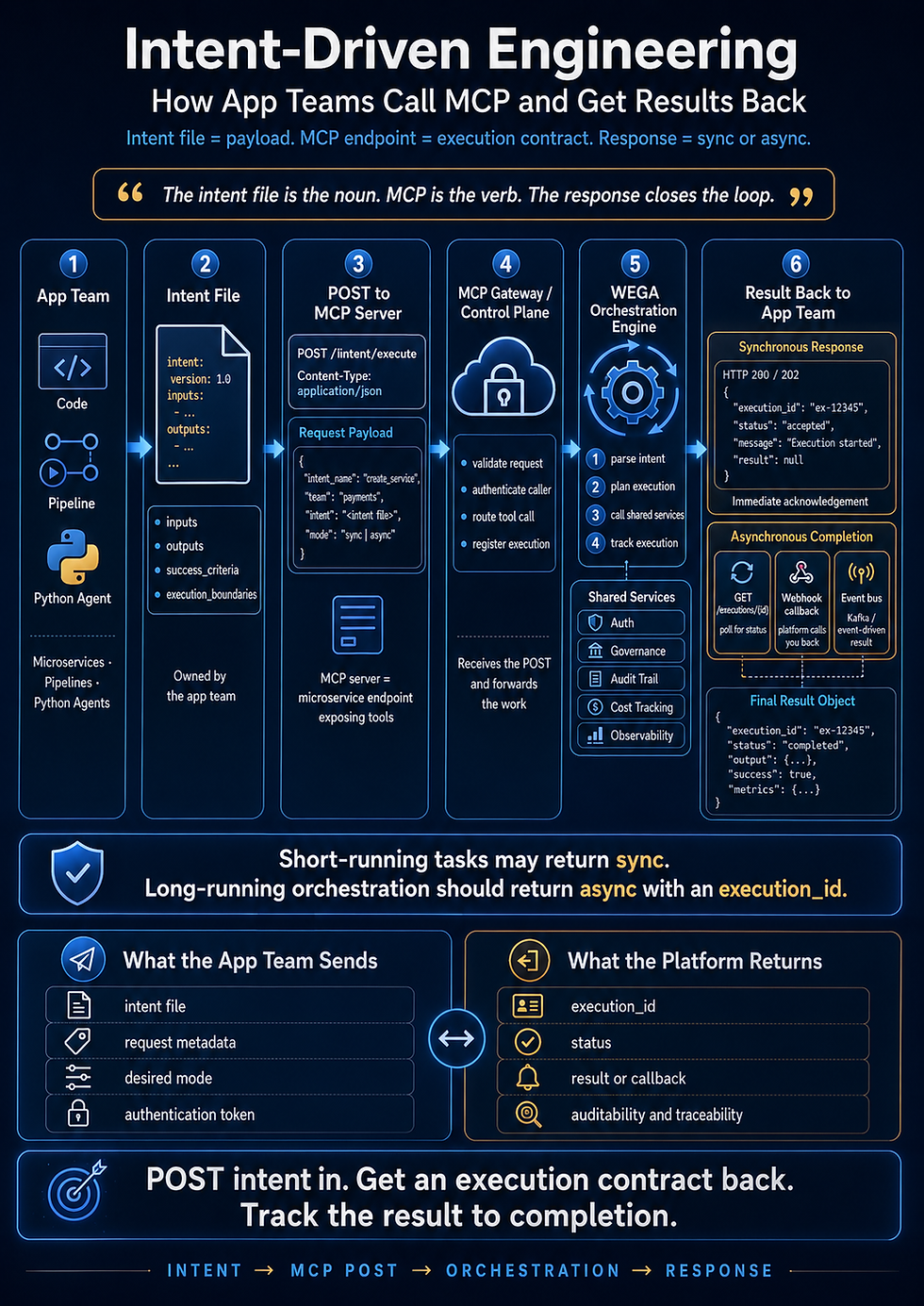
Intent-Driven Engineering is an architectural model where:
You define the outcome, constraints, and success criteria upfront—and the system determines how to execute it.
At the center of this model is the intent file.
An intent file is not documentation.
It is not a prompt.
It is the system.
It encodes:
Inputs — what goes into the system
Outputs — what must be produced
Success Criteria — how correctness is measured
Execution Boundaries — what is allowed or forbidden
Instead of telling AI how to do something, you declare:
“This is what must be true when the system is done.”
The Breaking Point: Why Prompt-Based Systems Fail
Let’s be clear—prompting works.
It just doesn’t scale.
1. Prompts Don’t Persist State
Every prompt is a stateless guess.
You might say:
“Generate a service”
“Now add validation”
“Now fix the bug”
But the system has no durable understanding of:
What already exists
What constraints must be respected
What success actually means
So you end up re-explaining context… over and over.
2. Humans Become the Orchestrator (Badly)
In prompt-based workflows, the developer is forced to:
Decide next steps
Manage dependencies
Track what’s missing
Validate outputs manually
This turns engineers into:
Manual orchestration engines
And humans are not good at that level of precision at scale.
3. No Defined Success Criteria
Most prompt workflows answer:
“Does this look right?”
Instead of:
“Did this meet the defined success criteria?”
That subtle difference leads to:
Hidden defects
Incomplete implementations
False confidence
4. Tool Sprawl Without Governance
Teams start mixing tools:
ChatGPT for ideation
GitHub Copilot for inline coding
Claude for reasoning
But without a governing model, this becomes:
Multiple smart tools… with no shared brain
The Realization: This Isn’t an AI Problem
This is the moment most teams miss.
The issue is not:
Model quality
Prompt wording
Tool selection
The issue is:
There is no system governing execution
Prompting is not architecture.
It’s interaction.
And interaction alone cannot produce reliable systems.
Why Intent-Driven Engineering Emerged
Intent-Driven Engineering didn’t appear out of theory.
It emerged from repeated failure patterns in real teams:
Pattern 1: “It worked yesterday”
Outputs change because:
Prompts drift
Context shifts
Models update
Without intent:
There is no anchor.
Pattern 2: “We can’t reproduce it”
A developer gets a working result… once.
But:
No structured input
No defined process
No validation criteria
So the result cannot be recreated reliably.
Pattern 3: “We don’t know if it’s complete”
Code is generated, but:
Are all edge cases handled?
Are all files created?
Are integrations correct?
There is no definition of done.
Pattern 4: “We’re debugging the AI, not the system”
Instead of debugging code, teams debug:
Prompts
Responses
Missing context
This is backwards.
The Shift: From Prompts to Intent
Intent-Driven Engineering introduces a fundamental change:
Old Model (Prompt-Based)
Input → Prompt → Output → Manual Validation
Repeat loop until “good enough”
New Model (Intent-Driven)
Intent → Structured Execution → Validation → Outcome
The difference:
Prompt-Based
Intent-Driven
Guessing
Declaring
Reactive
Planned
Human-driven flow
System-driven flow
Implicit success
Explicit success
The Role of the Orchestrator
This is the most important—and most overlooked—piece.
In Intent-Driven Engineering:
The orchestrator is the brain of the system
It is responsible for:
Translating intent into execution steps
Coordinating tools and agents
Enforcing constraints
Validating outcomes
Without an orchestrator:
You don’t have a system.
You have a collection of tools.
What Changes in Real Teams
This isn’t theoretical. It changes how teams actually work.
Before
Developers write prompts
Manually stitch outputs together
Debug inconsistencies
Hope results hold up
After
Teams define intent files
Systems execute consistently
Outputs are validated automatically
Results are reproducible
Why This Matters
This shift directly impacts:
1. Engineering Velocity
Less time:
Rewriting prompts
Debugging inconsistent outputs
More time:
Delivering working systems
2. Reliability
Systems become:
Deterministic
Measurable
Governed
3. Scalability
Prompt-based systems break as teams grow.
Intent-driven systems:
Standardize execution
Enable reuse
Support multi-agent orchestration
4. Enterprise Adoption
Enterprises don’t adopt:
Unpredictable systems
Non-reproducible workflows
Undefined success criteria
Intent-Driven Engineering provides:
Governance, traceability, and control
The Deeper Truth
This is not just a tooling evolution.
It’s a return to engineering fundamentals.
We’ve seen this before:
Scripts → Pipelines
Functions → Services
Services → Orchestrated systems
Now:
Prompts → Intent-driven systems
Key Takeaways
Prompting is powerful—but not sufficient for system design
The core problem is lack of orchestration and governance
Intent files replace prompts as the primary unit of execution
The orchestrator becomes the central control layer
Intent-Driven Engineering enables reliable, scalable AI systems
Final Thought
The industry is still asking:
“How do we write better prompts?”
But the real question is:
“Why are we still designing systems around prompts at all?”
nice!