

How I Would Build an Enterprise AI Shared Services Capability

How I Would Build an Enterprise AI Shared Services Capability
If I were asked to stand up an enterprise AI shared-services capability, I would not start with autonomous agents, MCP gateways, or a giant platform program.
I would start with the engineering teams.
Step 1: Raise the Team Baseline
If the organization has standardized on Claude, then teams first need to learn how to use it well.
That means more than prompting.
Teams need to understand how to work from the repository, express clear intent, define boundaries, use skills and commands, validate outcomes, and let the model reason without trying to script every thought.
This is where Intent-Driven Engineering becomes useful.
The first objective is simple:
Better teams. Better repos. Better use of AI.
That produces value immediately without requiring major infrastructure.
Step 2: Turn Repeated Work Into Shared Capabilities
Once teams begin working this way, patterns emerge.
Ten teams may all need the same scaffolding.
The same Jira validation.
The same security checks.
The same testing automation.
The same coding standards.
The same repository setup.
Those repeated patterns should become shared plugins, skills, slash commands, hooks, templates, or packages.
Instead of ten teams solving the same problem ten different ways, the enterprise AI team solves it once and distributes it through an internal marketplace or repository.
This is usually one of the fastest ways for a shared-services team to create visible productivity gains.
Step 3: Build the Enterprise Capability Layer
The next level is harder.
Now we begin exposing real enterprise systems to AI.
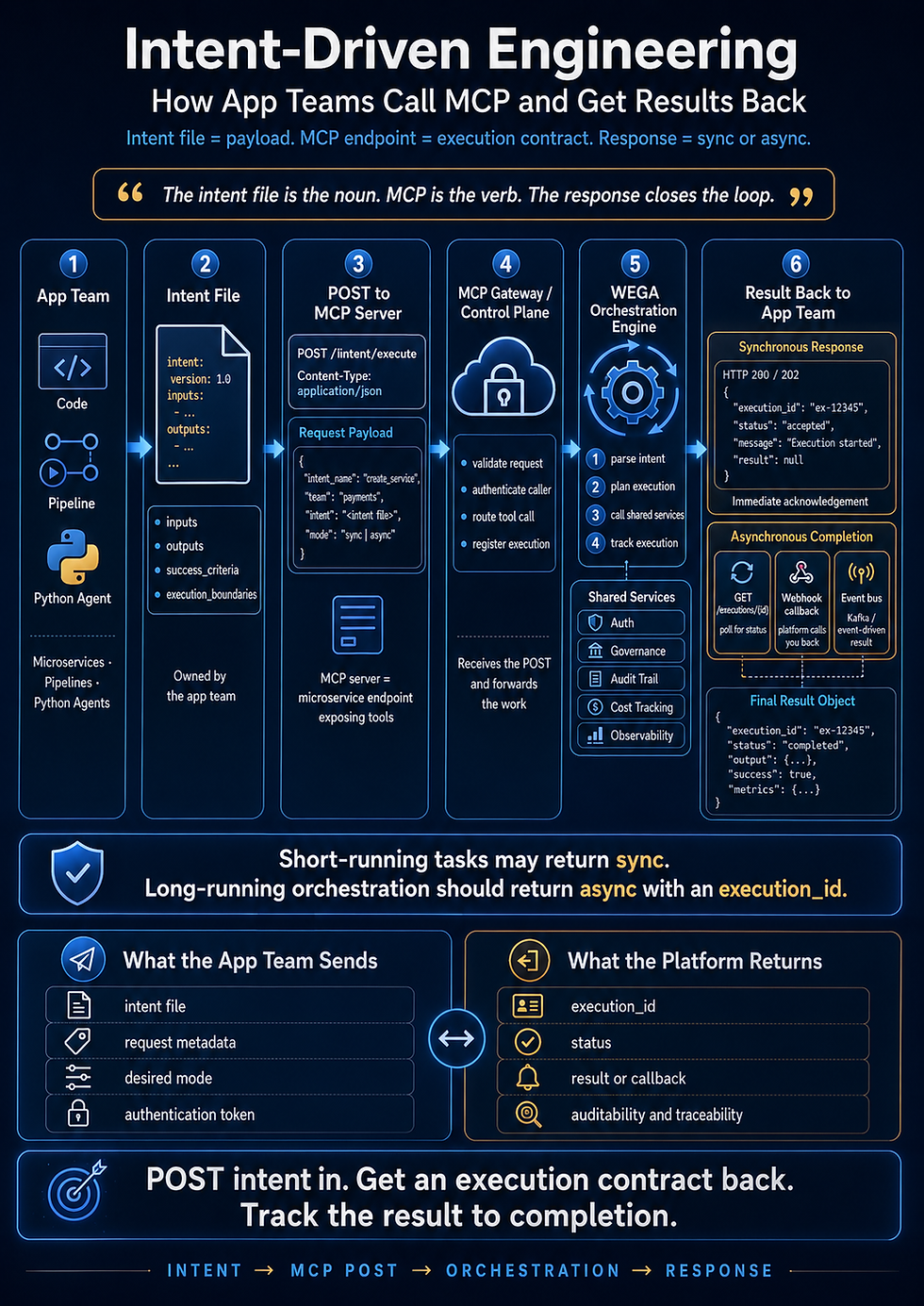
That is where MCP becomes important.
The questions change from:
“How do we make developers more productive?”
to:
“What enterprise capabilities should an intelligent system be allowed to access?”
Now we have to think about authentication, authorization, networking, data boundaries, auditability, observability, discovery, and security.
Perhaps the organization exposes approved access to Jira, Confluence, databases, internal APIs, search platforms, testing systems, or business services through governed MCP servers.
At this point, the shared-services team is building an enterprise AI capability layer.
Step 4: Put Agents on Top
Only after those foundations exist would I begin building larger agentic workflows.
Now an agent can receive an objective, discover approved capabilities, call tools, inspect results, revise its approach, and continue working toward the goal.
The agent gets room to reason.
But the enterprise still controls the boundary.
Tests verify outcomes.
Policies restrict actions.
Security controls govern access.
And humans approve consequential decisions.
That gives us a very simple architecture:
Human declares intent → Agent reasons → Shared services provide capabilities → Systems verify → Human approves where necessary.
Build the Ladder
The mistake would be starting at the top.
Do not begin with:
“We need autonomous AI agents across the enterprise.”
Build the capability progressively:
Train the teams.
Improve the repos.
Productize repeated capabilities.
Expose governed enterprise services.
Then build agents on top.
Each layer creates value.
Each layer also makes the next one safer and easier.
That is how I would build an enterprise AI shared-services organization: not as one enormous AI transformation project, but as a capability ladder that gets stronger with every step.
Teams → Repos → Plugins → MCP → Agents
And underneath all of it:
Humans own intent and boundaries. Agents get room to reason. Systems verify the outcomes.
For the image, I’d make the “Teams → Repos → Plugins → MCP → Agents” ladder the dominant visual, with the governance line running underneath it.
Comments