
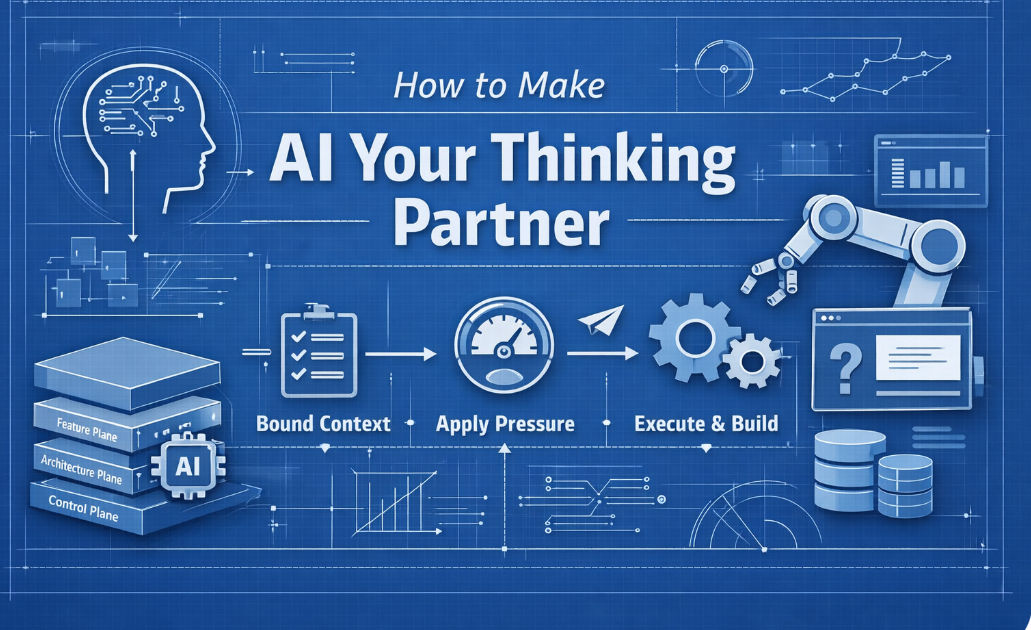
How to Make AI Your Thinking Partner (Not Your Shortcut)
- Mark Kendall
- 7 hours ago
- 3 min read

How to Make AI Your Thinking Partner (Not Your Shortcut)
There’s a lot of noise around AI right now.
Secret prompts.
Prompt engineering courses.
Markdown hacks.
Clone frameworks.
“Three prompts that bypass the internet.”
I’ve watched them all.
Some are useful.
Most are packaging.
But recently, I learned something more important than any prompt trick.
AI isn’t powerful because of hidden commands.
It’s powerful because of how you structure the conversation.
And that changes everything.
The Shift: From Tool to Thinking Partner
Most people use AI like a search engine.
They ask:
“What’s the best framework?”
“What’s the fastest way to learn this?”
“Give me a summary.”
That’s surface-level interaction.
But the real power shows up when you stop asking for answers and start structuring thought.
Here’s what changed for me:
When I realized I was thinking superficially about something technical, I didn’t look for a better prompt.
I bound the context.
I narrowed the field.
I set constraints.
I defined the room.
I simulated pressure.
Instead of saying:
“Teach me Python agents.”
I said:
“I have 24 hours. Strip this to the 20% that drives 80% of real capability. No fluff.”
That one move changes the depth of the response.
Not because the AI changed.
Because I changed the frame.
The Real Trick: Bound Context Before You Go Deep
If you feel like you’re getting surface-level answers, it’s usually not because the AI is shallow.
It’s because the context is wide.
Wide context produces general answers.
Bound context produces depth.
Here’s what bounding context looks like:
Instead of:
“Explain agent architecture.”
Try:
“I’m sitting in a room of senior engineers. What are the 10 hardest questions they would ask me about agent architecture to test whether I really understand it?”
That forces pressure.
Pressure forces clarity.
AI responds to constraints.
Planes of Thinking: Where Most People Get Stuck
One of the most valuable lessons I’ve learned is separating thinking into planes.
You can talk about:
Features
Architecture
Control loops
State modeling
Cognitive design
Most conversations stay on one plane.
When I was designing a Python-based agent control plane, I focused on:
Orchestration
Integrations
Observability
Webhooks
What I didn’t think about deeply enough?
State.
Not optimization.
Not performance.
State modeling.
That realization didn’t come from a “magic prompt.”
It came from a structured dialogue that moved from:
Feature layer → Architectural layer → Control loop layer → Cognitive layer.
That’s when it clicked.
AI didn’t “teach” me that.
The structure of the conversation exposed it.
Three Example Prompts That Actually Work
Not because they’re secret.
Because they create structure.
The Compression Prompt
“I have 24 hours to become disproportionately competent in this topic. Strip away everything non-essential. Identify the 20% that drives 80% of real-world capability. No beginner tone.”
This forces prioritization.
The Pressure Prompt
“Assume I’m in a room of senior engineers. Ask me the 10 hardest questions they would use to test whether I actually understand this system.”
This exposes blind spots.
The Execution Prompt
“Design a 24-hour build sprint that would move me from intermediate understanding to professional credibility. Specify what to build and why.”
This moves from theory to application.
None of these are hacks.
They are context binders.
Why You Don’t Need to Buy a Prompt Course
The idea that there are “secret prompts” that unlock AI is mostly marketing.
What actually unlocks depth is:
Clear constraints
Explicit intent
Defined audience
Simulated pressure
Narrowed scope
That’s it.
You don’t need a framework subscription.
You don’t need a 4-hour class.
You don’t need a prompt vault.
You need to stop asking broad questions.
The Bigger Insight
AI becomes a thinking partner when:
You use it to pressure-test ideas.
You let it interrogate your assumptions.
You allow it to expose what you didn’t model.
You move between abstraction layers deliberately.
It’s not about speed.
It’s about structured dialogue.
And here’s the unexpected part:
When you do this consistently, you don’t just get better outputs.
You become a better thinker.
More precise.
More structured.
Less cynical.
More accurate.
That’s not automation.
That’s augmentation.
Final Thought
If you want to go deeper with AI, don’t ask:
“What’s the best prompt?”
Ask:
“What plane am I thinking on right now?”
Then bind the context.
Apply pressure.
Move down a layer.
That’s how you turn AI from a tool into a thinking partner.
And that doesn’t cost more than the subscription you already have.
Comments