

Intent-Driven Development with Claude

Intent-Driven Development with Claude
From Zero to Production in Weeks — A New Model for Engineering Teams
Introduction
Something fundamental has changed in software engineering.
For years, teams have struggled with the same problems:
Requirements drift
Misalignment between business and engineering
Endless back-and-forth between design, code, and testing
AI tools that generate code—but not clarity
We’ve optimized how we write code.
But we’ve never truly optimized how we define what should be built.
Intent-Driven Development changes that.
Instead of starting with code, we start with intent—a clear, structured description of the outcome. From that, systems like Claude generate aligned, production-ready implementations.
This is not just a productivity improvement.
It’s a shift in how engineering works.
What Is Intent-Driven Development?
Intent-Driven Development is a model where:
You define what you want → the system generates how it is built
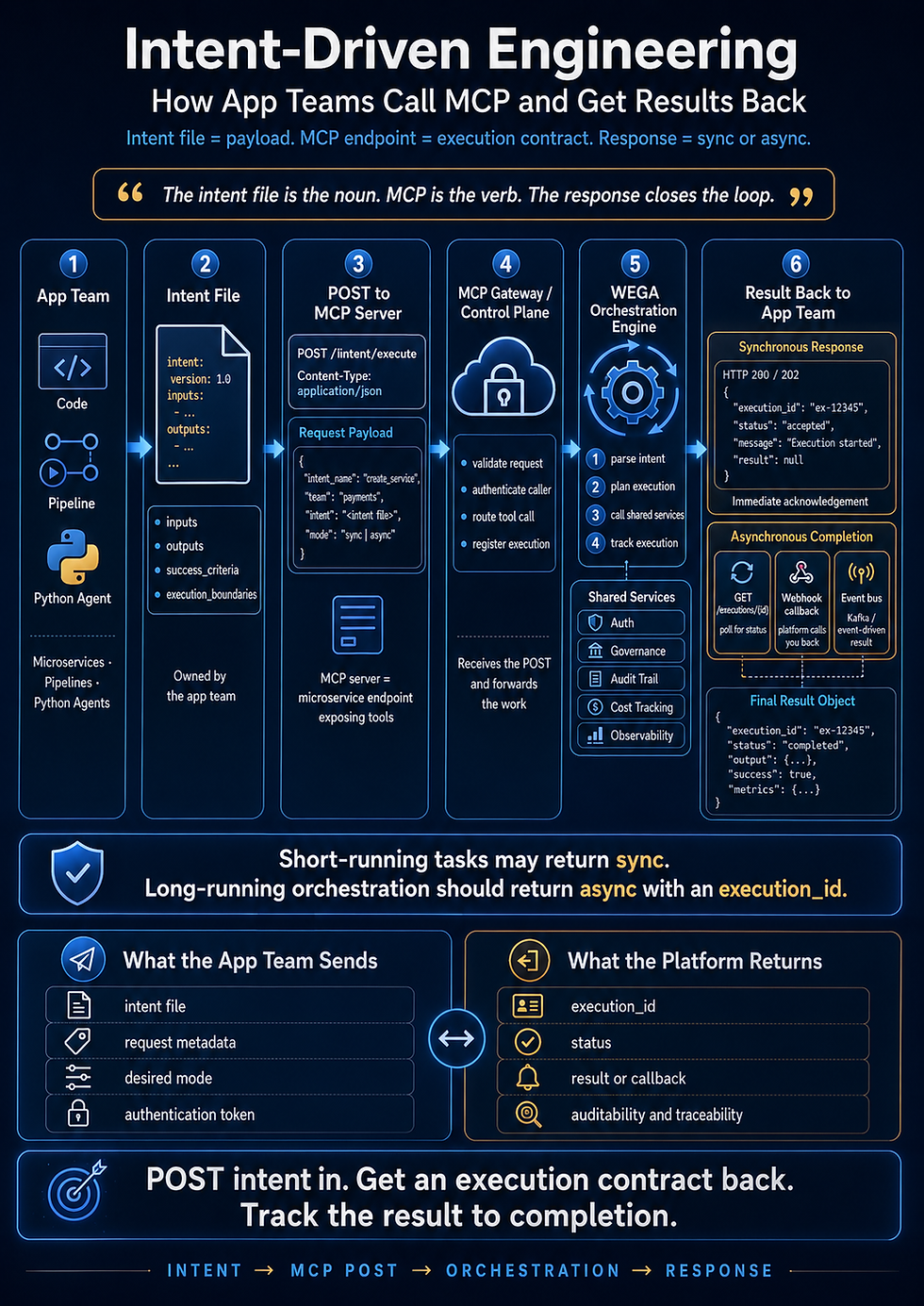
Instead of writing code first, teams write intent files that describe:
Purpose
Constraints
Technology
Expected behavior
Acceptance criteria
These intent files become the source of truth.
The Shift in Thinking
Traditional Engineering
Intent-Driven Engineering
Start with code
Start with intent
Specs drift from implementation
Intent stays aligned with output
Code is the source of truth
Intent is the source of truth
Ramp-up = learning codebase
Ramp-up = understanding intent
Reviews focus on code
Reviews focus on clarity of intent
The Core Principle
“Describe what you want once — everything else aligns automatically.”
How It Works in Practice
Intent-Driven Development runs on a simple but powerful loop:
The Generation Loop
Write intent
Validate intent (intent-check)
Feed to Claude
Review output
Refine intent
Repeat until the output matches the intent.
What Makes Strong Intent
Good results depend on clarity across four dimensions:
Purpose → What are you building and why
Constraints → Architecture, security, testing rules
Technology → Explicit stack and versions
Acceptance Criteria → Measurable success conditions
Example (Simplified Intent)
Intent: Customer Management API
Purpose:
Provide CRUD operations for customer data
Technology:
- Java Spring Boot
- PostgreSQL
Constraints:
- Follow architecture standards
- Apply security policies
- Enforce test coverage
Acceptance Criteria:
- All endpoints validated
- Standard error responses
- 90% test coverage
Why This Matters Now
AI has made code generation easy.
But it has also exposed a deeper problem:
The bottleneck is no longer writing code — it’s defining what should be built.
Without structure:
AI generates inconsistent outputs
Teams lose control
Governance breaks down
Intent-Driven Development solves this by:
Embedding standards directly into intent
Ensuring consistency across teams
Making alignment explicit instead of assumed
A Real Shift: Before vs After
Before (Traditional Approach)
Multiple meetings to define requirements
Specs written separately from code
Rework due to misunderstandings
Weeks to deliver a feature
After (Intent-Driven Approach)
One structured intent file
Immediate validation via intent-check
Code generated aligned to standards
Iteration happens at the intent level
The 4-Phase Onboarding Model
This is how teams adopt the model in 2–3 weeks.
Phase 1 — Understand the System
Read core intent files
Learn the generation loop
Understand governance (intent-check)
Outcome:
You understand how intent drives everything.
Phase 2 — Run a Demo
Execute sample intent files
Generate APIs or apps
Modify intent and observe changes
Outcome:
You see cause-and-effect between intent and output.
Phase 3 — Write Your First Intent
Take a real task
Write an intent file
Validate and generate output
Refine until correct
Important Rule:
👉 If output is wrong, fix the intent—not the code
Phase 4 — Apply in Real Work
Use intent for real features
Create reusable intent patterns
Review intent as part of code reviews
Outcome:
Intent becomes part of your engineering workflow.
Team Practices That Make This Work
Five Non-Negotiables
Intent before code — always
Fix intent, not generated output
Intent-check is mandatory
System intents define standards
Intent files are version-controlled assets
How It Fits into Agile
Sprint Stage
Intent-Driven Approach
Planning
Write intent per story
Refinement
Validate with intent-check
Development
Generate + refine via intent
Review
Review intent clarity
Retro
Improve intent patterns
Learn → Teach → Master
This model aligns directly with a simple progression:
Learn → Understand existing intent files
Teach → Explain intent clearly to others
Master → Write precise intent that produces correct output
Mastery is no longer about writing perfect code.
Mastery is about writing precise intent.
What This Enables for Enterprises
For organizations like L’Oréal, this unlocks:
Faster onboarding of new engineers
Consistent architecture across teams
Built-in governance and compliance
Reduced dependency on tribal knowledge
Scalable AI adoption without chaos
What Comes Next
The next evolution is already emerging:
Intent libraries for reusable patterns
Automated intent validation in CI/CD
AI agents that execute intent continuously
This leads to a future where:
Engineering becomes the act of defining intent — not writing code.
Key Takeaways
Intent replaces code as the source of truth
AI becomes an execution engine, not just a tool
Alignment is built into the system—not enforced later
Teams move faster by thinking more clearly, not coding faster
Final Thought
“Engineers who write excellent intent will outperform engineers who only write excellent code.”
Comments