
Intent-Driven Engineering (Claude Edition): The Canonical Model for AI-Native Systems
- Mark Kendall
- 3 days ago
- 3 min read

Intent-Driven Engineering (Claude Edition): The Canonical Model for AI-Native Systems
Introduction
We are entering a phase of engineering where code is no longer the primary bottleneck—clarity is.
Teams are not failing because they can’t write code.
They are failing because they cannot express what they actually want in a way machines can execute reliably.
That is the gap Intent-Driven Engineering (IDE) closes.
This is not prompting.
This is not automation.
This is a discipline.
And the reality is simple:
If your intent is ambiguous, your system is unreliable.
What Is Intent-Driven Engineering?
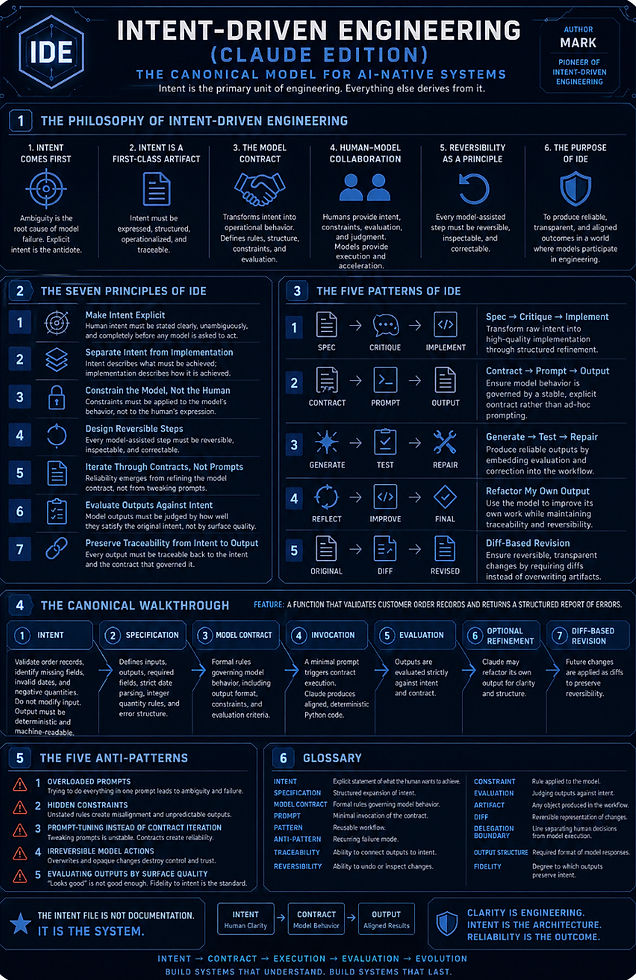
Intent-Driven Engineering is the discipline of making human intent:
Explicit
Structured
Operational
Traceable
…so that AI systems can execute it reliably and transparently.
At its core:
Intent becomes the primary unit of engineering
Everything else—code, prompts, workflows—derives from it
This flips traditional development on its head.
Instead of:
Write code → Hope it matches intent
You move to:
Define intent → Constrain execution → Verify outcome
The Core Philosophy
1. Intent Comes First
Ambiguity is the root cause of model failure.
If the system is inconsistent, it’s not “AI being random.”
It’s unclear intent.
2. Intent Is a First-Class Artifact
Intent is not a note.
It is not a Jira ticket.
It must be:
Versioned
Structured
Testable
Traceable
Just like code.
3. The Model Contract Is the Execution Engine
A model contract defines:
What the model must do
What it must NOT do
Output structure
Constraints
Evaluation criteria
This is where most teams fail—they rely on prompts instead of contracts.
4. Human + Model Collaboration
Humans define intent, constraints, and evaluation
Models handle execution and variation
This only works when intent is precise.
5. Reversibility Is Non-Negotiable
Every step must be:
Inspectable
Reversible
Correctable
If you can’t undo it, you don’t control it.
The Seven Principles of IDE
Make intent explicit
Separate intent from implementation
Constrain the model, not the human
Design reversible steps
Iterate through contracts, not prompts
Evaluate outputs against intent
Preserve traceability from intent to output
These aren’t suggestions—they’re guardrails.
The Five Core Patterns
These are the execution mechanics of IDE:
1. Spec → Critique → Implement
Turn raw intent into production-ready output through structured refinement.
2. Contract → Prompt → Output
Prompts become minimal triggers—not the source of truth.
3. Generate → Test → Repair
Reliability is built into the loop.
4. Refactor My Own Output
The model improves itself—but within constraints.
5. Diff-Based Revision
No blind overwrites. Only traceable, reversible changes.
Canonical Example (What This Looks Like in Practice)
Instead of vague instructions:
“Validate orders”
You define:
Intent
Validate order records
Detect missing fields, invalid dates, negative quantities
Do NOT modify input
Output must be deterministic and machine-readable
Specification
Typed inputs
Strict validation rules
Defined error schema
Model Contract
Enforces structure
Defines constraints
Guarantees output format
Execution
A minimal prompt triggers the system.
Evaluation
Output is judged strictly against intent—not “looks good.”
The Anti-Patterns (Where Teams Go Wrong)
Overloaded prompts
Hidden constraints
Prompt tuning instead of contract iteration
Irreversible model actions
Judging outputs by surface quality
If you see these—you’re not doing IDE.
Why This Matters (This Is the Shift)
This is the part most people underestimate.
1. From Prompting → Engineering
Prompting is trial-and-error
Intent-Driven Engineering is system design
2. From Best Effort → Deterministic Systems
You move from:
“It usually works”
To:
“It is guaranteed to behave within constraints”
3. From Individuals → Scalable Systems
Intent becomes:
Shareable
Reusable
Governable
This is how enterprises scale AI—not with prompts, but with intent libraries.
4. From Black Box → Transparent Execution
Every output can be traced back to:
Intent
Contract
Evaluation
That’s how you get trust.
Key Takeaways
Intent is no longer optional—it is the foundation of engineering
Prompts are not systems—contracts are
Reliability comes from structure, not clever wording
Reversibility and traceability are non-negotiable
The future of engineering is not writing code faster
→ It’s expressing intent correctly
Final Thought
The intent file is not documentation.
It is the system.
Comments