
Intent-Driven Engineering for Future Software Development
- Mark Kendall
- 5 days ago
- 3 min read

Software development has entered a new era where artificial intelligence tools are widely accessible. Yet, having access to AI is no longer enough to guarantee success. The real challenge lies in how teams turn human goals into reliable, measurable, and reusable software outcomes. This shift calls for a fresh approach beyond prompt crafting: Intent-Driven Engineering.
Intent-Driven Engineering focuses on transforming human intentions into structured, governed, and executable instructions that software systems can follow with certainty. This approach promises to bring clarity, control, and repeatability to AI-assisted development, moving past the noise of unstructured prompting.
The Limits of Prompting in Software Development
AI-powered tools have made it easy to generate code snippets, responses, or ideas through conversational prompts. However, prompts alone are exploratory and flexible by nature. They help developers experiment and prototype but fall short when it comes to delivering consistent, validated results in production environments.
Consider these challenges with prompt-based workflows:
Unpredictable outputs: Prompts can produce varied responses that are hard to control or verify.
Lack of measurement: It is difficult to track whether a prompt’s output meets the intended goal.
One-off experiments: Prompting often leads to isolated solutions that cannot be reused or scaled.
No clear boundaries: Without engineering guardrails, AI generation can produce unsafe or irrelevant results.
These issues highlight why prompt engineering, while useful, cannot be the foundation for reliable software development.
What Intent-Driven Engineering Means
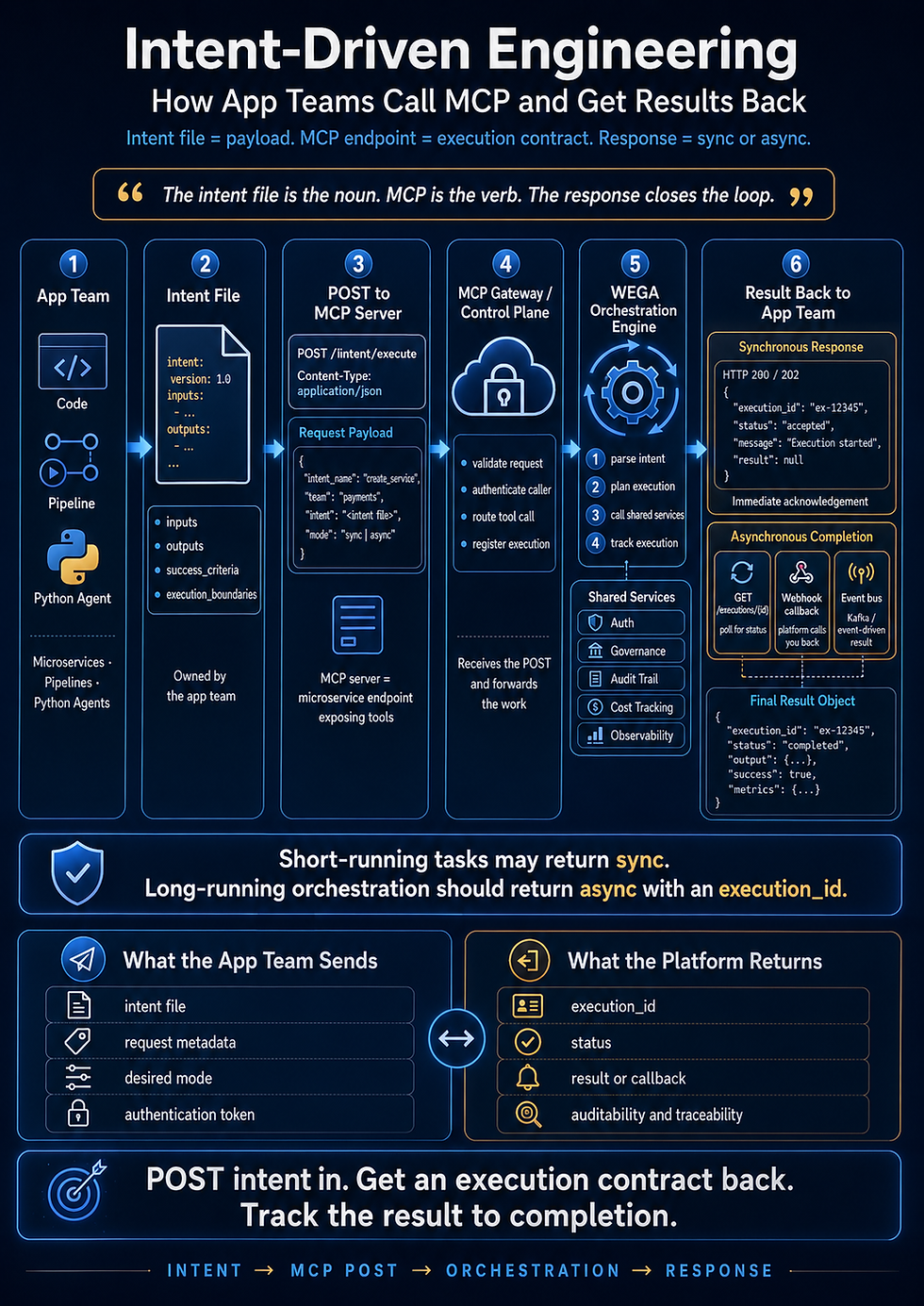
Intent-Driven Engineering is a discipline that captures human goals as executable intent—clear, structured instructions that software systems can interpret, validate, and act upon. This intent is not just a casual prompt but a governed artifact that guides AI and software components toward measurable outcomes.
Key aspects of Intent-Driven Engineering include:
Executable intent over conversational prompting: Intent is designed to be run and tested, not just discussed.
Validated outcomes over impressive responses: Success is measured by meeting goals, not by how clever the output looks.
Engineering boundaries over uncontrolled generation: Clear rules and constraints ensure safe and predictable behavior.
Reusable systems over one-off AI experiments: Intent can be stored, shared, and adapted for future use.
By focusing on intent, teams gain control over AI-assisted development and reduce the risk of unpredictable results.

How Intent-Driven Engineering Works in Practice
To understand how Intent-Driven Engineering changes software development, consider a team building a customer support chatbot powered by AI.
Traditional Prompt-Based Approach
Developers write prompts to generate chatbot responses.
They test prompts interactively, tweaking wording to improve answers.
The chatbot’s behavior depends heavily on prompt phrasing and AI model responses.
There is no formal way to verify if the chatbot meets business goals or handles edge cases safely.
Intent-Driven Engineering Approach
The team defines clear intents such as “Answer billing questions” or “Escalate complex issues.”
Each intent includes structured rules, validation tests, and fallback procedures.
The chatbot’s AI uses these intents as executable instructions, ensuring consistent behavior.
The team measures success by tracking resolution rates and customer satisfaction tied to each intent.
Intents are modular and reusable for future chatbot features or other AI applications.
This approach transforms vague prompts into precise, governed instructions that deliver reliable results.
Benefits of Adopting Intent-Driven Engineering
Moving to Intent-Driven Engineering offers several practical advantages:
Improved reliability: Software behaves predictably because intent governs execution.
Better measurement: Teams can track if outcomes meet defined goals.
Increased safety: Boundaries prevent AI from generating harmful or irrelevant content.
Enhanced collaboration: Clear intent definitions help align developers, product owners, and AI specialists.
Scalability: Reusable intents accelerate development of new features or products.
These benefits help teams build AI-assisted systems that deliver real value rather than just impressive demos.
Steps to Start Using Intent-Driven Engineering
Teams interested in adopting this approach can begin with these practical steps:
Identify core intents: Define the main goals your software must achieve.
Structure intents: Break down goals into clear, executable instructions with validation criteria.
Implement governance: Set rules and boundaries to control AI outputs.
Measure outcomes: Track success metrics tied to each intent.
Reuse and refine: Store intents in libraries for reuse and continuous improvement.
Starting small with a pilot project can demonstrate the power of intent-driven workflows before scaling across the organization.
Comments