
Intent-Driven Engineering: How to Restructure the Enterprise for AI, Scale, and Measurable ROI
- Mark Kendall
- 17 hours ago
- 3 min read

Intent-Driven Engineering: How to Restructure the Enterprise for AI, Scale, and Measurable ROI
Introduction
Most enterprises are trying to “add AI” without changing the structure that AI is supposed to improve.
That doesn’t work.
You don’t get ROI from AI by sprinkling it into a broken system.
You get ROI by restructuring the system around what AI actually enables.
That’s where Intent-Driven Engineering comes in.
It’s not just a development approach.
It’s a new operating model for the enterprise — one that allows organizations to:
Reduce team count without reducing output
Increase span of control without losing quality
Deliver faster with fewer coordination layers
Show real, measurable ROI on AI investments
What Is Intent-Driven Engineering?
Intent-Driven Engineering is a model where:
The enterprise defines intent (what outcomes are needed),
and platforms + AI systems execute the implementation.
Instead of:
Breaking work into tickets
Assigning to multiple teams
Coordinating across silos
You:
Define structured intent
Route it through shared services
Execute using standardized, automated systems
The Problem with Today’s Enterprise Structure
Most companies are still organized around feature teams.
What that looks like:
One team per feature or project
Separate Dev, QA, DevOps per team
Heavy coordination between teams
Duplicate effort across domains
Why it breaks at scale:
Output scales linearly with headcount
Coordination cost grows exponentially
Architecture becomes inconsistent
AI becomes a tool, not a multiplier
Why AI Forces a Structural Change
AI changes a fundamental constraint:
Execution is no longer the bottleneck. Coordination is.
If execution becomes faster:
You don’t need more teams
You need better structure and control
The Intent-Driven Enterprise Model
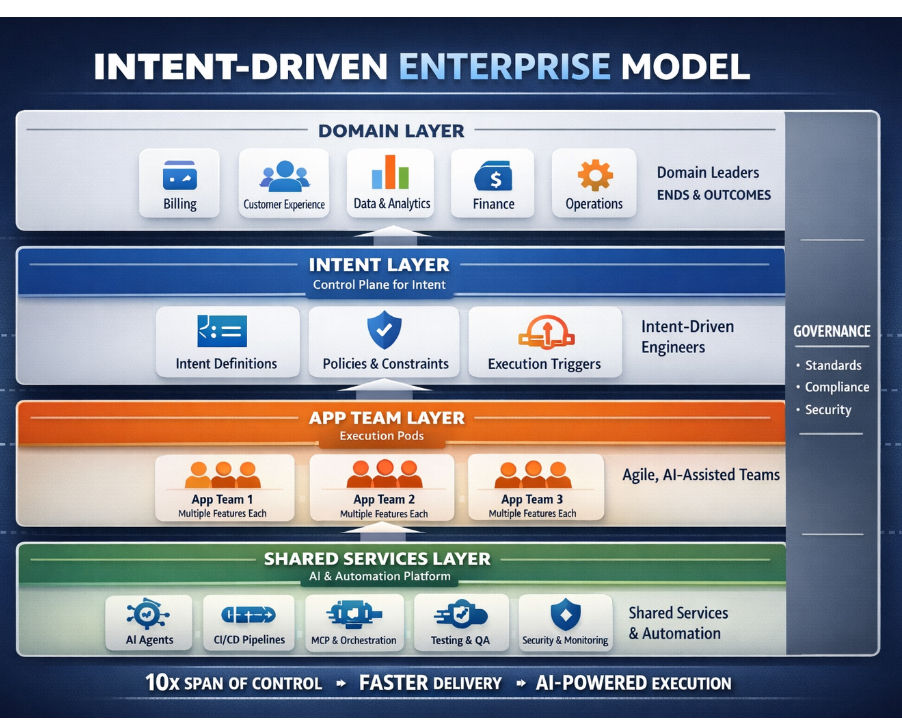
This model restructures the organization into five layers.
1. Domain Layer (Ownership)
Organize the enterprise around domains, not features.
Examples:
Billing
Customer Experience
Integration Platforms
Finance
Marketing
Operations
What domains do:
Own business capabilities
Define outcomes
Set architectural direction
2. Intent Layer (Control Plane)
This is the defining layer of the model.
What it does:
Converts business goals into executable intent
Defines constraints, policies, and expected outcomes
Triggers execution through platforms
What it replaces:
Manual backlog grooming
Ticket decomposition
Endless planning cycles
3. App Team Layer (Execution Pods)
Execution doesn’t disappear — it evolves.
Old:
1 team = 1 feature
New:
1 team = multiple features within a domain
What changes:
Less manual coding
More orchestration of systems
Higher throughput per team
4. Shared Services Layer (Execution Engine)
This is where ROI is unlocked.
Includes:
AI agents (code, test, validation)
MCP/orchestration servers
CI/CD pipelines
Observability and monitoring
Security frameworks
What it does:
Executes intent consistently
Eliminates duplicated work
Standardizes delivery
5. Governance Layer (Embedded Control)
Governance becomes part of the system — not a separate function.
Instead of:
Approval boards
Manual reviews
You get:
Automated policy enforcement
Built-in compliance
Cross-domain consistency
Span of Control: The Real Breakthrough
This is where executives start paying attention.
Traditional Model
1 manager → 1 team → 1 feature stream
Scaling requires more teams
Intent-Driven Model
1 domain → 1–2 teams → multiple feature streams
Platforms handle coordination
Real Impact
Instead of:
200 features → 200 teams
You get:
15 domains
1–2 teams per domain
→ ~20–30 teams total
How This Drives ROI on AI
Most AI initiatives fail to show ROI because:
They are layered on top of inefficient structures
They don’t reduce cost or increase throughput meaningfully
Intent-Driven ROI Model
You get measurable impact in three areas:
1. Cost Reduction
Fewer teams
Less duplication
Reduced coordination overhead
2. Throughput Increase
Faster execution via AI + automation
Multiple features per team
Reduced cycle time
3. Quality and Consistency
Standardized execution paths
Built-in governance
Reduced human error
What Organizations Must Get Right
This model only works if:
Domains truly own outcomes (not just services)
Shared services are fully funded and prioritized
Intent is structured and enforced
Teams shift from “builders” to “orchestrators”
What Happens If You Don’t Change
If organizations keep the old structure and add AI:
Teams stay bloated
Coordination remains slow
AI becomes underutilized
ROI remains unclear
Key Takeaways
Structure around domains, not features
Introduce an intent layer as the control plane
Use shared services as the execution engine
Expand span of control through AI and automation
Measure success through ROI, not activity
Closing
Intent-Driven Engineering is not just a technical shift.
It’s an organizational one.
The enterprises that win will not be the ones with the most AI —
but the ones structured to leverage it at scale.
Comments