

Intent-Driven Engineering: The Operating System for AI Execution
- Mark Kendall
- 2 days ago
- 3 min read

Intent-Driven Engineering: The Operating System for AI Execution
Intro
Over the past year, AI has made its way into everyday engineering workflows.
Teams are using tools like Claude Code, GitHub Copilot, and Google Gemini to accelerate development, generate code, and explore ideas faster than ever before.
At first, the results feel transformative.
But over time, a pattern emerges:
Outputs become inconsistent
Logic starts to drift
Prompts grow more complex
Confidence in results begins to drop
The problem isn’t the tools.
It’s the model we’re using to work with them.
That’s where Intent-Driven Engineering comes in.
What Is Intent-Driven Engineering?
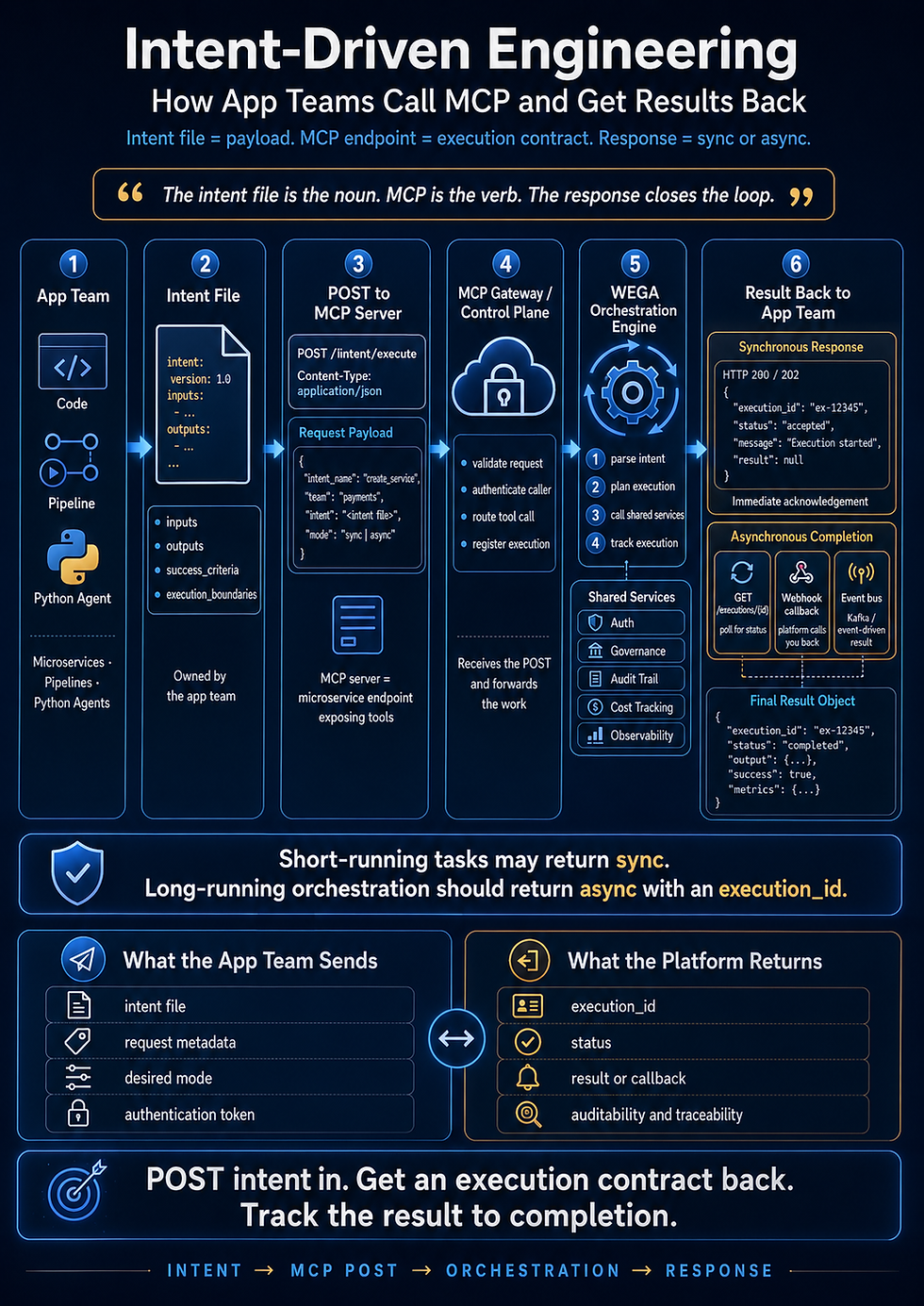
Intent-Driven Engineering is an approach where engineers define the desired outcome, constraints, and success criteria—and a governed system ensures that outcome is delivered correctly.
Instead of telling AI what to do step-by-step, you define:
What must be achieved
What inputs are required
What success looks like
What to do if things fail
The system then determines how to execute that intent using available tools.
At a high level:
Intent defines the outcome
Execution engines perform the work
Validation ensures correctness
Results are measured, not assumed
From Prompts to a System of Execution
Most teams today are still operating in a prompt-driven model:
Prompt-Driven Workflow
Engineer → Prompt → AI Tool → Output → Review → Retry
This works—but it has limitations:
Results vary from run to run
There is no built-in validation
Knowledge is not reusable
Scaling requires more human oversight
Now compare that to an intent-driven model:
Intent-Driven Workflow
Engineer → Intent File → Execution Engines → Validation → Verified Outcome
This changes everything:
Outcomes are defined upfront
Execution becomes repeatable
Results are measurable
Systems become reliable
Why It’s Like an Operating System
A helpful way to understand Intent-Driven Engineering is to think of it as an operating system for AI.
Traditional operating systems abstract hardware complexity so developers don’t need to think about CPUs, memory, or disk access directly.
In the same way, Intent-Driven Engineering abstracts AI tools.
Instead of worrying about:
Which model to use
How to structure prompts
How to chain outputs together
Engineers simply define the intent:
“Here’s the outcome. Execute it.”
The system handles the rest.
Not a Better Prompt—A Different Model
It’s important to be clear: this is not “better prompting.”
A prompt is:
Unstructured
Context-dependent
Difficult to validate
Inconsistent over time
An intent is:
Structured and machine-readable
Defined with inputs and outputs
Measured against success criteria
Designed for repeatability
A prompt is a request.
An intent is a contract.
That distinction is what allows systems to scale.
Why This Matters
In practice, even small groups adopting this approach begin to see disproportionate impact.
A handful of engineers working with structured intent can:
Reduce rework caused by inconsistent outputs
Standardize how work is executed across teams
Increase confidence in AI-assisted delivery
Deliver faster with fewer cycles of correction
The result isn’t just productivity—it’s predictability.
And in engineering, predictability is what scales.
A Practical Observation
Today, most organizations are still early in this shift.
It’s common to see:
Small groups experimenting
A few engineers adopting structured approaches
Early signs of measurable gains
But those early adopters often act as force multipliers.
They’re not just using AI tools—they’re systematizing outcomes.
And that’s where the real value begins to emerge.
Where This Is Going
As AI continues to evolve, the industry is heading in one of two directions:
Increasing complexity through prompts, agents, and orchestration layers
Simplifying execution through intent, governance, and outcome-driven systems
Intent-Driven Engineering represents the second path.
It allows engineers to move from:
Designing workflows
to
Defining outcomes
From:
Managing tools
to
Trusting systems
Key Takeaways
Intent-Driven Engineering separates what from how
It acts as a governed execution layer over AI tools
It replaces prompts with structured, testable intent
It enables repeatable and reliable outcomes
Even small teams can create outsized impact
Closing Thought
We’re still early.
But the shift is already visible.
The question is no longer:
“How do we prompt better?”
It’s:
“How do we define outcomes that systems can reliably execute?”
That’s the foundation of Intent-Driven Engineering.
Author
Mark Kendall
Pioneer in Intent-Driven Engineering
Time to move beyond prompts.
Comments