

Intent-Driven Engineering vs Prompt Engineering: Building the Same Mobile Banking App
- Mark Kendall
- 4 minutes ago
- 4 min read

Intent-Driven Engineering vs Prompt Engineering: Building the Same Mobile Banking App
Modern software teams are rapidly adopting AI-assisted development. But two very different engineering models are emerging underneath the hype:
Prompt Engineering
Intent-Driven Engineering
At first glance, they can appear similar. Both use AI. Both generate code. Both accelerate delivery.
But when real systems must be built — systems with governance, security, compliance, architecture, testing, observability, and operational ownership — the difference becomes dramatic.
Let’s walk through a simple example.
A company wants a new mobile banking app.
Not a massive enterprise platform. Just a clean, modern banking application with:
Login/authentication
Account balances
Transactions
Deposits
Credit card management
Settings/profile
Notifications
Secure APIs
Mobile frontend
Two engineers are assigned the same project:
Engineer A → Prompt Engineer
Engineer B → Intent-Driven Engineer
Both are talented.
Both use AI.
But they start in completely different places.
What Is Prompt Engineering?
Prompt engineering focuses on interacting directly with AI systems through natural language instructions.
The engineer manually guides the AI through iterative prompts:
“Create a login screen.”
“Generate a REST API.”
“Add JWT authentication.”
“Fix this bug.”
“Refactor this component.”
The engineer remains the orchestrator of all architectural decisions.
The AI becomes an advanced coding assistant.
This works extremely well for:
Small applications
Rapid prototyping
Isolated features
Personal projects
Short-lived implementations
But as systems scale, complexity shifts back onto the engineer.
What Is Intent-Driven Engineering?
Intent-Driven Engineering starts from a governed outcome instead of direct implementation instructions.
The engineer defines:
Desired business outcomes
Constraints
Security boundaries
Success criteria
Architecture expectations
Compliance requirements
Operational policies
The system then determines:
Required services
API structures
Security patterns
Infrastructure
Agent orchestration
Validation flows
Testing requirements
Deployment strategies
The engineer moves from:
manually constructing software
to:
declaring governed operational intent.
The Prompt Engineer Path
Day 1: Starting the Project
The prompt engineer opens Claude, ChatGPT, or another coding assistant.
They begin issuing prompts:
“Generate a React Native banking app.”
Then:
“Create a login screen with JWT authentication.”
Then:
“Build a transactions API using Spring Boot.”
Then:
“Generate a PostgreSQL schema.”
Then:
“Add a credit card dashboard.”
The engineer is continuously:
Managing prompts
Managing context
Managing architecture consistency
Managing dependencies
Managing security assumptions
Managing AI drift
The Architecture Exists Mostly in the Engineer’s Head
This is the hidden reality of prompt engineering.
The AI may generate:
Screens
APIs
DTOs
Database schemas
Terraform
Dockerfiles
But:
Governance is not encoded
Security policies are not enforced
Architecture standards are not guaranteed
Compliance is not systematic
Operational requirements are fragmented
The engineer becomes the human integration layer.
Common Prompt Engineering Failure Modes
1. Context Drift
After dozens or hundreds of prompts:
naming conventions drift
authentication patterns diverge
API styles become inconsistent
duplicated logic appears
security gaps emerge
The engineer constantly re-corrects the AI.
2. Architecture Fragmentation
One prompt creates:
REST APIs
Another creates:
GraphQL
Another introduces:
WebSockets
Another changes:
auth flows
Without centralized intent, the system evolves through accidental decisions.
3. Governance Becomes Manual
The engineer must manually remember:
encryption requirements
audit logging
PII handling
retry policies
rate limiting
observability
transaction integrity
regulatory requirements
The AI does not inherently enforce them.
4. Scaling Teams Gets Difficult
A single strong engineer may keep the system coherent.
But across:
10 engineers
30 prompts/day
multiple AI tools
multiple repos
the system begins fragmenting rapidly.
The Intent-Driven Engineer Path
Now let’s look at the second engineer.
Instead of starting with prompts, they start with intent.
Step 1: Define the Banking Intent
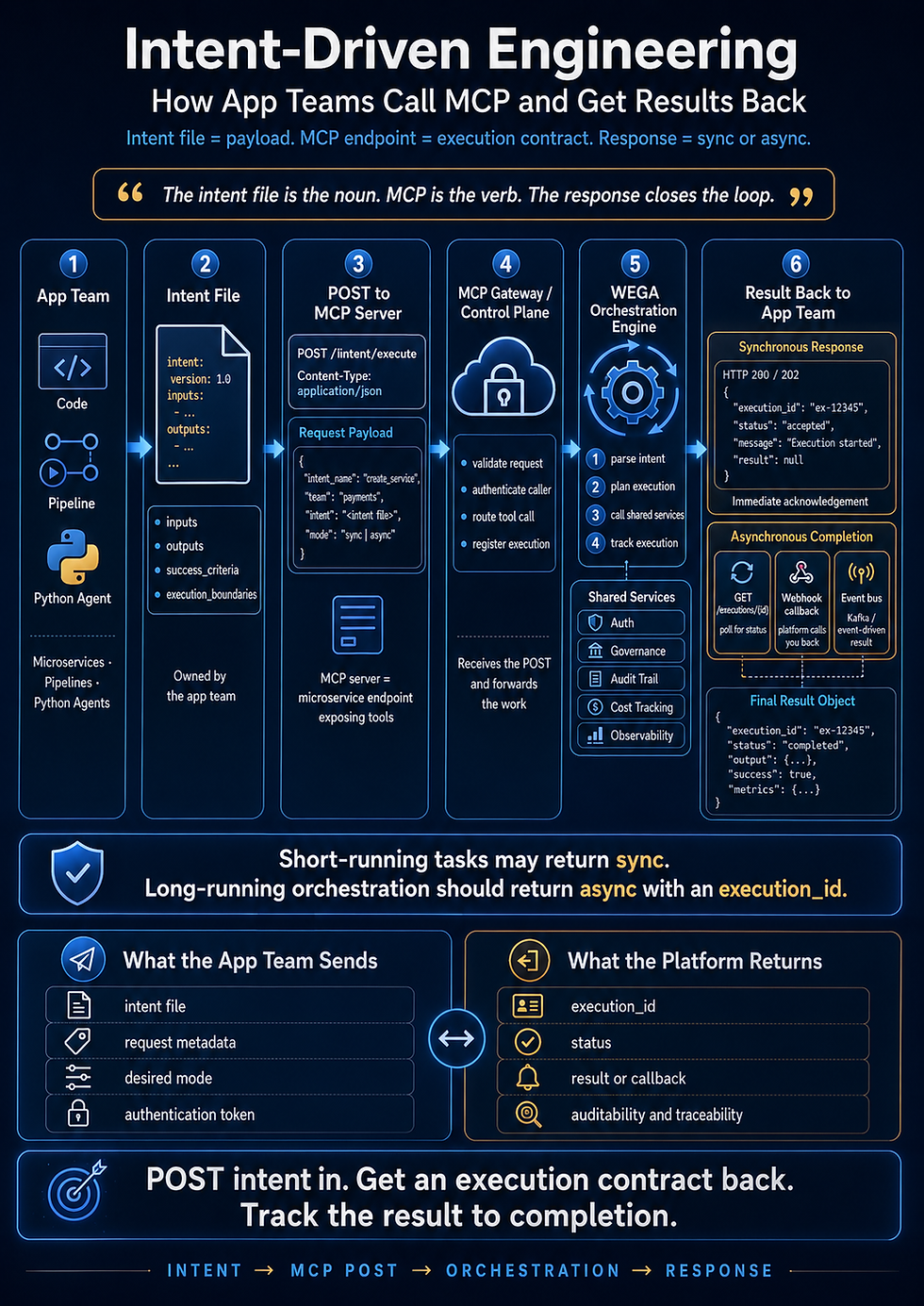
The engineer creates an intent file.
intent:
name: mobile-banking-platform
version: 1.0.0
business_goal:
provide secure consumer mobile banking capabilities
inputs:
- customer_identity
- banking_accounts
- transactions
- credit_card_data
outputs:
- authenticated_mobile_experience
- transaction_visibility
- secure_money_movement
security:
authentication: oauth2
encryption: required
pii_protection: enabled
audit_logging: mandatory
success_criteria:
- login_under_2_seconds
- transaction_accuracy_100_percent
- zero_unencrypted_pii
- mobile_availability_99_9
execution_boundaries:
approved_clouds:
- aws
approved_languages:
- kotlin
- typescript
forbidden_patterns:
- hardcoded_secrets
- direct_database_access_from_mobile
Notice the difference immediately.
The engineer is not asking:
“Generate a login page.”
The engineer is declaring:
“This is the governed operational system.”
Step 2: The Platform Determines Architecture
Now the platform can reason systematically.
The system derives:
Mobile frontend
Authentication service
Transaction service
Credit card service
API gateway
Audit logging
Encryption enforcement
Monitoring requirements
CI/CD policies
The architecture becomes reproducible.
Not improvised.
Step 3: Governance Is Inherited Automatically
Instead of manually remembering:
security
logging
compliance
retry handling
observability
the platform injects:
approved auth patterns
standard telemetry
audit events
encryption libraries
policy enforcement
deployment guardrails
This is inherited governance.
Not tribal knowledge.
Step 4: AI Becomes a Compiler Layer
This is the key shift.
In prompt engineering:
AI is the primary driver
In Intent-Driven Engineering:
intent is the primary driver
AI becomes an execution mechanism
The AI may still:
generate APIs
create screens
scaffold services
write tests
But now those outputs are constrained by declared operational intent.
The Core Difference
Prompt engineering asks:
“What should I ask the AI to do next?”
Intent-Driven Engineering asks:
“What operational outcome must exist?”
That sounds subtle.
But at enterprise scale, it changes everything.
Why This Matters for Real Banking Systems
Banking systems are not judged by:
how fast code was generated
They are judged by:
correctness
consistency
recoverability
auditability
compliance
operational resilience
governance
security
Prompt engineering accelerates code generation.
Intent-Driven Engineering accelerates governed system construction.
Those are not the same thing.
The Future Shift
Today, many organizations are still focused on:
prompts
copilots
assistants
code snippets
But eventually enterprises hit the same wall:
generated code is not the same as engineered systems.
The next evolution is not:
“better prompts”
It is:
governed intent compilation.
Key Takeaways
Prompt Engineering
AI-centric workflow
Engineer manually orchestrates architecture
Governance is mostly manual
Excellent for speed and prototyping
Complexity grows rapidly at scale
Intent-Driven Engineering
Outcome-centric workflow
Intent defines operational system
Governance becomes inherited
Architecture becomes reproducible
AI operates within constraints
Better aligned for enterprise systems
Final Thought
Prompt engineering helps developers talk to AI.
Intent-Driven Engineering helps enterprises govern AI-generated systems.
That is a fundamental difference.
And as systems become larger, regulated, distributed, and operationally critical…
that difference becomes impossible to ignore.
Comments