

Intent Is the Control Plane: Enterprise Agentic AI Architecture for 2026
- Mark Kendall
- 2 minutes ago
- 8 min read

Intent Is the Control Plane: Enterprise Agentic AI Architecture for 2026
Different protocols. Different layers. One governing idea: the enterprise should begin with intent.
Agentic AI architecture is becoming much clearer.
We now have protocols for agents talking to tools. Protocols for agents talking to other agents. Protocols for agents interacting with users. Emerging approaches allow agents to generate user interfaces dynamically. Underneath all of it, enterprises still have APIs, events, databases, cloud platforms, identity systems, observability, and decades of existing technology.
That is progress.
But it creates another question:
What coordinates all of it?
The answer should not be another protocol.
It should be intent.
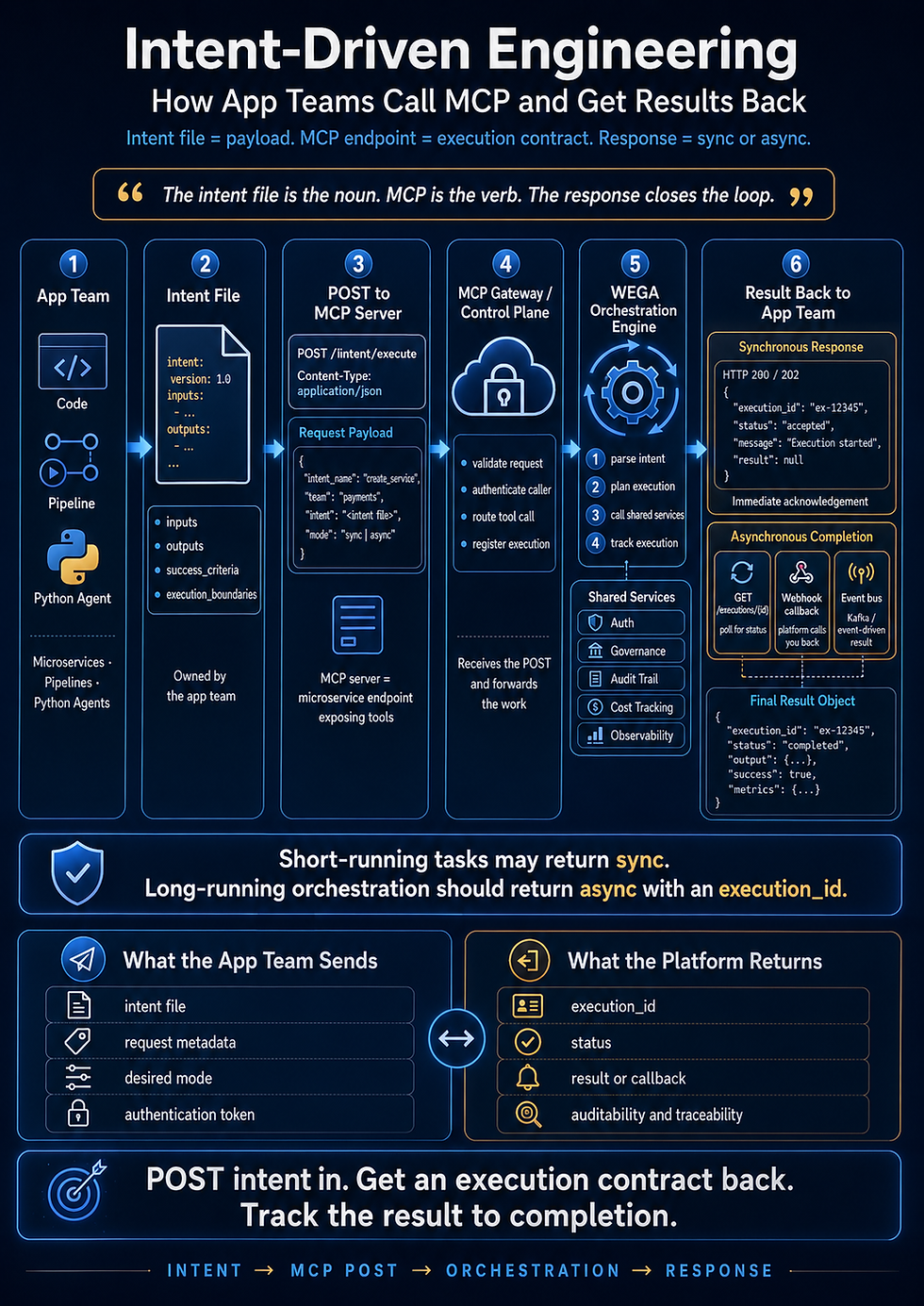
In an Intent-Driven Enterprise, the primary architectural flow becomes:
Intent → Orchestration → Agents → Tools & Services → Enterprise Systems → Validated Outcome
This changes the architecture from a collection of intelligent components into a governed execution system.
The Missing Layer: Intent as the Control Plane
Most agentic architecture diagrams begin with an agent or an orchestrator.
That is already one step too late.
Before an agent reasons, calls a tool, delegates to another agent, queries a database, publishes an event, or modifies a production system, something should define why the work is being performed and what success means.
That is the job of the Intent Control Plane.
An intent should minimally establish four things:
Intent — What outcome are we trying to achieve?
Inputs — What information is available to perform the work?
Outputs — What artifacts, actions, or results should be produced?
Success Criteria — How do we determine that the requested outcome was actually achieved?
Enterprise implementations can extend this with:
constraints
policies
guardrails
security requirements
validation rules
ownership
cost boundaries
architectural patterns
implementation guidance
compliance requirements
observability expectations
The important point is that the agent does not invent the mission.
The agent receives the mission.
The Enterprise Intent-Driven Agentic Architecture
The architecture can be viewed as several cooperating layers.
USER & APPLICATION LAYER
Web • Mobile • Teams • Slack
│
▼
INTENT CONTROL PLANE
Intent → Constraints → Success Criteria
│
▼
WEGA / ORCHESTRATOR
Plan • Route • Validate • Coordinate
│ │ │
▼ ▼ ▼
Agent A Agent B Agent C
│ │ │
Skills A2A Skills
│ │ │
└─────────┼─────────┘
▼
MCP / TOOLS
│
┌────────────┼────────────┐
▼ ▼ ▼
REST/gRPC Kafka Databases
│ │ │
└────── ENTERPRISE ───────┘
↕ DURABLE STATE ↕
Saga • Checkpoints • Registry • Audit
CROSS-CUTTING CONTROL
Identity • Security • Hooks • Policy • Telemetry
Observability • Cost • Governance
The value is not any individual box.
The value is the separation of responsibilities.
1. Intent Control Plane — Define the Outcome
Intent sits above execution.
The intent layer describes what the organization wants accomplished without prematurely prescribing every implementation decision.
For example:
## Intent
Provision a new enterprise customer across Salesforce,
billing, ServiceNow, and the customer portal.
## Inputs
Validated TMF customer and product-order information.
## Outputs
Provisioned customer records in all required systems
with a correlated completion result.
## Success Criteria
- Salesforce customer created
- Billing account created
- ServiceNow relationship established
- Portal access provisioned
- All identifiers correlated
- No duplicate provisioning
- Complete audit trail available
Notice what is missing.
There are no detailed instructions telling an AI model exactly which classes to modify, which HTTP requests to execute, or how every system should be implemented.
Those decisions can be discovered from the repository, architecture, skills, policies, tools, and available services.
The intent defines the destination and boundaries.
2. Wega — The Orchestration Layer
Below intent sits the orchestration layer.
In this architecture, we can call that Wega.
Wega is not necessarily an LLM.
It is the execution and coordination capability that turns intent into controlled work.
Its responsibilities can include:
task decomposition
planning
routing
agent selection
context management
workflow coordination
policy enforcement
validation
retries
compensation
telemetry
evaluation
completion determination
This distinction matters.
An agent may be excellent at reasoning.
That does not mean the agent should automatically own the enterprise transaction.
For a production workflow spanning six systems, the enterprise needs something that knows:
What has completed?
What is still running?
What failed?
What can be retried?
What must be compensated?
What evidence proves success?
That is orchestration.
3. Agents Reason — They Should Not Be the Database
One of the easiest mistakes in agentic architecture is confusing context with state.
An agent may maintain temporary context while performing a task.
That is useful.
But durable enterprise workflow state belongs outside the model.
For example, imagine this workflow:
Customer Order
↓
Salesforce
↓
Billing
↓
ServiceNow
↓
Provisioning
↓
Notification
If step four fails, the organization cannot depend on an LLM conversation remembering what happened.
The workflow needs durable information such as:
workflow_id: 89321
salesforce: COMPLETE
billing: COMPLETE
servicenow: COMPLETE
provisioning: FAILED
notification: NOT_STARTED
retry_count: 2
That belongs in an external workflow or state store.
This gives us another important architectural principle:
Agents reason. Orchestrators coordinate. State stores remember.
That separation makes agentic systems much more predictable.
4. A2A — Agent-to-Agent Collaboration
Not every task should be handled by one giant agent.
An enterprise may have specialized agents for:
security
finance
legal
HR
operations
architecture
testing
compliance
Agent-to-Agent communication allows these capabilities to collaborate.
For example:
Wega
│
├──► Architecture Agent
│
├──► Security Agent
│
├──► Implementation Agent
│
└──► Testing Agent
The orchestration layer can delegate bounded tasks while retaining responsibility for the overall workflow.
This is a much healthier model than creating an enormous autonomous agent with unlimited responsibilities.
Specialization belongs to agents. Coordination belongs to orchestration.
5. MCP — Agent-to-Tools and Data
The Model Context Protocol has become an important boundary in agentic architecture because it gives agents a standardized way to access external capabilities.
An enterprise agent may need access to:
Jira
Confluence
GitHub
ServiceNow
Databases
Cloud services
Internal APIs
Search systems
Observability platforms
MCP provides a consistent mechanism for exposing those capabilities.
But MCP should not become an architectural religion.
If an existing application already exposes a clean REST API and a deterministic service simply needs to call it, there may be no reason to place MCP between those systems.
A useful distinction is:
MCP is primarily an agent access boundary—not a replacement for every enterprise API.
That keeps the architecture pragmatic.
6. Skills — Reusable Organizational Expertise
Protocols provide connectivity.
Skills provide knowledge of how work should be performed.
An organization may have reusable skills such as:
/create-api
/create-tmf-adapter
/security-review
/create-react-component
/deploy-aws-service
/create-service-now-integration
Those skills can encode:
architecture conventions
coding standards
reusable workflows
implementation patterns
security requirements
testing practices
deployment expectations
This is how organizational knowledge becomes reusable by agents without stuffing every rule into every prompt.
7. Hooks — Deterministic Control
Some decisions should never depend entirely on probabilistic reasoning.
Examples include:
secrets detection
schema validation
required tests
security scanning
protected-file rules
deployment authorization
intent validation
compliance checks
These belong in deterministic controls such as hooks, policies, CI pipelines, and platform enforcement.
This gives us a powerful division:
Agent reasoning → probabilistic
Skill guidance → reusable expertise
Intent → desired outcome
Hook/policy → deterministic enforcement
AI can reason creatively while the enterprise retains hard boundaries.
8. Native APIs and Events Still Matter
Agentic architecture does not eliminate conventional enterprise integration.
REST is still useful.
gRPC is still useful.
GraphQL is still useful.
Kafka is still useful.
Databases are still useful.
Event-driven architecture is still useful.
The agentic layer sits above and alongside these technologies.
For example:
Intent
↓
Wega
↓
Agent
↓
MCP
↓
Enterprise Tool
may be appropriate for an agent-driven operation.
But:
Order Service
↓
Kafka
↓
Billing Adapter
↓
Billing API
may remain entirely deterministic.
Both can coexist.
That is what makes the architecture composable rather than revolutionary for revolution’s sake.
9. The Intent Registry
As organizations accumulate intents, another capability becomes valuable: an Intent Registry.
The registry can provide a searchable catalog of:
intents
versions
owners
schemas
templates
patterns
relationships
success criteria
execution history
reusable architectural guidance
The registry does not have to become a massive centralized approval system.
A lightweight implementation might simply record intents whenever practical and make them searchable.
More mature implementations can introduce:
Intent
↓
Validation
↓
Registration
↓
Execution
↓
Evidence
↓
Outcome
The registry becomes institutional memory.
10. Cross-Cutting Enterprise Services
Around all of these layers sit capabilities that should not be recreated by individual agents.
These include:
Identity and Access
Agents require identities and constrained permissions just like applications and users.
Security
Agent actions must respect enterprise security boundaries.
Secrets Management
Credentials should come from controlled secret stores rather than prompts or source code.
Observability
Agent decisions, tool calls, workflow transitions, failures, retries, and outcomes should be observable.
Audit and Compliance
Organizations need evidence explaining what happened and why.
FinOps
Agentic workloads introduce variable model and tool costs that should be measured.
Governance
Organizations need policies defining what agents may perform autonomously and what requires approval.
These are platform capabilities.
They should not be reinvented inside every agent.
Protocols Become Plumbing
Once this architecture is viewed through an Intent-Driven lens, something interesting happens.
The protocols become less confusing.
They each have a job.
Protocol / Capability
Primary Responsibility
AG-UI
Agent ↔ User/UI
A2UI
Agent → Dynamic UI
A2A
Agent ↔ Agent
MCP
Agent ↔ Tools/Data
Native APIs
Application ↔ Services
Events/Kafka
Asynchronous system communication
Skills
Reusable expertise/workflows
Hooks
Deterministic enforcement
Intent
Desired outcome and success
Wega
Coordination and execution
External State
Durable workflow memory
Instead of asking:
Which protocol wins?
We ask:
Which protocol belongs at this boundary?
That is a much better architectural question.
A Real Enterprise Example
Consider a customer-order intent.
The user submits an order through a web application.
The application produces an intent.
Wega validates the intent and creates a durable workflow instance.
A product agent determines the appropriate fulfillment plan.
A security agent evaluates required access.
A billing capability is accessed through an API.
ServiceNow may be accessed through MCP.
Kafka carries asynchronous provisioning events.
The state store records each completed stage.
Hooks enforce security and deployment rules.
Observability captures the entire transaction.
The orchestrator finally evaluates the original success criteria.
Only then is the intent considered complete.
The flow becomes:
User
↓
Intent
↓
Wega
↓
Plan
↓
Agents
↓
Skills / MCP / APIs / Events
↓
Enterprise Systems
↓
State + Evidence
↓
Validation
↓
Success Criteria Satisfied
↓
Intent Complete
That final step is extremely important.
Completion is not “the agent stopped talking.”
Completion means the system can demonstrate that the original intent was satisfied.
From Prompt-Driven AI to Intent-Driven Enterprise Systems
The first generation of generative AI applications was largely prompt-driven.
Prompt → Model → Response
Agentic systems expanded that:
Prompt → Agent → Tools → Response
Multi-agent systems expand it again:
Prompt → Agent → Agents → Tools → Systems
But enterprise architecture needs one more evolution:
INTENT
│
▼
ORCHESTRATION
│
┌───────┼───────┐
▼ ▼ ▼
Agents Skills Policies
│ │ │
└───────┼───────┘
▼
Tools / Protocols
│
▼
Enterprise Systems
│
▼
Evidence
│
▼
Success Criteria
That closes the loop.
The Architectural Principle
The entire architecture can ultimately be summarized in nine statements:
Intent defines what.
Wega coordinates how.
Agents reason.
Skills provide expertise.
A2A enables collaboration.
MCP provides agent access to tools and data.
APIs and events integrate enterprise systems.
External state provides durability.
Hooks and policies provide deterministic control.
Together they create something much larger than an AI assistant.
They create an enterprise execution architecture.
The Future Is Not One Giant Agent
The future enterprise probably will not be controlled by one giant autonomous AI.
It will consist of thousands of capabilities:
agents, APIs, services, event streams, databases, skills, tools, models, workflows, policies, and human approvals.
The architectural challenge is not making all of those things intelligent.
The challenge is making them work together toward a declared outcome while remaining secure, observable, governable, and recoverable.
Protocols such as MCP, A2A, AG-UI, and emerging interoperability standards provide increasingly powerful connective tissue.
But protocols alone do not provide purpose.
That is why the architecture begins one level higher.
It begins with intent.
Because when intent becomes the primary artifact, agents stop being the center of the architecture.
The outcome becomes the center.
And that may be the most important architectural shift of the agentic era.
Mark Kendall
Intent-Driven Engineering
Intent → Orchestration → Execution → Evidence → Outcome
Comments