

Skills vs Agents vs Intent: The Difference Nobody Is Saying Out Loud
- Mark Kendall
- 2 days ago
- 3 min read

Skills vs Agents vs Intent: The Difference Nobody Is Saying Out Loud
Intro
There’s a debate happening right now in AI engineering:
“Don’t build agents — build skills.”
“Agents are overkill.”
“Just structure your tools better.”
And on the surface, that sounds right.
But if you zoom in just a little…
You realize we’re still asking engineers to do the same thing we’ve always asked them to do:
Design the system.
And that’s the problem.
What Problem Are We Actually Trying to Solve?
Let’s make this real.
We’re trying to solve something simple:
“Give me a reliable, accurate explanation of a complex topic
using up-to-date information, without hallucinating.”
That’s it.
Not a science fair.
Not a framework.
Just:
Better research
Better answers
More confidence
Engineer A: Prompt + Skills + “Smart” Engineering
Engineer A is sharp. Very sharp.
He starts simple:
“Explain this concept.”
The answer is… okay.
Not great. A little shallow. Maybe slightly off.
So now he improves it.
Step 1 — Better Prompting
Adds structure
Adds constraints
Adds instructions
Better… but still not reliable.
Step 2 — Introduces Skills
Now he says:
“Let’s build a reusable skill for research.”
So he creates:
A research skill
A summarization skill
Maybe a validation step
Now we’re cooking.
Step 3 — Adds Conditional Logic
But wait… he doesn’t want research every time.
So now:
If answer is weak → call research
Else → return result
Step 4 — Introduces Sub-Agents
Now the logic gets deeper:
Main skill calls a sub-agent
Sub-agent handles research
Sub-agent calls MCP tools
MCP pulls external data
Step 5 — Adds External Execution
Now he says:
“I don’t want that logic inline…”
So:
Calls a Python function
Python function runs research workflow
Might call another tool (YouTube, APIs, etc.)
Where We End Up
Engineer A has now built:
Skills
Sub-agents
MCP integrations
Conditional routing
External execution
Context passing
Orchestration logic
He didn’t build an agent…
But he absolutely built:
A distributed workflow system with AI inside it
The Reality
Let’s call it what it is:
He is still designing the system.
He is deciding:
When to call what
How things connect
What runs where
What happens on failure
That’s engineering.
Just… with new names.
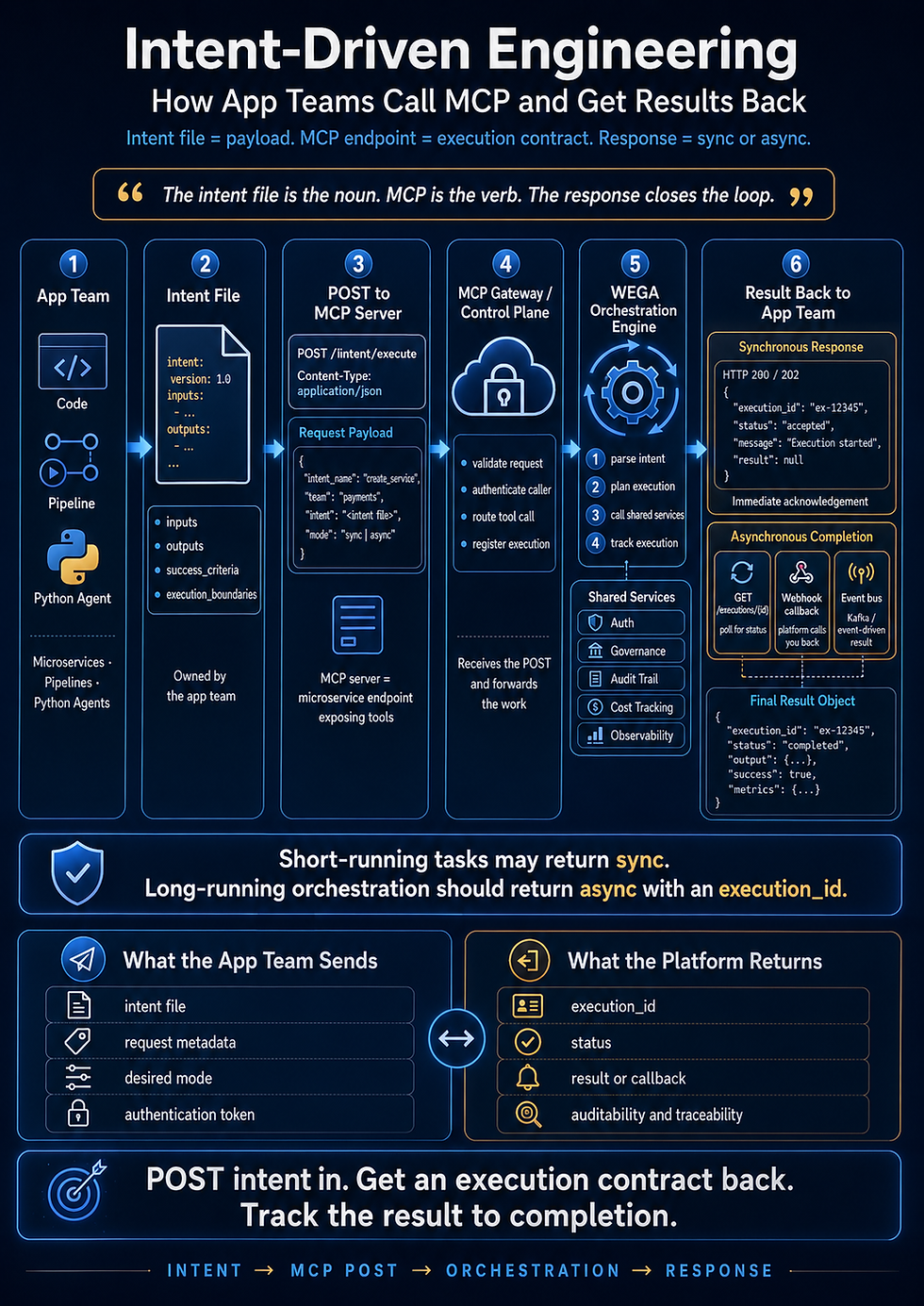
Engineer B: Intent-Driven Engineering
Engineer B walks in and does something very different.
He doesn’t start with:
skills
agents
sub-agents
MCP
Python functions
He starts with this:
The Intent
“Produce a reliable explanation of this topic
using current sources,
validate against multiple references,
avoid unsupported claims,
and only perform external research when confidence is low.”
That’s it.
What Happens Next
The system decides:
Start with prompt
Evaluate confidence
If low → trigger retrieval
If needed → call external tools (MCP)
If needed → spawn research execution
Validate output
Return result
Engineer B never wrote:
a sub-agent
a callback
an if/else chain
a Python research handler
a tool routing layer
The Key Difference
Engineer A:
Designs the execution
Engineer B:
Declares the outcome
The Hard Truth
“Just write skills” sounds simpler than agents.
But the moment you add:
conditions
fallbacks
external calls
validation
context routing
You are back to:
Manually engineering the workflow
The Shift That Actually Matters
This is the real disruption:
Not agents vs skills
Not prompts vs tools
But:
Who owns the complexity?
Your Lane (Own This)
Here’s the line:
Skills reduce agent complexity.
Intent reduces engineering complexity.
And Yes… Let’s Talk About Multipliers 😏
Engineer A is proud.
He says:
“We improved output by 50%.”
Respect.
Engineer B?
He’s not saying percentages.
He’s watching what happens:
Same engineer
Same problem
Same time window
But now:
3x more output
with higher consistency
Not because he worked harder.
Not because he built a better workflow.
But because:
He stopped designing the system
and started defining the outcome.
The Final Shot
“If I have to manually design the sub-agent tree,
callback behavior, MCP routing, and fallback logic…
I’m not doing AI-native engineering.
I’m just writing distributed workflow code with prettier names.”
Key Takeaway
It’s not about skills vs agents.
It’s about whether the engineer is still responsible for building the system.
Because if they are…
Nothing fundamentally changed.
Comments