

The Agentic Harness Is the Engine. Intent Is the Steering System.
- Mark Kendall
- 12 minutes ago
- 8 min read

The Agentic Harness Is the Engine. Intent Is the Steering System.
Enterprise technology is entering a new phase.
The first wave of generative AI focused on individual productivity. People used copilots to write code, summarize documents, generate tests, draft requirements, and accelerate routine work.
The second wave focused on agents.
Organizations began connecting models to tools, APIs, repositories, databases, ticketing systems, cloud platforms, and enterprise workflows. Agents could now do more than answer questions. They could take action.
That was an important step.
But deploying more agents will not create a lasting enterprise advantage.
The next advantage will come from building governed agentic harnesses that can convert business intent into validated, repeatable delivery.
The agentic harness is the engine.
Intent is the steering system.
Without the engine, nothing moves.
Without the steering system, movement is not the same as progress.
The Enterprise Does Not Need More Uncontrolled Motion
Agents are becoming easier to build.
A team can create a coding agent, testing agent, security agent, deployment agent, documentation agent, or planning agent in a relatively short period of time.
That accessibility creates an illusion of maturity.
An organization may have dozens of agents operating across engineering, operations, security, finance, customer service, and product delivery. But the existence of those agents does not mean the organization has created an effective agentic operating model.
More agents may simply create more motion.
They can generate more code, more plans, more tickets, more documents, more recommendations, and more automated actions.
But unless those actions are coordinated, governed, validated, and connected to a clearly defined outcome, the enterprise has not created intelligence at scale.
It has created activity at scale.
The central question is not:
How many agents have we deployed?
The better question is:
Can our agentic system consistently understand what the business is trying to accomplish, execute within enterprise constraints, validate the result, and produce an auditable outcome?
That is the purpose of the agentic harness.
What Is an Agentic Harness?
An agentic harness is the governed execution environment around one or more AI agents.
It determines how intent enters the system, how work is decomposed, how agents are selected, what tools they can use, what context they receive, what controls they must follow, how outputs are tested, and when humans must intervene.
It is not merely an agent framework.
It is not just an orchestration library.
It is not a collection of prompts connected to a workflow.
A true enterprise agentic harness includes the structures required to make agentic execution dependable.
That typically includes:
Intent capture
Context assembly
Planning and task decomposition
Agent and model routing
Tool permissions
Workflow sequencing
Policy enforcement
Security and compliance controls
Validation and testing
Observability
Cost management
Human approval points
Auditability
Failure handling
Learning and feedback loops
The harness turns individual agent capability into an enterprise delivery system.
The models may change.
The agents may change.
The tools may change.
The harness becomes the durable operating layer.
The Engine Is Becoming Powerful
Modern agentic systems can already perform increasingly complex work.
They can inspect repositories, read requirements, query enterprise systems, create implementation plans, generate code, execute tests, diagnose failures, prepare pull requests, provision infrastructure, update documentation, and coordinate work across multiple specialized agents.
This is the engine.
It provides the reasoning, automation, sequencing, tool use, and execution capacity necessary to move work through the enterprise.
But powerful engines create powerful risks.
An agent may produce a technically correct result that solves the wrong problem.
It may optimize for speed while violating architecture standards.
It may satisfy a prompt while ignoring a regulatory requirement.
It may generate functioning software that does not support the intended business outcome.
It may complete every assigned task while still failing the enterprise.
That is why agentic capability alone is not enough.
The system must know where it is going.
Intent Is More Than a Requirement
Traditional requirements often describe what a system should do.
A specification may define interfaces, behaviors, data structures, acceptance criteria, and expected outputs.
These are essential.
But intent goes further.
Intent describes why the work matters, what outcome is expected, what constraints must be respected, who is affected, what tradeoffs are acceptable, and how success will be measured.
A strong intent definition may include:
The business objective
The user or operational outcome
The reason the change is necessary
Scope boundaries
Non-negotiable constraints
Regulatory and security expectations
Architecture principles
Performance requirements
Cost limitations
Validation criteria
Evidence required for approval
Intent provides direction.
It gives the agentic harness a basis for making decisions when the path is not fully prescribed.
This distinction is critical.
A requirement can tell an agent what to build.
Intent helps the system determine whether what it built was worth building.
From Business Intent to Executable Delivery
The real enterprise opportunity is not simply automating tasks.
It is creating a governed chain from business intent to validated delivery.
That chain might look like this:
Business Intent → Structured Context → Plan → Execution → Validation → Evidence → Human Approval → Deployment → Observation
Each stage matters.
The original intent is captured in a form that both humans and agents can understand.
Relevant enterprise context is assembled from approved sources such as architecture repositories, policy libraries, product documentation, APIs, ticketing platforms, design systems, operational data, and source code.
The harness decomposes the intent into an executable plan.
Specialized agents perform the work using controlled tools and defined permissions.
Validation agents confirm that the result meets technical, business, security, operational, and compliance expectations.
The system produces evidence showing what was changed, why it was changed, how it was tested, and whether the original intent was satisfied.
Human reviewers intervene where judgment, accountability, risk acceptance, or regulatory approval is required.
Only then does the result move forward.
This is not unrestricted autonomy.
It is governed agency.
Agents Should Not Govern Themselves
One of the most dangerous assumptions in enterprise AI is that an intelligent agent can be trusted to determine its own boundaries.
It cannot.
An agent should not independently decide:
What systems it may access
What data it may expose
Which policies can be ignored
Whether a failed test is acceptable
Whether a security warning is material
Whether a production release should continue
Whether additional spending is justified
Whether its own output is correct
Those decisions must be governed by the harness.
The harness defines the operating envelope.
It establishes where the agent can act freely, where deterministic controls apply, where validation is mandatory, and where human approval is required.
The most effective enterprise systems will not be fully deterministic or fully autonomous.
They will combine both.
Agents will reason where judgment and adaptability are valuable.
Deterministic workflows will control repeatable, high-risk, and policy-sensitive activities.
The harness will decide how the two interact.
Validation Is the Difference Between Demonstration and Delivery
An agent completing a task is not the same as an enterprise accepting the result.
For enterprise delivery, every meaningful output must be validated.
In software engineering, that may include:
Unit and integration testing
Security scanning
Architecture conformance
Code quality checks
Performance testing
Accessibility validation
Data protection checks
Infrastructure policy validation
Deployment readiness
Business acceptance criteria
In other business domains, validation may include financial controls, legal review, policy compliance, customer impact analysis, data quality checks, or management approval.
The harness should not merely ask whether the agent completed its assignment.
It should determine whether the resulting outcome satisfies the original intent.
That requires a closed loop.
The system must continuously compare execution against intent.
When the result falls short, it should refine the plan, correct the work, escalate the issue, or stop execution.
This is where repeatability begins.
The Harness Creates Repeatable Enterprise Performance
A single successful agentic workflow proves very little.
Enterprise value comes from reproducing success across teams, products, repositories, business units, and operating environments.
That requires standardization.
A governed harness can provide reusable patterns for:
Intent definition
Agent roles
Context retrieval
Planning
Tool access
Security controls
Testing
Approvals
Deployment
Monitoring
Cost attribution
Audit evidence
Teams can still innovate.
Agents can still adapt.
Models can still reason.
But they operate inside a shared enterprise system.
That is how organizations move from isolated experiments to institutional capability.
The enterprise does not need every team inventing its own agent architecture, prompt conventions, security model, validation strategy, and approval workflow.
It needs a shared operating model that can be extended without being abandoned.
Intent Must Remain Visible Throughout the Lifecycle
In many delivery systems, the original business purpose disappears once work enters execution.
The business objective becomes a ticket.
The ticket becomes a task.
The task becomes code.
The code becomes a build.
The build becomes a deployment.
By the time the result reaches production, the system may have preserved every technical artifact while losing the original reason the work existed.
Intent-driven delivery prevents that loss.
The intent should remain connected to every stage of the lifecycle.
The plan should reference it.
The agents should receive it.
The tests should validate it.
The pull request should explain it.
The approval should confirm it.
The deployment evidence should trace back to it.
The monitoring strategy should measure it.
This creates continuity from executive objective to operational result.
It also creates accountability.
An enterprise should be able to ask:
What business intent initiated this change?
What context did the agents use?
What decisions were made?
What controls were applied?
What evidence supports the result?
Who approved the outcome?
Did the deployed capability achieve its intended purpose?
A governed harness makes those questions answerable.
The Agentic Harness Becomes the New Delivery Platform
For years, enterprises have built platforms around infrastructure, integration, data, DevOps, cloud, security, and developer experience.
The next platform layer will be the agentic harness.
It will sit across existing systems rather than replacing them.
It will connect business goals to the tools and platforms that already run the enterprise.
It may integrate with:
Product management systems
Jira and Confluence
Source-code repositories
Design tools
CI/CD platforms
Cloud infrastructure
Security scanners
Observability systems
Data platforms
Enterprise APIs
Knowledge repositories
Governance and compliance systems
The harness becomes the coordination layer through which intent is interpreted and executed.
This is larger than developer productivity.
It is an enterprise execution architecture.
The Competitive Advantage Will Be Operational
Foundation models will continue to improve.
Access to capable agents will become widespread.
Tool use will become standard.
Multi-agent orchestration will become easier.
Those capabilities alone will not remain differentiators for long.
The competitive advantage will come from how well an organization operationalizes them.
The strongest enterprises will know how to:
Capture intent clearly
Supply trusted context
Route work intelligently
Control agent authority
Combine deterministic and agentic execution
Validate outcomes automatically
Escalate risk appropriately
Measure cost and performance
Preserve evidence
Improve the system continuously
That capability will not be purchased as a single product.
It will be designed into the enterprise operating model.
Intent-Driven Engineering Provides the Direction
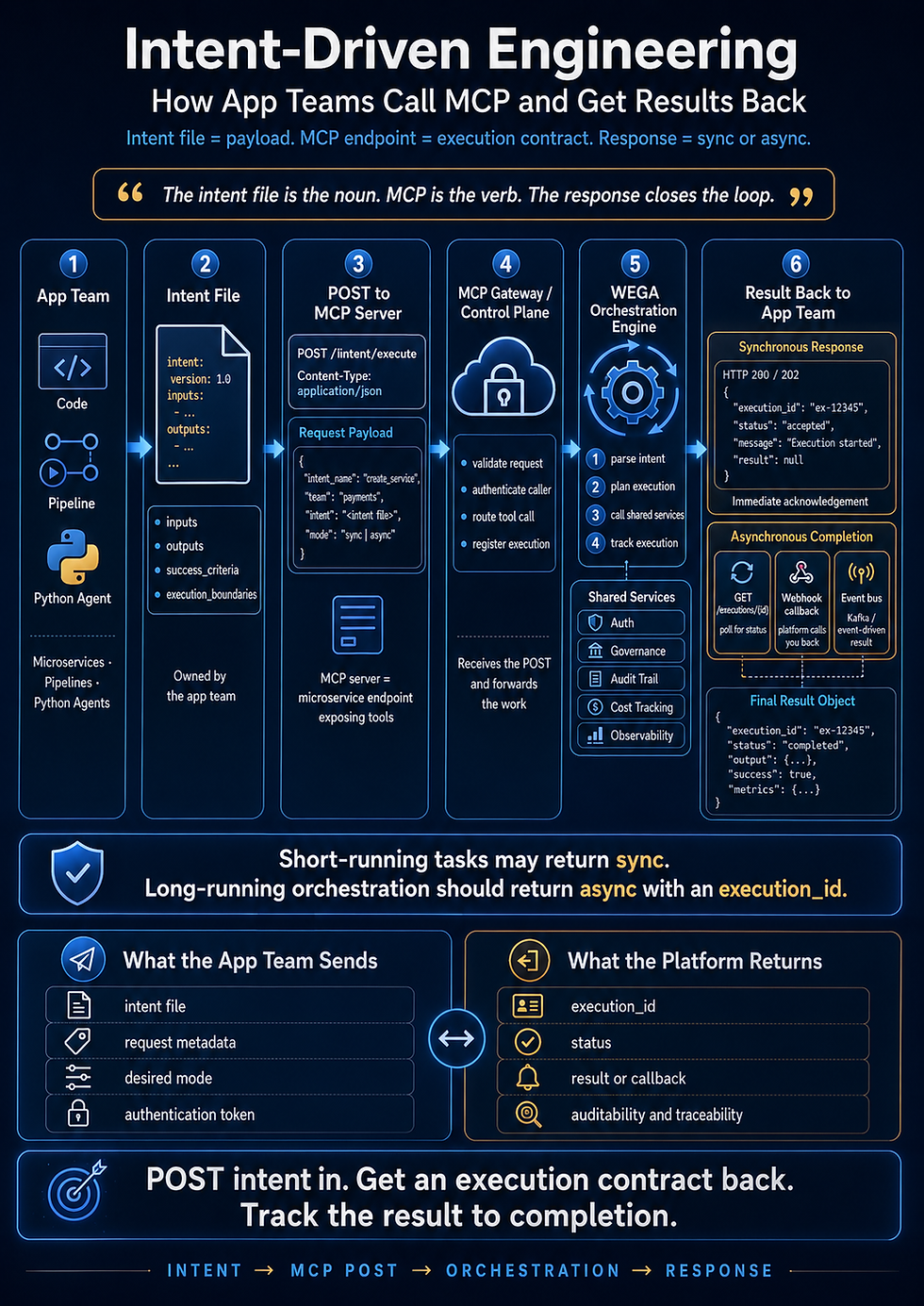
In software delivery, Intent-Driven Engineering provides the structure required to connect human objectives to agentic execution.
It creates a disciplined path from intent to context, planning, implementation, validation, and production delivery.
The intent file becomes more than documentation.
It becomes an executable contract between the business, the engineering organization, the agentic harness, and the final delivered system.
It does not eliminate architecture, agile practices, DevOps, security, testing, or human oversight.
It connects them.
Intent-Driven Engineering gives the agentic harness a destination, a set of boundaries, and a definition of success.
The harness then provides the controlled execution environment needed to reach that destination.
The Future Is Not Agent-Driven
The future will certainly contain agents.
There will be planning agents, implementation agents, testing agents, security agents, deployment agents, operational agents, and agents that coordinate other agents.
But the enterprise should not become agent-driven.
It should remain intent-driven.
Agents are mechanisms.
Intent is direction.
Governance is control.
Validation is trust.
The agentic harness brings those elements together.
The organizations that understand this distinction will move beyond demonstrations, pilots, and isolated productivity gains.
They will build systems capable of turning enterprise intent into repeatable execution.
That is the next competitive advantage.
Not more agents.
Not larger models.
Not more automation for its own sake.
The advantage will come from a governed agentic harness that knows what the enterprise is trying to accomplish, understands the boundaries within which it must operate, validates every meaningful outcome, and produces evidence that the result is ready to trust.
The agentic harness is the engine.
Intent is the steering system.
Comments