
The Intent-Driven Engineering Manifesto: Why It Is Time to Move Beyond Prompts
- Mark Kendall
- 5 days ago
- 8 min read

The Intent-Driven Engineering Manifesto: Why It Is Time to Move Beyond Prompts
Intro
Every major shift in software starts the same way.
At first, it looks like a tool change.
Then it becomes a workflow change.
Then it becomes a cultural change.
Agile did not win because it had the perfect process. Agile won because it gave software teams language for something they were already feeling: heavyweight process, unused documentation, and corporate theater were getting in the way of delivering real software.
Today, we are in a similar moment.
Only this time, the problem is not too much process.
The problem is too much unstructured AI activity.
Everyone has access to powerful AI tools. Everyone can prompt. Everyone can generate code, documents, diagrams, tests, and ideas.
But access is no longer the advantage.
Execution is.
That is why I believe the next serious movement in software delivery is not prompt engineering.
It is Intent-Driven Engineering.
And this is the manifesto.
What Is Intent-Driven Engineering?
Intent-Driven Engineering is the practice of turning human goals into structured, governed, executable intent that can be validated, measured, reused, and delivered safely.
A prompt is a conversation.
An intent is a contract.
A prompt asks the model to help.
An intent defines what must be true when the work is complete.
That difference matters.
In the early days of AI-assisted development, it was enough to ask a tool to generate code. That was impressive. It still is.
But production software does not run on impressive answers.
Production software needs boundaries.
It needs standards.
It needs tests.
It needs ownership.
It needs architecture.
It needs governance.
It needs evidence.
That is where Intent-Driven Engineering begins.
Why a Manifesto?
The word “manifesto” can sound old-fashioned.
It can even sound dramatic.
But in software, a manifesto has a specific purpose. It is not supposed to be a marketing slogan. It is supposed to draw a line.
A manifesto says:
This is what we value.
This is what we reject.
This is what we are trying to restore.
The Agile Manifesto worked because it was not just about process. It was about people, trust, collaboration, and delivering working software instead of hiding behind heavyweight corporate machinery.
Intent-Driven Engineering needs the same kind of line.
Because right now, too many teams are confusing AI activity with engineering progress.
They are generating code without clear success criteria.
They are creating agents without boundaries.
They are running prompts without reusable patterns.
They are building demos that cannot survive production.
They are moving fast, but not always moving forward.
The manifesto matters because AI-assisted delivery needs a new center of gravity.
That center is intent.
The Intent-Driven Engineering Manifesto
We are uncovering better ways of building AI-assisted software systems by doing the work, teaching the work, and helping others master the work.
Through this work, we have come to value:
Executable intent over conversational prompting
Validated outcomes over impressive responses
Engineering boundaries over uncontrolled generation
Reusable systems over one-off AI experiments
That does not mean prompts have no value.
They do.
Prompts are useful for exploration, learning, brainstorming, and discovery.
But prompts alone are not enough for serious software delivery.
The future belongs to teams that can move from prompt to intent, from intent to execution, and from execution to validated production outcomes.
The Core Belief
The prompt may start the conversation.
But intent must govern the system.
That is the heart of Intent-Driven Engineering.
A prompt can create a draft.
An intent can define a delivery contract.
A prompt can ask for code.
An intent can define the architecture, inputs, outputs, success criteria, execution boundaries, failure behavior, and validation gates.
A prompt can produce something useful once.
An intent can produce something repeatable across a team.
That is the difference between experimenting with AI and engineering with AI.
Principle 1: Intent Is Not Documentation. Intent Is the System.
Traditional documentation often sits beside the work.
Intent must sit inside the work.
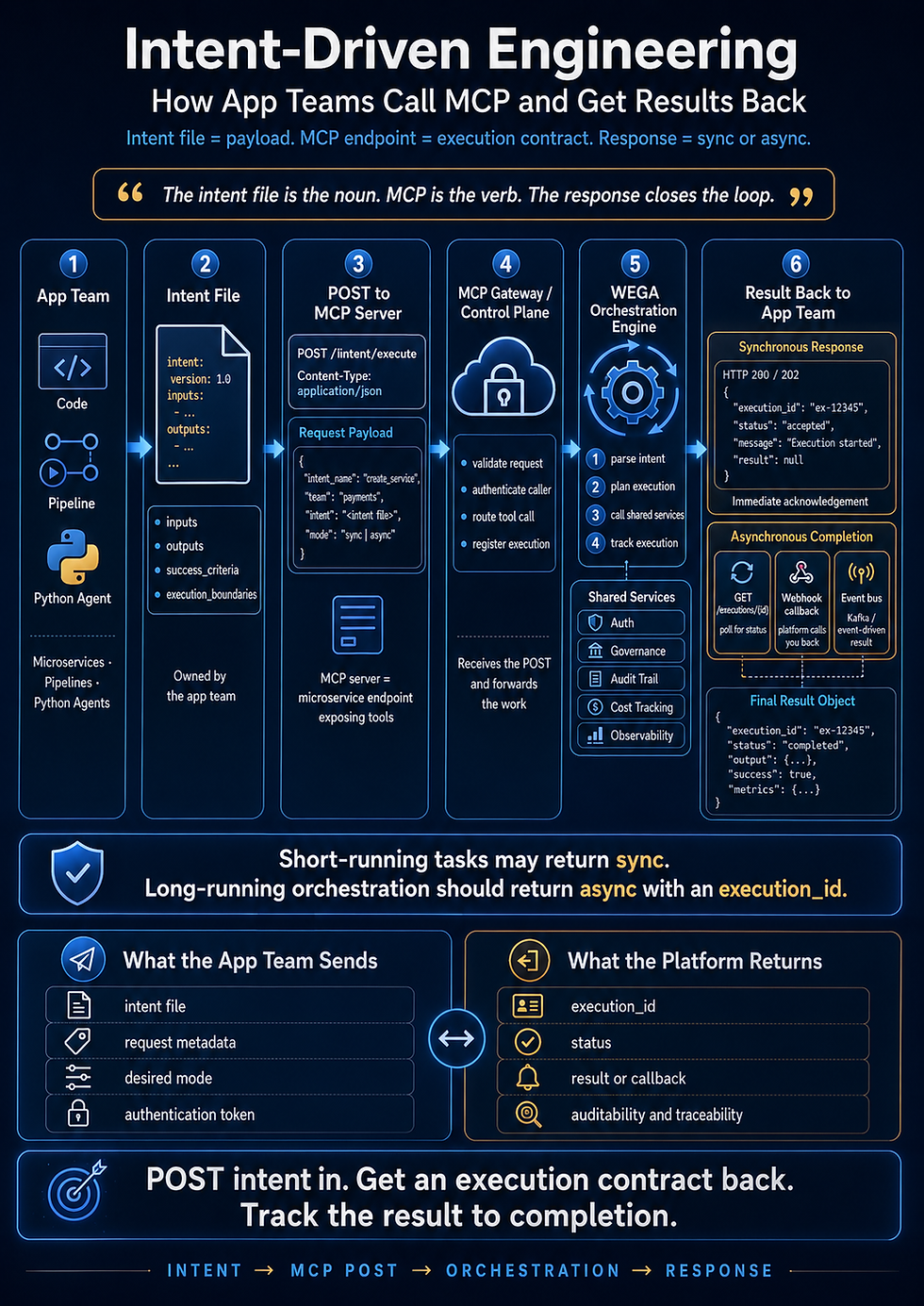
In Intent-Driven Engineering, the intent file becomes the system’s instruction layer. It defines what the system is supposed to do before an AI model, coding agent, developer, pipeline, or executor begins work.
A strong intent should define:
InputsOutputsSuccess criteriaExecution boundariesFailure behaviorValidation rulesOwnershipGovernance expectations
This is not documentation for documentation’s sake.
This is documentation that drives execution.
The intent file is not a note.
It is the contract.
Principle 2: Prompts Are Not Enough
Prompting is a real skill.
But it is not the same thing as engineering.
A great prompt can produce a useful answer.
A great intent can produce a repeatable delivery pattern.
That is the shift.
Prompt engineering helped people learn how to communicate with models.
Intent-Driven Engineering helps teams build systems around that communication.
It asks better questions:
What is the expected output?
How will we validate it?
What should the AI not touch?
What standards must be followed?
What happens when the result is incomplete?
What evidence must be produced?
Who owns the final decision?
Without those answers, a team is not engineering.
It is experimenting.
Principle 3: AI Must Operate Inside Boundaries
Unbounded AI is not innovation.
It is risk.
The more powerful AI becomes, the more important boundaries become.
Intent-Driven Engineering does not slow AI down. It makes AI safe enough to use at speed.
Boundaries define:
What the AI can changeWhat it cannot changeWhat standards it must followWhat data it can useWhat tools it can callWhat must be reviewedWhat must be testedWhat must be escalated
The goal is not to control AI because we distrust it.
The goal is to design systems where trust can be earned.
Principle 4: The Output Must Be Testable
If the result cannot be validated, it cannot be trusted.
That is one of the simplest rules of Intent-Driven Engineering.
AI-generated output should not be accepted because it looks good.
It should be accepted because it meets defined success criteria.
That means the success criteria must exist before execution begins.
Not after.
Not when production breaks.
Not when someone asks, “Did this actually work?”
Before.
Every intent should answer one question clearly:
How do we know this worked?
If a team cannot answer that, the intent is not ready.
Principle 5: Reuse Beats Heroics
One brilliant person with one brilliant prompt is not a scalable system.
A shared intent library is.
This is where Intent-Driven Engineering becomes powerful for organizations.
The real value is not one prompt, one demo, or one generated microservice.
The value is repeatable patterns.
A team should be able to reuse:
Shared input typesShared output schemasShared validation rulesShared success criteriaShared failure behaviorsShared execution patternsShared governance rules
That is how individual learning becomes organizational capability.
That is how AI stops being a personal productivity trick and becomes an engineering operating model.
Principle 6: AI Should Amplify Engineering Judgment, Not Replace It
Intent-Driven Engineering is not anti-developer.
It is pro-engineering.
The developer does not disappear.
The architect does not disappear.
The senior engineer does not disappear.
Their role moves up the stack.
Instead of hand-coding every artifact from scratch, they define the system of execution:
The architectureThe standardsThe constraintsThe reusable templatesThe validation gatesThe deployment modelThe operational evidenceThe governance framework
That is not less engineering.
That is higher-order engineering.
Principle 7: Context Is Part of the Intent
Real software does not live in a vacuum.
It lives inside companies.
It lives inside budgets, platforms, legacy systems, security rules, compliance needs, cloud standards, team maturity, and operational realities.
That means generic AI output is not enough.
Intent must encode the environment.
A good intent does not simply say:
“Build a Java microservice.”
It says:
Build it using this architecture.Follow these naming conventions.Expose this Swagger contract.Use these validation rules.Respect these security boundaries.Produce these tests.Run with these commands.Emit this evidence.Stay inside this organization’s reality.
That is what separates AI-generated code from enterprise-ready delivery.
Principle 8: Governance Must Move Left
AI governance cannot be a PDF written after the system ships.
It must be part of the execution model.
In Intent-Driven Engineering, governance moves left into the intent itself.
Before execution begins, the intent should define:
What is allowedWhat is not allowedWhat must be reviewedWhat must be testedWhat must be loggedWhat must be escalatedWhat must be proven
Governance should not be theater.
Governance should be executable.
Principle 9: Evidence Matters
AI systems need an audit trail.
Not because teams need more bureaucracy.
Because trust requires evidence.
Every serious AI-assisted delivery process should be able to show:
What intent was executedWhat inputs were usedWhat outputs were producedWhat checks passedWhat checks failedWhat was retriedWhat changedWho approved itWhat evidence was created
Without evidence, there is no trust.
Without trust, there is no scale.
Principle 10: The Future Engineer Is an Intent Architect
The future engineer is not just a coder.
The future engineer is not just a prompt writer.
The future engineer is an intent architect.
That person can define outcomes clearly enough for humans, AI systems, agents, pipelines, and validators to execute against them.
That person understands how to move from ambiguity to structure.
From structure to execution.
From execution to evidence.
From evidence to trust.
This is the new engineering skill.
Not replacing judgment.
Scaling judgment.
Why This Matters Now
AI has created a dangerous illusion.
Because something can be generated quickly, people assume it can be delivered quickly.
But delivery is not generation.
Delivery requires integration.
Delivery requires testing.
Delivery requires maintainability.
Delivery requires security.
Delivery requires production readiness.
Delivery requires accountability.
That is why the next phase of AI-assisted software development will not be won by the people who prompt the fastest.
It will be won by the people who define intent the clearest.
The LearnTeachMaster Position
LearnTeachMaster.org is an open, practical knowledge platform focused on helping engineers, architects, consultants, and teams move from AI experimentation to AI-assisted delivery.
My position is simple:
Learn the pattern.Teach the pattern.Master the pattern.
I do not need to claim to be the founder of a category.
Categories are not owned by declaration.
They are earned by contribution.
My role is as an early pioneer working in public, building the language, patterns, examples, templates, and delivery models that help teams move beyond prompts.
That is enough.
The work will prove itself.
What We Reject
We reject AI theater.
We reject random prompting as a delivery strategy.
We reject demos that cannot survive production.
We reject agents without boundaries.
We reject code generation without validation.
We reject governance that cannot be enforced.
We reject hype that ignores architecture.
We reject the idea that AI removes the need for engineering discipline.
What We Believe
We believe AI should make engineers stronger.
We believe architecture still matters.
We believe delivery still matters.
We believe validation still matters.
We believe context still matters.
We believe human judgment still matters.
We believe teams need more than prompts.
They need intent.
Key Takeaways
Intent-Driven Engineering is the shift from asking AI for outputs to governing AI-assisted delivery through structured intent.
Prompts are useful, but they are not enough for serious software engineering.
An intent file defines the inputs, outputs, success criteria, boundaries, validation rules, and evidence required for execution.
The future engineer will not simply write code or prompts. The future engineer will define clear, executable intent.
The organizations that win with AI will be the ones that turn individual prompting into reusable, governed, measurable engineering systems.
Closing Thought
The tools will change.
The models will change.
The vendors will change.
The hype will change.
But the need for clear intent, strong boundaries, measurable outcomes, and responsible execution will not change.
That is why Intent-Driven Engineering matters.
It is not a rejection of prompts.
It is the next step after prompts.
The prompt starts the conversation.
Intent governs the system.
Time to move beyond prompts.
Comments