

The Intent-Driven Playbook A practical starting point for teams that want to move from prompting AI to engineering with intent
- Mark Kendall
- 17 hours ago
- 7 min read

The Intent-Driven Playbook
A practical starting point for teams that want to move from prompting AI to engineering with intent
Most teams do not need another AI framework.
They need a way to start.
They need a structure that is simple enough to use immediately, but strong enough to scale into real engineering. They need to know what belongs in the request, what context the AI should receive, when to use agents, when to use automation, how to validate the work, and how to get all the way to production without losing the original business goal.
That is what this playbook is for.
The Intent-Driven Playbook is a practical entry point into Intent-Driven Engineering. It is not tied to Claude, Copilot, Cursor, Gemini, or any other individual AI platform. Those systems are execution environments. The playbook sits above them.
The basic idea is simple:
Start with intent. Preserve that intent as context moves through the engineering system. Add only the structure necessary to produce a reliable outcome.
The twelve elements below are the foundation.
1. Intent First
Everything begins with a clear statement of what you are trying to accomplish.
Before deciding which model to use, which agent to create, or which workflow to automate, define the intent.
At minimum, answer four questions:
Business goal
What outcome matters to the business?
User need
Who needs something different, better, faster, safer, or easier?
Scope boundary
What are we solving, and equally important, what are we not solving?
Value target
What improvement are we actually trying to create?
A useful intent should be understandable without knowing anything about the implementation.
That matters because the implementation can change.
The intent should not.
A team might change models, tools, frameworks, databases, or cloud platforms during a project. The intent remains the anchor that keeps those decisions pointed toward the same outcome.
2. The Four Pillars
A usable intent needs more than a paragraph describing what someone wants.
For most engineering work, four things should be explicit:
Intent
What are we trying to accomplish?
Inputs
What information, systems, files, APIs, requirements, and constraints are available?
Outputs
What should the system actually produce?
Success criteria
How will we know that the result is acceptable?
These four pillars create a lightweight contract between the human and the AI system.
They remove a large amount of ambiguity before any implementation begins.
They also create a simple test:
If the AI cannot tell you the intent, the inputs, the expected outputs, and how success will be measured, the system probably does not yet have enough context to work reliably.
3. Context Layers
Context is not one large bucket of information.
It has layers.
A useful model is:
Business context
Why the work exists and what outcome matters.
Product context
How the capability fits into the larger product or customer experience.
Repository context
Architecture, conventions, dependencies, code structure, tests, and engineering constraints.
Task context
The specific thing being changed right now.
This layering is important because not every model, agent, or task needs everything.
The goal is not maximum context.
The goal is minimum sufficient context.
Give each part of the system what it needs to make the right decision without flooding it with unrelated information.
That keeps the original intent clearer and reduces unnecessary reasoning, cost, and confusion.
4. Feature.md
At some point, intent has to become something an engineering system can work with.
That is where a bounded intent artifact such as Feature.md becomes useful.
The name is not important. The structure is.
A strong feature or intent file should contain:
Bounded request
The capability being requested.
Constraints
Technical, business, security, architectural, or operational limits.
Acceptance checks
Observable conditions that must be true when the work is complete.
Evidence notes
What information should be captured to demonstrate that the result works.
This becomes the working contract for the change.
Instead of telling an AI system, “Build this feature,” the team gives it a structured engineering problem.
The more clearly this boundary is defined, the less unnecessary reasoning has to occur later.
Structure the boundary, not the reasoning.
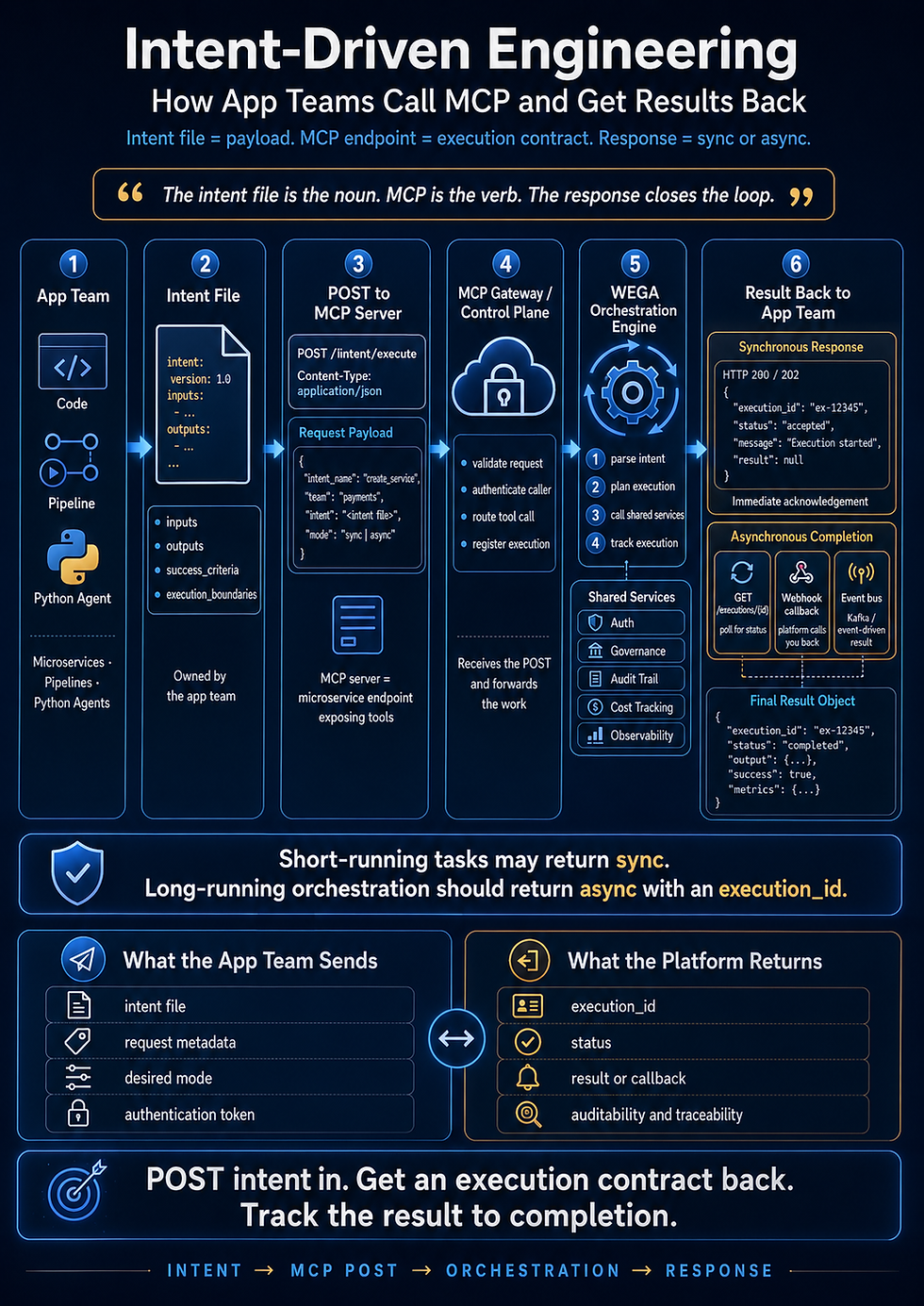
5. Shared Services + MCP
Engineering does not happen inside a prompt.
Real work depends on real systems.
Requirements may live in Jira. Architecture may be documented in Confluence. Designs may be in Figma. Application behavior may depend on APIs, databases, cloud services, observability systems, and internal platforms.
Modern AI engineering therefore needs a controlled way to access those systems.
That may involve MCP servers, connectors, APIs, enterprise plugins, or other shared-service mechanisms.
The architectural principle is more important than the specific technology:
Do not copy the enterprise into the prompt. Connect the AI safely to the enterprise.
Shared services create reusable access to trusted information and capabilities.
Instead of every team inventing a custom integration, organizations can provide governed building blocks for things like:
Jira
Confluence
Figma
source control
databases
cloud services
testing platforms
observability systems
internal APIs
This is where AI starts becoming part of the engineering platform rather than simply another desktop tool.
6. Plan → Refine → Delta
Large implementations should rarely be executed in one shot.
A better pattern is iterative.
Plan
Create the first implementation approach.
Refine
Review assumptions, constraints, architecture, and missing context.
Delta
Make the smallest useful change.
Then repeat.
This pattern reduces risk because each iteration remains understandable.
Instead of asking the AI system to redesign an application, implement multiple features, update infrastructure, change the database, and produce a pull request simultaneously, break the work into bounded deltas.
Each delta should leave the system in a valid state.
Small changes are easier to review.
Easier to test.
Easier to reverse.
And easier for humans to understand.
AI increases engineering velocity. Smaller deltas help ensure that velocity does not become uncontrolled acceleration.
7. Skills + Hooks + Agents
Once the work becomes repeatable, teams can start turning engineering knowledge into reusable capabilities.
Three mechanisms are especially useful.
Skills
Skills package reusable expertise or procedures.
Examples might include:
creating API tests
performing repository analysis
reviewing architecture
generating documentation
preparing deployment evidence
Hooks
Hooks enforce rules at important points in the workflow.
They are useful for things that should not depend on someone remembering to ask.
Examples include:
validating an intent file
running security checks
checking required metadata
ensuring tests execute
confirming output structure
Agents
Agents are useful when work benefits from specialization, isolation, or parallelism.
Examples might include:
architecture analysis
test generation
security review
documentation
dependency analysis
The important point is not to create agents everywhere.
Use the least amount of orchestration necessary.
If one model can safely perform the task, let one model perform the task.
Add agents when they create measurable value.
8. Structured Handoffs
Every boundary between steps creates an opportunity for information to degrade.
One agent summarizes something for another.
A workflow passes a result into a tool.
A planning step hands work to implementation.
Implementation hands work to testing.
Testing hands evidence to deployment.
Those handoffs should not depend on loose conversational summaries.
They should have structure.
A strong handoff defines:
Clear contracts
What information must be provided?
Schema in/out
What format should the receiving step expect?
Metadata
Where did the information come from?
Traceable steps
What decisions were made and what evidence supports them?
This becomes increasingly important as systems become more agentic.
The more autonomous the workflow becomes, the more important the boundaries become.
You do not need to control every internal reasoning step.
You do need to control what crosses the boundary.
9. Automation
Once a process works reliably, automate the repeatable parts.
Automation can include:
Workflow triggers
An event starts a process automatically.
Validation steps
Tests, checks, policy validation, and readiness checks run without someone asking for them.
PR support
AI can help prepare, review, summarize, or validate pull requests.
Scheduled tasks
Recurring engineering or operational work can run automatically.
The goal is not automation for automation’s sake.
The goal is to remove repetitive work while preserving the engineering controls that made the manual process successful.
A useful rule is:
First make it work. Then make it repeatable. Then automate it.
10. Repo-Aware Build
The repository is one of the most important sources of truth in AI-native engineering.
The AI should understand the environment it is changing.
That includes:
project structure
architecture
coding conventions
dependencies
existing tests
configuration
deployment patterns
neighboring components
Repo-aware AI can do far more than generate code.
It can:
Explain code
Understand how an existing capability works before changing it.
Refactor safely
Change implementation while preserving behavior.
Work with files
Modify the actual artifacts that make up the system.
Implement changes
Apply the intent directly within the engineering environment.
This is one of the major differences between conversational AI and AI-native software engineering.
The model is no longer answering questions about the code.
It is participating in the repository.
11. Validation + Observability
Generated code is not the outcome.
Working software is the outcome.
Every Intent-Driven workflow should include mechanisms for proving that the change works.
That means validation must be part of the architecture rather than something added at the end.
Useful controls include:
Tests
Unit, integration, contract, regression, and end-to-end tests where appropriate.
Readiness checks
Can the system actually proceed safely to the next stage?
Logs and evidence
Capture what happened and what proves that it succeeded.
Stop conditions
Define when the system should stop rather than continuing to reason, retry, or modify the environment indefinitely.
Observability is especially important in AI-enabled workflows because engineers need to understand not just that an operation occurred, but whether it produced the intended outcome.
The goal is evidence.
Not confidence.
12. Production + ROI
Intent-Driven Engineering does not end when a pull request is merged.
The final question is whether the original intent produced value.
That means closing the loop from engineering back to the business.
The final stage should include:
Deploy with governance
Move the capability into production using the appropriate controls.
Measure velocity
Did intent move to working software faster?
Measure impact
Did the software improve the customer, business, or operational outcome?
Measure ROI
Did the value created exceed the investment required to produce it?
This creates a simple progression:
Intent → Velocity → Impact → ROI
That is how AI engineering becomes more than a productivity experiment.
It becomes a business capability.
Where to Start
Do not try to implement all twelve pieces on day one.
Start with the first four.
Define the intent.
Define the inputs.
Define the outputs.
Define success.
Put that into a bounded intent artifact.
Then give the AI enough business, product, repository, and task context to understand the work.
Run one real feature through the process.
Plan it.
Refine it.
Implement a small delta.
Validate the result.
Capture the evidence.
Then ask what part of that workflow should become a skill, a hook, an agent, a shared service, or an automation.
That is how the system grows organically.
You do not begin by building an enormous AI architecture.
You begin by delivering one governed outcome.
Then another.
Then another.
And eventually the organization has not just adopted AI.
It has built an AI-native engineering capability.
The Playbook in One Line
Intent first. Context deliberately. Structure the boundaries. Automate what works. Validate everything. Measure the outcome.
That is a strong place for almost any engineering team to begin.
The Intent-Driven Playbook is not the end-state architecture. It is the starting architecture.
And that is exactly why I would start here.
Comments