

When AI Writes the Code, Architecture Becomes the Job

When AI Writes the Code, Architecture Becomes the Job
Morning Brief — September 18, 2026
The software industry spent decades treating code as the center of gravity.
Requirements became designs.
Designs became code.
Code was tested, deployed, maintained, and eventually replaced.
That model is beginning to invert.
AI can now produce a growing portion of the implementation. The scarce resource shifts away from typing code and toward specifying what should exist, constraining how it behaves, safely connecting it to enterprise systems, and proving that the result works.
That change has a major implication for software architects:
Architecture is no longer something that happens before development. Architecture is becoming the continuous control system for AI-driven development.
Faster Coding Does Not Automatically Mean Faster Delivery
One of the most interesting lessons coming from enterprise AI adoption is that speeding up coding does not automatically speed up delivery.
Oracle executives recently described how AI-assisted coding accelerated software creation but pushed bottlenecks into testing, validation, deployment, and release. (Business Insider)
Every architect should recognize the pattern.
Software delivery is a system.
If one stage becomes dramatically faster, the constraint moves somewhere else.
Yesterday the constraint may have been implementation.
Tomorrow it may be:
deciding what to build, reviewing generated code, validating security, testing integration behavior, handling exceptions, controlling model costs, approving autonomous actions, or tracing why an intelligent system made a particular decision.
The architect becomes a designer of flow, not merely structure.
The Static Architecture Document Is Losing Ground
Traditional architecture often worked like this:
Design the target state.
Create diagrams.
Approve standards.
Publish guidance.
Review major exceptions.
That model was already under pressure from cloud and DevOps.
Agentic AI may finish the transformation.
Gartner argues that enterprise architecture needs to become dynamic because AI and agentic systems are accelerating how quickly enterprise environments change. (Gartner)
Architecture therefore cannot remain a document describing the environment every six months.
It increasingly needs to participate in the environment every day.
Policies become executable.
Standards become reusable services.
Guardrails become automated checks.
Architectural decisions become discoverable by AI.
Success criteria become evaluations.
The future architecture repository may be as machine-readable as it is human-readable.
The New Unit of Architecture Is the Decision
For years architects thought primarily in terms of systems and components.
The next generation will increasingly think in terms of decisions.
Consider an AI customer-service agent.
The important architecture questions are not only which database and API it uses.
They include:
Can the agent issue a refund?
At what amount does human approval become mandatory?
What customer information may it access?
What confidence level is required before acting?
Which model should handle which request?
What happens when the model cannot determine the proper action?
How is each action audited?
How do we prove that a policy change has not introduced unsafe behavior?
These are decision boundaries.
Decision boundaries are becoming first-class architecture.
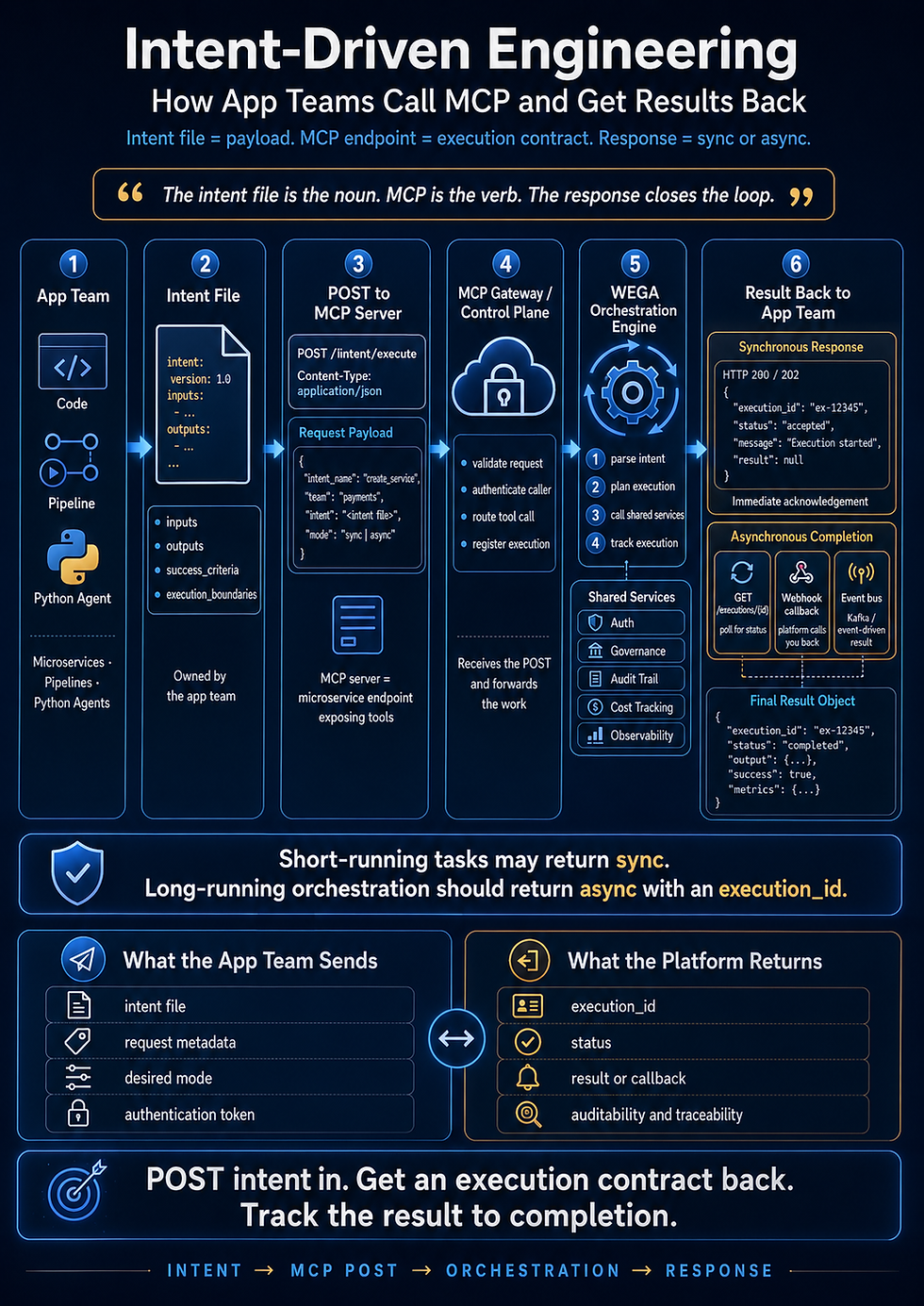
Intent Becomes a Technical Artifact
That creates another important shift.
The intent behind a system can no longer live only in meetings, PowerPoints, Jira stories, and somebody’s memory.
AI systems need access to the intent.
A coding agent needs to know the objective.
An implementation agent needs constraints.
A test agent needs success criteria.
A security agent needs policies.
A review agent needs evidence.
A deployment process needs release rules.
The logical conclusion is that intent itself becomes part of the architecture.
A strong machine-readable intent artifact can describe the outcome, inputs, expected outputs, constraints, assumptions, approved tools, success criteria, tests, guardrails, and escalation conditions.
Once intent becomes explicit, AI can execute against it.
Without explicit intent, AI simply accelerates ambiguity.
Architects Need to Design for Multiple Models
Models vary.
They differ in cost, speed, reasoning ability, coding performance, tool use, context capacity, privacy characteristics, and availability.
Gartner’s July 2026 guidance recommends model-agnostic architecture, multiple-provider strategies, and AI FinOps. (Gartner)
That sounds remarkably similar to lessons architects have learned from every other major technology transition.
Do not bury the business inside the implementation.
Create boundaries.
Create contracts.
Preserve optionality.
Measure actual usage.
Choose the right capability for the right workload.
AI does not repeal architecture fundamentals.
It makes them more important.
Architecture Must Own Verification
One of the biggest mistakes organizations can make is treating AI-generated software as ordinary boilerplate.
It is not.
AI can generate plausible designs, plausible code, plausible tests, and plausible explanations that are still incorrect.
The answer is not to prohibit AI.
The answer is to architect verification.
That means combining deterministic tests, security scanning, architecture rules, runtime telemetry, model evaluations, independent review, policy validation, and human approval where consequences justify it.
The principle is simple:
Do not try to structure every reasoning step. Structure the boundary and verify the result.
That principle may become one of the defining ideas of AI-native software engineering.
The Architect Moves Closer to the Business
If AI reduces the effort required to produce implementation, architects can spend more time where they have always been most valuable:
understanding the actual problem.
What outcome matters?
What friction should disappear?
What process is broken?
What decision should become faster?
What should never be automated?
Where does human judgment add value?
What is the financial value of success?
This pushes architecture closer to product strategy and operating-model design.
It also raises expectations.
An architect who can explain Kubernetes but cannot explain the business outcome becomes less differentiated.
An architect who can connect business intent to AI agents, enterprise systems, data, controls, costs, and measurable outcomes becomes much more valuable.
The Architecture Job Is Expanding
AI does not shrink architecture.
It expands its territory.
The architect now has to understand the traditional enterprise stack plus models, context, agents, tools, memory, evaluations, routing, AI security, token economics, human approvals, machine-readable policies, and autonomous execution.
That sounds difficult.
It is also an enormous opportunity.
Software architecture is returning to its deepest purpose.
Not producing diagrams.
Not policing standards.
Not arguing about frameworks.
Designing how complex systems make good decisions.
When AI writes more of the code, architecture does not become less relevant.
Architecture becomes the job.
Comments