
Who are you learning with? AI Paradox
- Mark Kendall
- 1 day ago
- 4 min read

Why Every Engineer Needs an AI Power Circle
The Lone Engineer Era Is Ending
For decades, engineering culture rewarded the individual hero.
The programmer who stayed up all night.
The architect who knew every system.
The senior engineer who carried the team through sheer experience.
That model worked when technology moved in predictable cycles.
It does not work anymore.
AI changed the velocity of engineering itself.
Today, frameworks evolve weekly.
Models improve monthly.
Entire workflows disappear overnight.
One engineer alone cannot absorb the explosion of tooling, orchestration patterns, governance models, agent systems, runtime behavior, infrastructure evolution, security implications, and organizational change happening simultaneously.
The future belongs to engineering groups.
Not giant departments.
Not bloated committees.
Small, focused, high-trust AI learning teams.
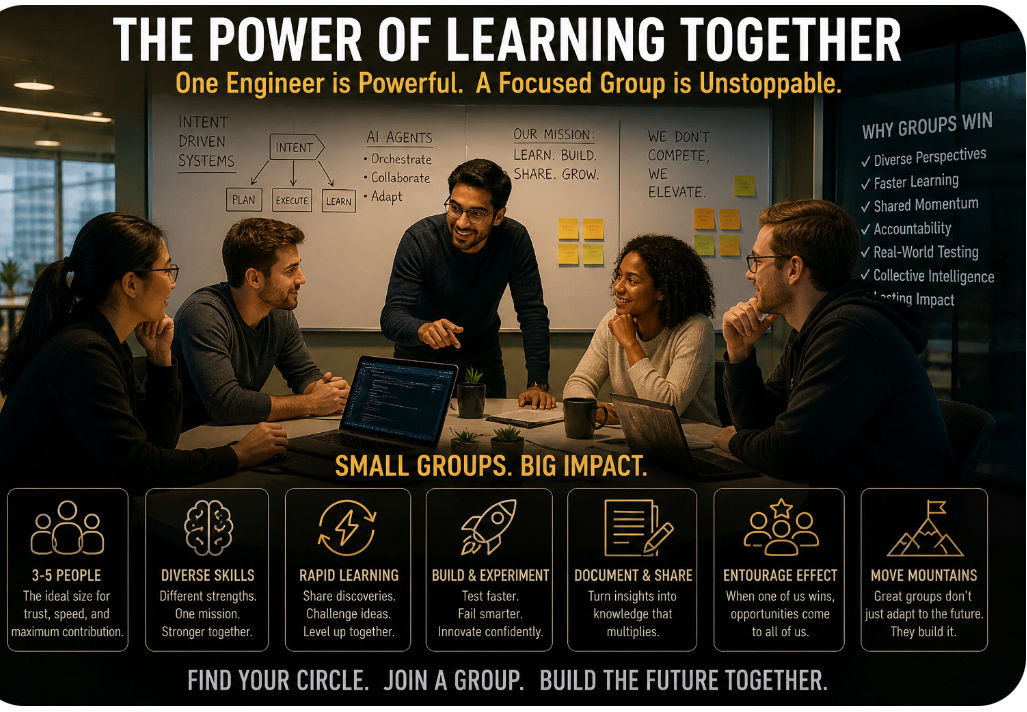
Three to five people.
That is the new power unit of modern engineering.
The Rise of the AI Power Circle
Imagine a small group of engineers who meet consistently:
They experiment together
They learn together
They challenge each other
They build together
They publish ideas together
They test emerging AI patterns together
They create demos together
They grow reputations together
This is not just a study group.
It is not a social club.
It is an acceleration engine.
A force multiplier.
A modern engineering entourage.
And the organizations that understand this first will dominate.
The “Entourage Effect” Is Real
Hollywood figured this out decades ago.
When a major actor succeeds repeatedly, production companies often hire the surrounding team too.
Why?
Because excellence is rarely isolated.
The chemistry matters.
The trust matters.
The rhythm matters.
The supporting ecosystem matters.
Sports teams know this too.
Sometimes a player performs dramatically better when surrounded by familiar teammates who understand their flow, instincts, and timing.
The same phenomenon is now emerging in AI engineering.
A great AI engineer surrounded by:
a workflow architect,
a systems thinker,
a strong implementer,
a governance-minded engineer,
and a relentless experimenter…
…becomes exponentially more effective.
Not incrementally.
Exponentially.
Because modern AI development is no longer just coding.
It is:
orchestration,
collaboration,
experimentation,
validation,
governance,
integration,
prompting,
intent modeling,
runtime engineering,
communication,
and rapid adaptation.
No single engineer masters all of it alone anymore.
Why Small Groups Win
The ideal AI engineering circle is small.
Usually 3–5 people.
Why?
Because small groups create:
trust,
accountability,
consistency,
rapid exchange of ideas,
emotional safety for experimentation,
and fast iteration.
Large groups create spectators.
Small groups create contributors.
In a five-person AI learning circle:
everyone participates,
everyone builds,
everyone teaches,
everyone experiments,
everyone contributes insight.
The learning velocity becomes extraordinary.
One person discovers a new orchestration pattern.
Another tests a framework.
Another discovers a deployment strategy.
Another creates governance guardrails.
Another validates the workflow against enterprise reality.
Suddenly the group evolves faster than individuals ever could.
The Future Engineer Will Not Learn Alone
This is the part corporations are only beginning to understand.
The future engineer is not simply:
a coder,
a prompt engineer,
or even an architect.
The future engineer is a node inside a continuously learning intelligence network.
The best engineers of the AI era will not be isolated experts.
They will be members of trusted capability circles.
Micro-teams.
AI guilds.
Intent circles.
Engineering cohorts.
Power learning groups.
Call them whatever you want.
But they are coming.
And the engineers inside them will outperform isolated engineers repeatedly.
These Groups Should NOT Be Profit-Driven
This part matters.
The strongest AI engineering groups are not formed around immediate monetization.
They are formed around:
mastery,
experimentation,
curiosity,
learning,
publishing,
teaching,
exploration,
and collective advancement.
The moment pure profit becomes the primary driver, politics usually follows.
The magic disappears.
The best groups behave more like:
research labs,
engineering guilds,
academic circles,
elite workshops,
or open innovation studios.
The output eventually becomes commercially valuable anyway.
But that is the byproduct.
Not the mission.
Intent-Driven Engineering Makes These Groups Even More Powerful
This is where the future becomes fascinating.
As engineering shifts toward Intent-Driven Engineering, the role of the group becomes even more important.
Because now teams are not merely sharing code.
They are sharing:
intents,
execution models,
governance patterns,
reusable architectures,
orchestration strategies,
validation techniques,
runtime observations,
and organizational learning systems.
The engineering conversation evolves from:
“How do I code this?”
to:
“How do we design systems that can continuously produce governed outcomes?”
That is a much bigger conversation.
And it requires collaboration.
The Most Valuable Thing These Groups Produce
It is not code.
It is not prompts.
It is not even demos.
It is momentum.
Momentum is the rarest asset in modern engineering.
A motivated AI learning group creates:
constant forward motion,
continuous experimentation,
visible progress,
accountability,
energy,
and optimism.
That changes careers.
It changes confidence.
It changes organizations.
And eventually, it changes industries.
What an AI Power Circle Might Look Like
A modern AI engineering circle might:
meet once a week,
maintain a shared Discord,
build small experimental projects,
review intent files together,
publish short blogs,
test orchestration patterns,
explore agent systems,
critique architectures,
rotate demo ownership,
and openly teach one another.
No gatekeeping.
No ego.
No corporate theater.
Just focused advancement.
Over time, something remarkable happens:
The group develops a recognizable identity.
People begin associating the members together.
Opportunities begin flowing toward the entire circle.
The entourage effect emerges naturally.
The Future Belongs to Engineering Circles
The next decade of engineering will not be defined by isolated geniuses.
It will be defined by connected capability networks.
Small elite groups of engineers continuously learning together.
Experimenting together.
Building together.
Growing together.
That is how modern AI mastery scales.
Not through isolation.
But through intentional collaboration.
And eventually, every serious engineer will realize:
The question is no longer:
“What do you know?”
The real question becomes:
“Who are you learning with?”
Comments