
You Bought the AI Tools. Now Build the Operating Model.
- Mark Kendall
- 8 hours ago
- 10 min read

You Bought the AI Tools. Now Build the Operating Model.
Across the enterprise, the first phase of AI adoption has already happened.
Developers have access to coding assistants. Teams are experimenting with agents. Pilots have been completed. Training sessions have been delivered. Repositories are being connected to AI tools, and engineering leaders are being asked to show results.
The excitement is real.
So is the pressure.
Executives now want to know whether AI is improving delivery, reducing cost, increasing quality, and helping the business move faster. CTOs and vice presidents of engineering are being asked to explain the return on investment. Security teams want stronger controls. Finance leaders want cost visibility. Engineering managers want consistency across teams.
The problem is no longer whether AI can generate code.
The problem is whether the organization knows how to operate AI engineering at scale.
That is the next challenge facing enterprise technology leaders.
Which Companies Should Be Thinking About This?
This conversation is most relevant to companies that have already moved beyond basic AI experimentation.
These organizations may have purchased Claude Code, GitHub Copilot, Cursor, Codex, or other AI engineering platforms. They may already have teams using AI inside development workflows. Some developers may be achieving impressive results, while others are still struggling to find a repeatable way of working.
The companies that should be paying the closest attention usually have several of the following characteristics:
Multiple software engineering teams
Dozens or hundreds of repositories
Several programming languages and technology stacks
Distributed or offshore development groups
Existing Agile and DevOps processes
Significant cloud infrastructure
Compliance, security, or regulatory obligations
Growing AI usage costs
Inconsistent adoption across engineering teams
Pressure from executives to demonstrate measurable value
These companies are not starting their AI journey.
They are entering the difficult second stage.
The first stage was about access.
Give developers AI tools.
The second stage is about operations.
Build a repeatable, governed, measurable system for using them.
That second stage is where many organizations are now becoming stuck.
Who Is the Primary User?
The primary users of an AI engineering operating model are the people responsible for turning business demand into reliable software delivery.
That includes:
Software developers
Architects
Product owners
Business analysts
Quality engineers
DevOps engineers
Security engineers
Platform teams
Engineering managers
Delivery leads
Scrum masters
AI enablement teams
Each of these roles interacts with AI differently.
Developers may use AI to understand repositories, generate code, write tests, or troubleshoot defects.
Architects may use it to analyze systems, evaluate tradeoffs, or design new capabilities.
Product owners may use it to improve requirements and clarify business intent.
Quality engineers may use it to generate scenarios, validate acceptance criteria, or improve coverage.
DevOps and platform teams may use agents to support deployment, infrastructure, observability, and incident response.
The operating model must connect all of these activities.
Without that connection, each team creates its own process, its own instructions, its own guardrails, and its own definition of success.
That may produce isolated productivity gains.
It does not create enterprise capability.
Who Is the Primary Buyer?
The primary buyer is usually the executive who is accountable for engineering performance and AI investment.
That may be the:
Chief Technology Officer
Chief Information Officer
Chief Digital Officer
Vice President of Engineering
Head of Software Development
Head of Enterprise Architecture
Head of Developer Experience
Head of Platform Engineering
AI Transformation Leader
Engineering Enablement Leader
The buyer may have approved the tools, sponsored the pilots, or been asked by the board to create an AI strategy.
Now that executive is being asked harder questions.
What has actually improved?
How much money are we spending?
Why are some teams moving faster while others are not?
How do we stop every repository from developing a different AI workflow?
How do we prevent AI-generated technical debt?
Who owns AI engineering?
How do we measure value beyond lines of code?
How do we move from a successful pilot to fifty or five hundred engineers?
These are not tool-selection questions.
They are operating-model questions.
The Tooling Trap
Many organizations began AI engineering by selecting a tool.
That was understandable.
The tools were highly visible, easy to demonstrate, and relatively easy to purchase. A developer could generate code in minutes, complete a task faster, or produce an impressive proof of concept.
But enterprise software delivery is not an individual coding exercise.
It depends on business priorities, architecture, security, testing, integration, deployment, documentation, support, and long-term maintainability.
Giving every developer an AI assistant does not automatically align those elements.
In many organizations, AI has been placed on top of an engineering system that already had problems:
Incomplete requirements
Poorly groomed backlogs
Inconsistent repositories
Missing documentation
Weak automated testing
Manual approval processes
Fragmented architecture
Unclear ownership
Limited observability
Unmeasured rework
AI does not remove those problems.
In some cases, it accelerates them.
A team can generate code faster while still producing the wrong feature. A developer can complete more tasks while creating additional review work downstream. An agent can make changes across a repository without understanding the broader business purpose.
Local speed is not the same as enterprise throughput.
The Missing Layer
Most companies have business strategy at the top and engineering execution at the bottom.
Between those two layers, there is often a gap.
Business leaders describe what they want. Product teams convert that into requirements. Architects make technical decisions. Developers write code. Quality teams validate the output. DevOps teams deploy it.
AI agents are now entering almost every part of that chain.
The missing layer is a structured way to connect business purpose to governed AI execution.
That layer should define:
Why the work is being performed
What business outcome is expected
Which enterprise context is authoritative
Which repositories and systems are involved
What agents are allowed to do
Where human review is required
Which security controls must be enforced
How quality will be validated
How cost will be measured
What evidence is required before production
This is the role of an AI engineering operating model.
From Prompts to Intent
Many AI development efforts begin with prompts.
Prompts are useful, but they are often temporary, individual, and incomplete.
One developer asks an agent to add an endpoint. Another asks it to modify a user interface. A third asks it to write tests. Each interaction may be reasonable, but the broader business intent can easily be lost.
A stronger model begins with intent.
Intent explains:
Why the capability matters
Who it serves
What outcome must be achieved
Which constraints cannot be violated
What success looks like
How the work fits into the larger enterprise
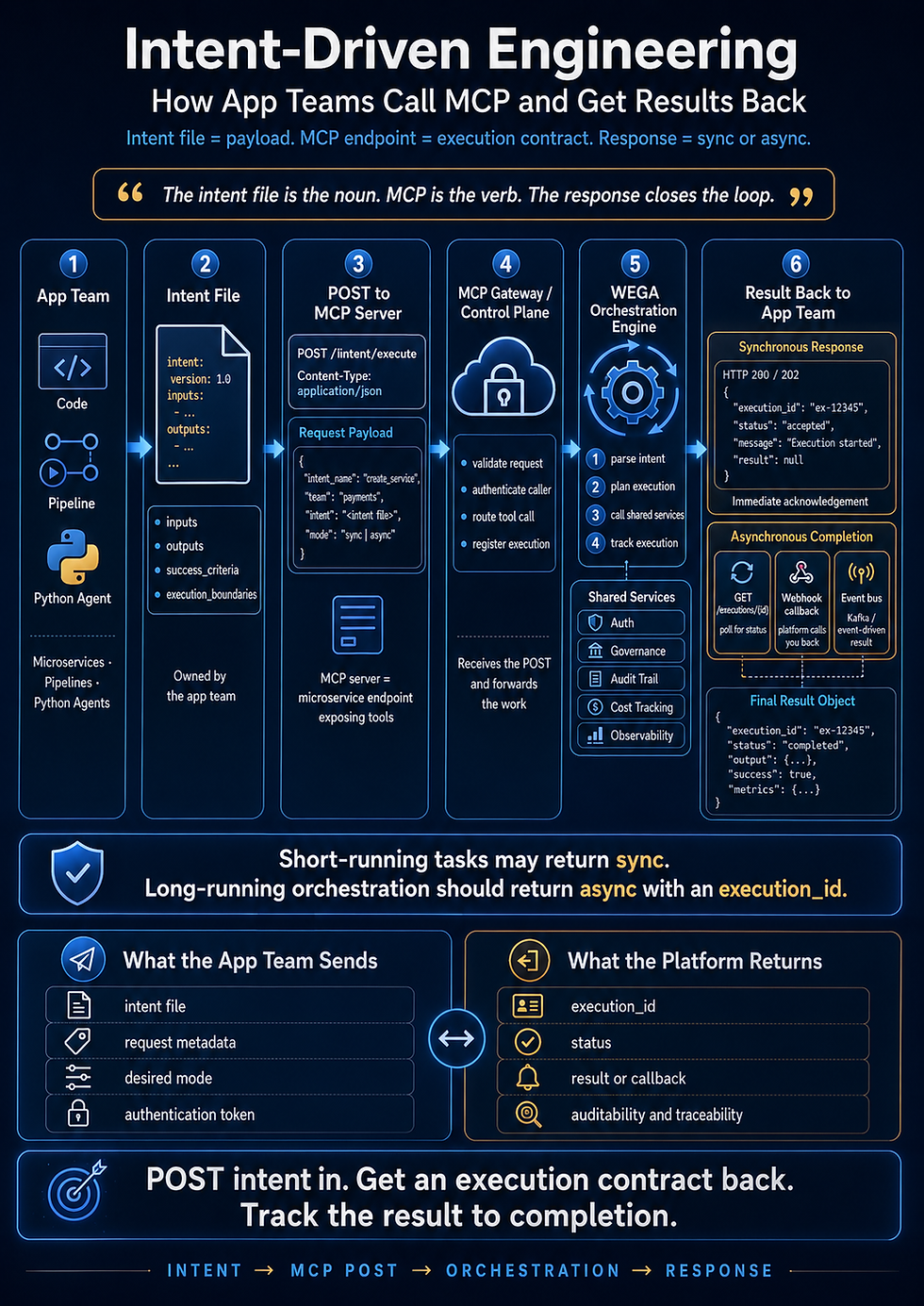
That intent can then be refined into executable specifications, plans, tasks, tests, controls, and deployment evidence.
The progression becomes:
Business Intent
→ Enterprise Context
→ Executable Intent
→ Planning
→ Controlled Agent Execution
→ Validation
→ Human Approval
→ Production
→ Measurement
→ Learning
This creates a repeatable system rather than a collection of unrelated AI conversations.
The CTO’s Real Problem
The CTO’s problem is not that AI tools are failing.
The problem is that the organization may not have a shared way of using them.
One team may have strong repository instructions, automated testing, and clear review gates.
Another may rely on ad hoc prompts and manual inspection.
One team may carefully control model usage.
Another may repeatedly send large amounts of context into expensive models.
One repository may be well documented.
Another may require the agent to rediscover the architecture every time it starts.
From the executive level, this creates uncertainty.
The organization may be spending more while producing inconsistent results.
The CTO is then placed in the uncomfortable position of defending an AI investment without reliable operational evidence.
The best way to reduce that pressure is not to buy another tool.
It is to create visibility, standards, ownership, and measurable outcomes.
Start with an Enterprise Readiness Assessment
Before attempting a large transformation, companies should evaluate their current state.
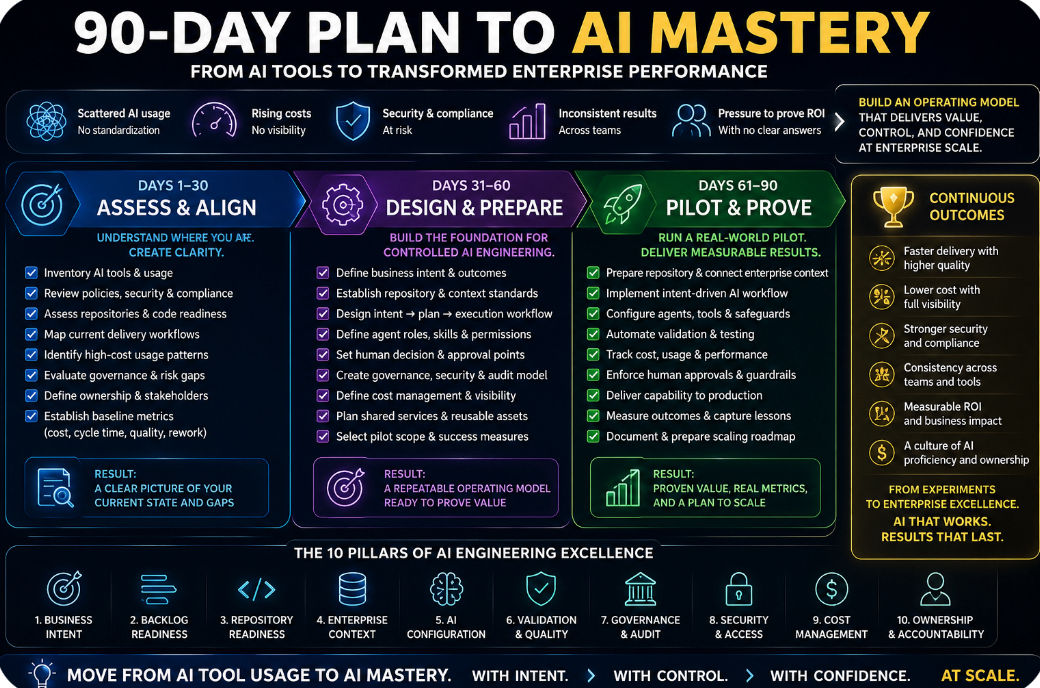
A practical AI engineering readiness assessment should examine at least ten areas.
1. Business Intent
Are teams clear about why features are being built?
Are desired outcomes captured, or are developers working primarily from technical tickets?
2. Backlog Readiness
Are requirements complete enough for humans and agents to act on?
Do acceptance criteria reflect real business rules?
3. Repository Readiness
Can a new developer or AI agent understand the system quickly?
Are architecture, standards, build instructions, and testing expectations documented?
4. Enterprise Context
Can approved information be retrieved from systems such as Jira, Confluence, Figma, source control, service catalogs, and architecture repositories?
5. AI Configuration
Are instructions, skills, agents, hooks, and context strategies standardized?
Or is every developer building a personal workflow?
6. Validation
Are generated changes tested automatically?
Are acceptance criteria, security checks, and production requirements verifiable?
7. Governance
Are permissions, approval points, audit trails, and prohibited actions clearly defined?
8. Security
Can agents access only the data, tools, and environments required for the task?
9. Cost Management
Can the organization measure model usage, repeated context, failed loops, and cost per accepted change?
10. Ownership
Is someone accountable for the AI engineering operating model?
Without clear ownership, improvement efforts become fragmented.
Measure the Right Things
Many companies begin by measuring AI adoption.
They count licenses, active users, prompts, tokens, or generated lines of code.
Those metrics may be useful, but they do not prove business value.
The organization should eventually be able to answer questions such as:
What is the cost per accepted feature?
Has cycle time improved?
Has escaped-defect volume changed?
Has review time increased or decreased?
How much AI-generated work is rejected?
How much rework is being created?
Which repositories are producing the strongest results?
Which teams are using the most context?
How often do agents enter failed or repeated loops?
Are production incidents increasing or decreasing?
Is customer value being delivered sooner?
The goal is not maximum AI usage.
The goal is better delivery.
Create Shared Services
Large organizations should not expect every team to independently build its own AI engineering platform.
Common capabilities should be developed as shared services.
That may include:
Approved MCP servers
Enterprise connectors
Repository instruction templates
Reusable skills and agents
Security policies
Prompt and intent patterns
Validation frameworks
Testing utilities
Model-routing standards
Cost controls
Observability dashboards
Audit logging
Reference implementations
Shared services reduce duplication and create consistency.
They also allow successful practices from one team to be reused across the enterprise.
The objective is not to remove team flexibility.
It is to prevent every team from repeatedly solving the same foundational problems.
Define Human Decision Points
AI engineering should not mean removing people from the process.
It should mean using people at the points where judgment matters most.
Human approval may still be required for:
Business-priority decisions
Architectural tradeoffs
Security exceptions
Production deployment
Regulatory interpretation
High-risk code changes
Customer-impacting behavior
Financial commitments
Data-access changes
Acceptance of residual risk
The operating model should make those points explicit.
Agents should know when to proceed, when to stop, when to request clarification, and when to escalate.
This is how organizations gain speed without losing control.
Build a Role-Based Learning Model
AI transformation cannot be treated as developer training alone.
Every role needs a different learning path.
Executives need to understand economics, governance, operating ownership, and risk.
Architects need to understand context design, agent orchestration, integration patterns, and technical controls.
Product leaders need to understand how to express intent and create agent-ready requirements.
Developers need to understand repository-aware workflows, planning, implementation, testing, and review.
Quality engineers need to understand AI-assisted validation, evidence, and risk-based testing.
DevOps teams need to understand agentic deployment, infrastructure intent, observability, rollback, and production controls.
Security teams need to understand tool permissions, data boundaries, agent identity, auditability, and executable policy.
The company does not become AI-capable because a group of developers attended a class.
It becomes AI-capable when the organization develops a shared way of working.
Use a Pilot to Prove the Model
The operating model should not be introduced through a year-long transformation plan.
It should be proven through a focused pilot.
A strong pilot includes:
A real business capability
A defined engineering team
One or more representative repositories
Clear success measures
Existing delivery constraints
Production-quality requirements
Cost tracking
Human approval points
Security and quality controls
The goal is not to create the most impressive demonstration.
The goal is to prove that the operating model works under real enterprise conditions.
The pilot should answer:
Can the team move from intent to production more reliably?
Can cost be measured?
Can quality be maintained or improved?
Can the process be repeated?
Can another team adopt the same patterns?
Can the organization explain why the results improved?
A successful pilot should produce reusable assets, not just a successful feature.
A Practical 90-Day Approach
Companies do not need to solve everything at once.
A practical first 90 days can be divided into three phases.
Days 1–30: Understand the Current State
During the first month, the organization should:
Identify current AI tools and users
Review existing AI policies
Examine representative repositories
Map current delivery workflows
Identify high-cost usage patterns
Document major governance gaps
Determine who currently owns AI engineering
Establish a baseline for cost, cycle time, quality, and review effort
The output should be a clear assessment, not another broad AI strategy.
Days 31–60: Design the Operating Model
During the second month, the organization should define:
Intent standards
Repository readiness requirements
Approved agent workflows
Human approval points
Shared-service responsibilities
Security and access controls
Cost-measurement standards
Team roles
Pilot scope
Executive success measures
This is where the organization moves from discussion to design.
Days 61–90: Run the Pilot
During the third month, the organization should:
Select a real capability
Prepare the repository
Connect approved enterprise context
Implement the intent workflow
Configure agents and controls
Automate validation
Measure usage and outcomes
Document lessons
Prepare the scaling roadmap
At the end of 90 days, leadership should have evidence, not promises.
What Success Looks Like
A mature AI engineering organization should eventually be able to say:
We know which business outcomes our AI engineering investments support.
We have a consistent way to move from intent to production.
Our repositories are prepared for humans and agents.
Our teams use approved shared services.
Our agents operate within defined permissions.
Human approvals occur at deliberate control points.
Costs are visible and connected to outcomes.
Quality is validated through evidence.
Successful workflows can be repeated across teams.
One executive owner is accountable for the operating model.
That is far more meaningful than reporting how many developers are using an AI assistant.
The Pressure Will Not Go Away by Itself
CTOs and engineering leaders are under pressure because expectations have moved faster than operating maturity.
Executives have seen demonstrations and now expect transformation.
Developers have seen what AI can do and expect better tools.
Finance leaders see growing spend and expect accountability.
Security leaders see new risks and expect control.
Business leaders expect faster delivery.
The answer is not to slow everything down.
The answer is to build the structure that allows the organization to move faster with confidence.
AI can generate code.
It can analyze repositories, create plans, write tests, propose architectures, assist deployments, and support operations.
But it cannot independently create the organizational system required to connect business intent, enterprise context, human judgment, governance, cost, and production outcomes.
Leadership must create that system.
The Next Phase of Enterprise AI Engineering
The first phase of enterprise AI engineering was driven by curiosity.
The second was driven by tool adoption.
The next phase will be driven by operational discipline.
The companies that succeed will not necessarily be the companies with the most AI tools.
They will be the companies that know:
Why the tools are being used
How teams should use them
Which context agents can access
Where humans remain accountable
How risks are controlled
How success is measured
How effective practices are scaled
The real competitive advantage will not come from merely giving developers AI.
It will come from building an enterprise capable of operating with intent.
You Bought the AI Tools. Now Build the Operating Model.This version positions the article as a practical executive guide rather than a promotion, while still naturally establishing the need for Intent-Driven Engineering.
Comments