

Article #10: Structured Output Is How Claude Becomes Reliable, Testable, and Enterprise-Ready
- Mark Kendall
- 1 day ago
- 9 min read

Article #10: Structured Output Is How Claude Becomes Reliable, Testable, and Enterprise-Ready
Why Structured Output Matters for the Claude Certified Architect Exam
When people first use Claude, they usually think about conversation.
They ask Claude a question.
Claude gives an answer.
That is useful.
But for enterprise architecture, conversation is not enough.
A business cannot run critical workflows on loose, unstructured responses. A development team cannot reliably automate delivery if every answer comes back in a different format. A governance team cannot audit AI behavior if the output is just a long paragraph with no traceable evidence.
That is why structured output matters.
Structured output turns Claude from a helpful assistant into a reliable participant in an engineering process.
For the Claude Certified Architect exam, this is a key idea.
The architect must understand how to design Claude systems that produce predictable, machine-readable, reviewable, and auditable results.
Claude does not only need to answer.
Claude needs to answer in a form the enterprise can use.
The Problem With Loose AI Answers
A loose answer might sound impressive, but it can be hard to use.
For example, imagine Claude reviews a Jira story and says:
“The story looks mostly complete, but there are a few missing details around error handling, test coverage, and logging. I recommend clarifying the retry behavior and adding acceptance criteria for failure cases.”
That is helpful.
But it is not enough for automation.
A delivery system needs more structure.
It may need to know:
Is the story ready?
What is missing?
What is the severity?
What evidence was reviewed?
What action should happen next?
Who needs to approve it?
Can the workflow continue?
A human can read the paragraph and interpret it.
A system cannot depend on interpretation.
A structured response might look more like this:
{
"story_ready": false,
"readiness_score": 72,
"missing_items": [
{
"category": "error_handling",
"severity": "high",
"description": "Retry and timeout behavior are not defined."
},
{
"category": "testing",
"severity": "medium",
"description": "Acceptance criteria do not specify required negative test cases."
}
],
"recommended_next_action": "clarify_requirements",
"human_approval_required": true,
"evidence_reviewed": [
"jira_story",
"acceptance_criteria",
"linked_api_contract"
]
}
Now the output can be inspected, stored, validated, routed, and acted on.
That is the difference between an answer and an enterprise artifact.
Structured Output Gives Claude a Contract
The simplest way to think about structured output is this:
Structured output is an output contract.
Just like an API has a request and response contract, Claude should often have an expected output shape.
That shape may be JSON, XML, YAML, markdown tables, checklists, scorecards, decision records, or validation reports.
The format depends on the workflow.
But the principle is the same.
Claude should know what fields to return.
The system should know what fields to expect.
Humans should know how to review the result.
That is how we reduce ambiguity.
In enterprise AI, ambiguity is expensive.
Structured output helps remove it.
Why Architects Should Care
Structured output sits at the intersection of prompt engineering, workflow design, validation, and governance.
That makes it an architect-level concern.
The architect should decide:
What output format is required?
Which fields are mandatory?
Which values are allowed?
What evidence must be included?
What confidence level should be reported?
What happens if Claude is uncertain?
What should the system do if the output is invalid?
Which outputs are human-readable?
Which outputs are machine-readable?
This is not just a prompt detail.
It is part of the system design.
If Claude is supporting enterprise delivery, the output needs to fit the delivery process.
Common Structured Output Patterns
There are several structured output patterns that matter for Claude Code architects.
1. Implementation Plan
Before Claude changes code, it can produce a structured implementation plan.
Example fields:
Objective
Files likely to change
Dependencies
Risks
Test strategy
Acceptance criteria mapping
Human approval required
This helps the developer review the plan before execution.
2. Code Review Summary
After Claude reviews code, it can produce a structured review.
Example fields:
Findings
Severity
Affected files
Recommended fix
Security concerns
Performance concerns
Test gaps
This makes the review easier to triage.
3. Test Evidence Report
After running tests, Claude can produce evidence.
Example fields:
Test command
Test result
Passed count
Failed count
Failure summary
Coverage notes
Logs reviewed
Evidence links
This helps teams prove that the work was validated.
4. Deployment Readiness Report
Before deployment, Claude can generate a readiness report.
Example fields:
Service name
Environment
Build status
Test status
Security scan status
Open risks
Rollback plan
Approval status
This supports release governance.
5. Intent Validation Report
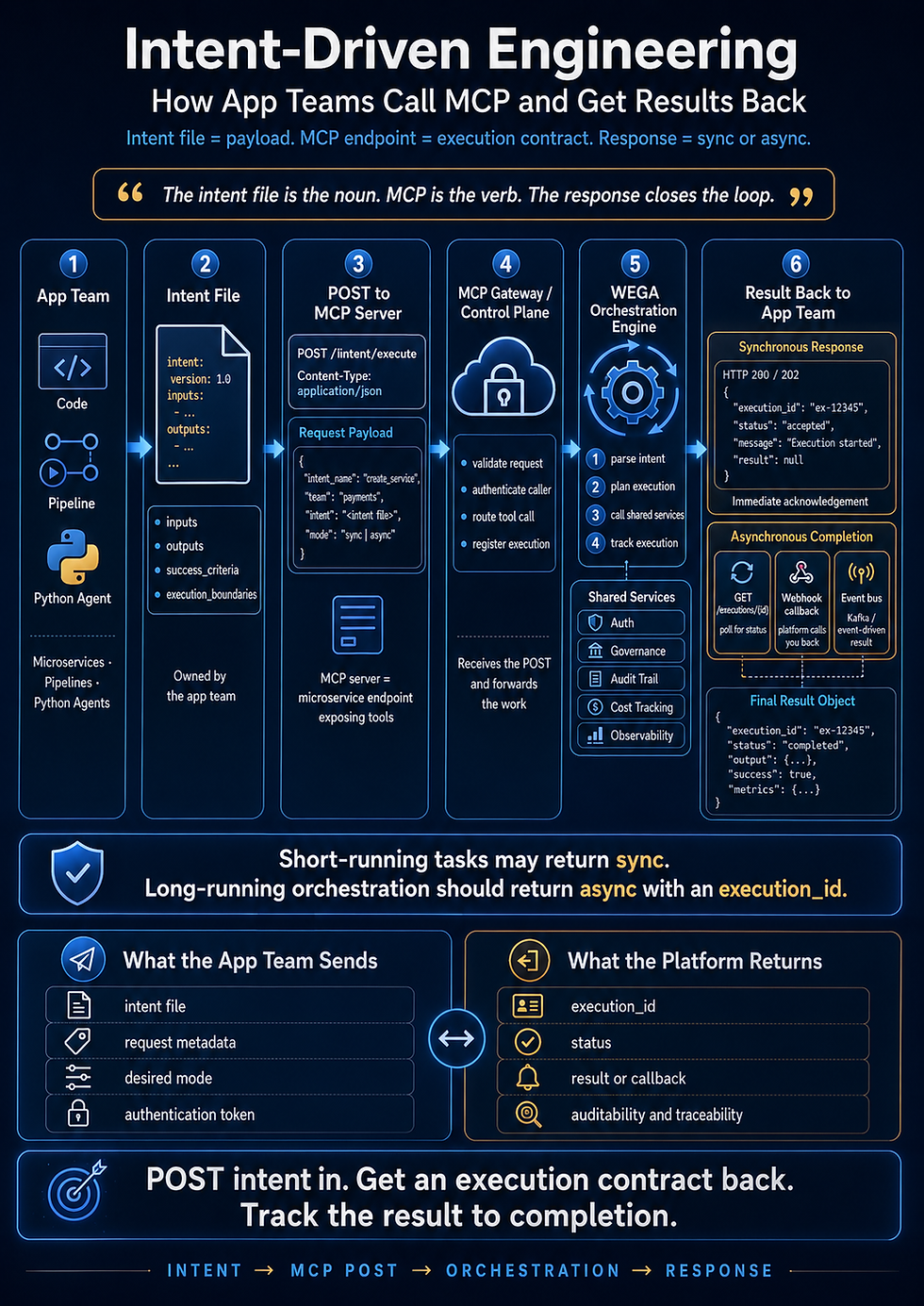
In Intent-Driven Engineering, Claude can compare actual work against the intent file.
Example fields:
Intent ID
Stated objective
Acceptance criteria
Implementation evidence
Missing evidence
Completion status
Confidence score
Recommended next action
This is powerful because it connects intent, execution, and proof.
Structured Output and Intent-Driven Engineering
Intent-Driven Engineering depends heavily on structured outputs.
The intent file defines the work.
Claude Code performs or supports the work.
Structured output proves what happened.
That gives us a clean operating loop:
Intent describes the desired outcome.
Claude reads the repo and context.
Claude creates a structured plan.
Claude performs the work or recommends the work.
Claude runs or requests validation.
Claude produces structured evidence.
Humans review and approve.
The result is stored as proof.
This is how AI-assisted delivery becomes manageable.
Without structured output, the process becomes a conversation.
With structured output, the process becomes an operating model.
The Architect’s Rule for Structured Output
Here is the rule:
If the output will drive a workflow, decision, audit, or automation, structure it.
Not every Claude response needs JSON.
Sometimes a paragraph is fine.
But if the result will be used to make a decision, trigger a next step, update a system, validate work, or prove completion, then the output should be structured.
For example:
A brainstorming conversation can be free-form.
A deployment recommendation should be structured.
A casual explanation can be conversational.
A security review should be structured.
A learning summary can be narrative.
A production incident report should be structured.
The architect decides where structure is required.
Structured Output Reduces Hallucination Risk
Structured output does not magically eliminate hallucination.
But it helps reduce risk.
Why?
Because it forces Claude to separate different kinds of information.
For example, a structured output can require Claude to distinguish between:
Facts found in source systems
Assumptions
Missing information
Recommendations
Confidence level
Evidence links
That matters.
A weak response may blur facts and assumptions together.
A stronger response makes the distinction explicit.
For example:
{
"facts": [
"Unit tests passed on branch feature/customer-notification.",
"The API contract includes POST /notifications."
],
"assumptions": [
"The notification retry policy should follow the existing billing service pattern."
],
"missing_information": [
"No acceptance criteria were found for failed delivery handling."
],
"recommendation": "Clarify retry and failure handling before implementation is marked complete.",
"confidence": "medium"
}
This structure gives humans a better basis for review.
Claude is not just producing an answer.
Claude is exposing how solid the answer is.
Structured Output and Tool Use
Structured output becomes even more important when Claude uses tools.
If Claude calls tools through MCP, the final answer should often include tool evidence.
For example:
Which Jira story was read?
Which Confluence page was used?
Which test command was run?
Which logs were inspected?
Which deployment status was retrieved?
Which API contract was compared?
Which file changes were made?
This matters because enterprise teams need traceability.
A Claude recommendation should not feel like magic.
It should feel like a reasoned output based on known evidence.
A good structured response might include:
Tool calls used
Source systems checked
Evidence retrieved
Gaps found
Decision
Confidence
Next action
This is how AI becomes auditable.
Structured Output Supports Automation
Automation requires predictability.
If Claude returns a different format every time, downstream systems cannot reliably use the response.
But if Claude always returns the same schema, other systems can consume it.
For example, a CI/CD pipeline might consume a deployment readiness report.
A Jira workflow might consume a story readiness score.
An engineering dashboard might consume a risk summary.
A test harness might consume structured test results.
An enterprise control center might consume evidence summaries across teams.
This is where structured output becomes very powerful.
It allows Claude to participate in larger workflows without requiring a human to interpret every sentence.
The architect should decide when Claude’s output is for a human and when it is for a system.
Often, the best answer is both.
A structured output can include machine-readable fields and a human-readable summary.
JSON Is Useful, But It Is Not the Only Option
When people hear structured output, they often think JSON.
JSON is very useful because systems can parse it easily.
But structured output can also be:
Markdown tables
YAML
XML
CSV
Checklists
Scorecards
Decision records
Validation reports
Test summaries
Architecture review templates
The best format depends on the job.
For system-to-system automation, JSON is often best.
For human review, markdown may be better.
For architecture governance, a decision record may be best.
For executive reporting, a scorecard may be best.
The architect should not blindly choose a format.
The architect should choose the format that fits the workflow.
A Practical Structured Output Template
Here is a simple template architects can reuse for Claude Code validation work:
{
"task_id": "",
"objective": "",
"status": "not_started | in_progress | blocked | complete | failed",
"summary": "",
"evidence": [
{
"type": "test | file_change | tool_result | log | document | approval",
"source": "",
"description": "",
"result": "pass | fail | warning | unknown"
}
],
"risks": [
{
"severity": "low | medium | high | critical",
"description": "",
"mitigation": ""
}
],
"missing_information": [],
"assumptions": [],
"human_approval_required": false,
"recommended_next_action": "",
"confidence": "low | medium | high"
}
This gives Claude a clear output contract.
It also gives the enterprise a repeatable evidence structure.
That is exactly the kind of pattern a Claude Code architect should understand.
Structured Output and Guardrails
Structured output also acts as a guardrail.
For example, you can require Claude to say when it does not know something.
You can require Claude to mark missing information.
You can require Claude to produce a confidence level.
You can require Claude to avoid taking action unless approval is present.
You can require Claude to separate facts from recommendations.
You can require Claude to include evidence before marking work complete.
These are simple patterns, but they are powerful.
A weak system says:
“Claude, tell me if this is done.”
A stronger system says:
“Claude, evaluate this task using the required schema. Mark it complete only if every acceptance criterion has supporting evidence. If evidence is missing, return status as blocked or incomplete.”
That is much more reliable.
Example: Intent Completion Report
Imagine an intent file says:
Add customer notification support and prove the API passes unit tests, contract tests, and deployment readiness checks.
Claude’s final output should not simply say:
“Done.”
A structured completion report might say:
{
"intent_id": "customer-notification-api",
"completion_status": "partial",
"acceptance_criteria": [
{
"criterion": "API endpoint created",
"status": "complete",
"evidence": "POST /notifications implemented in notification controller."
},
{
"criterion": "Unit tests pass",
"status": "complete",
"evidence": "Unit test command passed."
},
{
"criterion": "Contract tests pass",
"status": "missing_evidence",
"evidence": "Contract test command not found."
},
{
"criterion": "Deployment readiness verified",
"status": "not_started",
"evidence": "No deployment readiness check was executed."
}
],
"overall_confidence": "medium",
"recommended_next_action": "Run contract tests and deployment readiness checks before marking complete."
}
That is much better.
It prevents false completion.
It shows exactly what was done and what still needs to happen.
This is enterprise-grade AI behavior.
What the Exam Wants You to Understand
For the Claude Certified Architect exam, you should understand that structured output is a reliability pattern.
You should be able to explain that structured output:
Makes Claude responses predictable
Supports automation
Helps downstream systems parse results
Improves auditability
Separates facts, assumptions, risks, and recommendations
Supports evidence-based workflows
Reduces ambiguity
Helps humans review AI-generated work
Works especially well with tools and MCP
Is critical for Intent-Driven Engineering and validation
The exam may not ask this in the exact language of “structured output is an output contract,” but that is the concept.
Claude needs to produce outputs that fit the system.
That is the architect’s responsibility.
The Certification Mindset
A Claude Certified Architect should not only ask:
What can Claude generate?
The architect should ask:
What format should Claude generate so the result can be trusted, reviewed, validated, and used?
That is the shift.
Free-form output is good for learning and exploration.
Structured output is better for systems.
And enterprise architecture is about systems.
Final Thought
Structured output is one of the simplest and most powerful ways to make Claude more reliable.
It gives Claude a contract.
It gives humans a reviewable artifact.
It gives systems something they can parse.
It gives governance teams evidence.
It gives architects control.
When Claude is just chatting, loose output is fine.
But when Claude is helping deliver software, validate intent, inspect production risk, or support enterprise decisions, structured output becomes essential.
That is why this topic belongs directly in the Claude Certified Architect preparation path.
Because in the enterprise, a good answer is not enough.
The answer must be structured, traceable, and usable.
:::
Article #10 is a strong bridge into the next one: context management and reliability — how to decide what Claude should know, what it should ignore, and how to prevent context overload.
Comments