
Claude Architect Certification Articles 11–14: The Operating Model Is the Architecture
- Mark Kendall
- 20 hours ago
- 7 min read

Claude Architect Certification Articles 11–14: The Operating Model Is the Architecture
At this point in the Claude Architect certification journey, the pattern should be getting clearer.
This exam is not only about knowing what Claude can do.
It is about knowing how to design a system around Claude so that the work is structured, reliable, secure, explainable, and repeatable.
That is the real shift.
A beginner asks:
“Can Claude write this code?”
An architect asks:
“What context does Claude need, what tools should it be allowed to use, what workflow should it follow, what evidence should it produce, and how do we know the output is safe enough to deliver?”
That is the certification mindset.
Articles 11 through 14 are really one big lesson:
The Claude architect is designing the operating model around the agent.
Not just the prompt.
Not just the code.
Not just the tool.
The operating model.
That means agents, tools, MCP servers, Claude Code configuration, structured output, memory, evidence, validation, and delivery rules all working together.
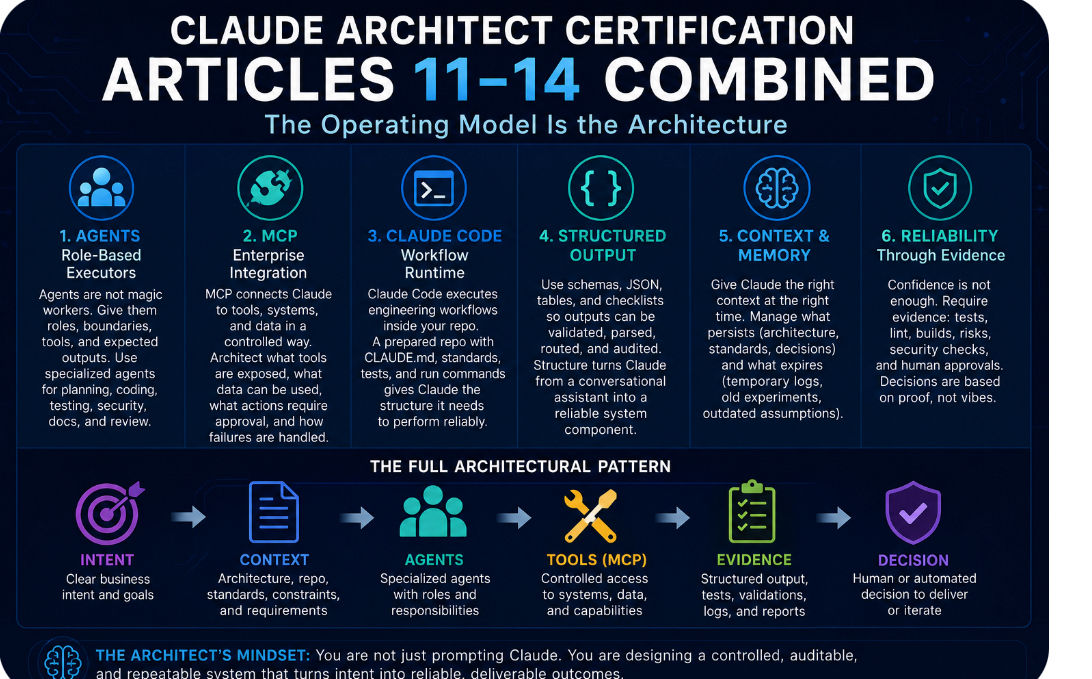
1. Agents Are Not Magic Workers. They Are Role-Based Executors.
The first architectural concept is the agent.
An agent is not just a chatbot with a better name. In a real engineering system, an agent should have a job, a boundary, a context, a set of tools, and an expected output.
For certification purposes, the important idea is this:
Agents need roles.
You do not want one giant agent doing everything. That creates confusion, tool misuse, weak validation, and unpredictable outputs.
Instead, you design agents around responsibilities.
For example:
A planning agent reads the intent and breaks down the work.
A code agent implements the change.
A testing agent validates behavior.
A security agent checks risks.
A documentation agent updates README files, runbooks, and architecture notes.
A reviewer agent compares the output against the original intent.
That is an architectural pattern.
The architect’s job is to decide when the work should stay with one agent and when it should be delegated to specialized sub-agents.
The wrong answer is:
“Let Claude do everything.”
The better answer is:
“Give Claude a controlled workflow with specialized roles, scoped tools, and evidence-producing outputs.”
That is how agentic architecture becomes enterprise architecture.
2. MCP Turns Claude Into an Enterprise Participant
The second major concept is MCP: Model Context Protocol.
MCP matters because it gives Claude a standardized way to connect with tools, systems, files, databases, APIs, and enterprise knowledge sources.
Without MCP, Claude is mostly reasoning from the prompt and the local context.
With MCP, Claude can become part of a controlled enterprise workflow.
That does not mean Claude should have unlimited access.
It means the architect decides what tools are exposed, what permissions exist, what data can be read, what actions can be taken, and what must require human approval.
This is a huge certification idea.
MCP is not just a connector.
MCP is an architectural boundary.
It answers questions like:
What tools can the agent use?
What data sources can it reach?
What operations are read-only?
What operations can mutate systems?
What actions require confirmation?
What evidence is logged?
What happens when the tool fails?
How does the agent recover?
A good MCP design does not just make the agent more powerful.
It makes the agent safer.
For an enterprise architect, MCP is where AI meets governance.
3. Claude Code Is Not Just a Coding Assistant. It Is a Workflow Runtime.
Claude Code is easy to underestimate.
A lot of people look at it and think:
“It writes code.”
That is only the surface.
The better way to think about Claude Code is:
“It executes an engineering workflow inside a repository.”
That means the repository itself becomes part of the context. The folder structure, naming conventions, tests, scripts, documentation, package files, CI/CD definitions, and architecture notes all become signals that Claude can use.
But Claude Code only performs well when the repo is prepared for it.
That is why files like CLAUDE.md, intent files, architecture notes, test commands, coding standards, and delivery checklists matter so much.
The architect is not just giving Claude a task.
The architect is shaping the environment Claude works inside.
A good Claude Code setup should answer:
What is this repo?
What is the architecture?
What are the coding standards?
How do we run tests?
How do we validate changes?
What should Claude never touch?
What does “done” mean?
What evidence is required before delivery?
That is the difference between a casual Claude Code session and a production-ready Claude Code workflow.
4. Structured Output Is How Claude Becomes Auditable
Another major certification concept is structured output.
In casual usage, we often accept paragraphs, explanations, or general recommendations.
In enterprise systems, that is not enough.
A system needs outputs that can be parsed, checked, routed, scored, stored, and compared.
That means JSON, schemas, checklists, tables, validation reports, test summaries, risk scores, decision records, and evidence packages.
Structured output turns Claude from a conversational assistant into a reliable system component.
For example, instead of asking:
“Does this look good?”
The architect asks Claude to produce:
{
"intent_alignment": "pass",
"tests_run": ["npm test", "npm run lint"],
"risks_found": [],
"files_changed": ["src/App.jsx", "src/api/dashboard.js"],
"delivery_recommendation": "ready_for_review"
}
That kind of output can be used by humans, pipelines, dashboards, agents, and governance systems.
This is one of the biggest mindset shifts.
The architect should not only care whether Claude gives a good answer.
The architect should care whether Claude gives an answer that can be verified.
5. Context Management Is the Real Skill
Context is everything.
Claude can only reason well when it has the right context at the right time.
Too little context, and it guesses.
Too much context, and it gets noisy.
Wrong context, and it solves the wrong problem.
That is why context management is one of the most important parts of the certification.
The architect must know how to separate:
Project context
Architecture context
Business intent
User requirements
Repository structure
Standards
Constraints
Prior decisions
Test evidence
Deployment rules
Security boundaries
This is also where memory becomes important.
Memory should not be treated as a magic storage bucket. It should be treated as a persistent context layer.
Some things belong in memory or long-lived project files:
Architecture decisions
Naming conventions
Coding rules
Security policies
Deployment patterns
Team preferences
Reusable workflows
Other things should stay temporary:
One-time debugging details
Outdated assumptions
Failed experiments
Temporary logs
Old errors that no longer apply
The architect’s job is to decide what context should persist and what context should expire.
That matters because bad memory creates bad reasoning.
6. Reliability Comes From Evidence, Not Confidence
One of the biggest mistakes people make with AI is believing confident output.
Claude can sound right even when it is wrong.
The certification mindset is different.
The architect does not ask:
“Does Claude sound confident?”
The architect asks:
“What evidence proves this is correct?”
That evidence can include:
Tests passed
Lint passed
Build succeeded
Requirements mapped
Files changed
Risks identified
Security checks completed
Human approvals captured
Simulation results produced
Rollback plan documented
This is where Claude becomes part of a delivery system.
The answer is not done because Claude says it is done.
The answer is done when the evidence says it is done.
That is a very important architectural line.
7. The Full Pattern: Intent → Context → Agents → Tools → Evidence → Decision
If I had to compress articles 11 through 14 into one architecture flow, it would be this:
Business Intent
↓
Architecture Context
↓
Claude Code / Agents
↓
MCP Tools and Repository Actions
↓
Structured Output
↓
Evidence and Validation
↓
Human or Automated Delivery Decision
That is the heart of the Claude Architect mindset.
The architect is not just prompting.
The architect is designing a controlled execution system.
That system should be able to answer:
What was the intent?
What context was used?
Which agent did the work?
Which tools were called?
What changed?
What evidence was produced?
What risks remain?
Who approved the delivery?
Can we reproduce or audit the decision?
That is enterprise-grade AI.
8. How This Maps to Intent-Driven Engineering
This is also where Intent-Driven Engineering fits perfectly.
Intent-Driven Engineering says the work should start with clear intent before code is written.
Claude architecture says the agent needs the right context, tools, workflow, and validation before action is trusted.
Together, the model becomes:
Intent file
↓
Claude context
↓
Agent workflow
↓
Tool execution
↓
Evidence package
↓
Delivery decision
This is why the intent file is so powerful.
The intent file is not just a requirement document.
It becomes the operating contract for the AI engineering workflow.
It tells Claude:
What we are building
Why we are building it
What constraints matter
What architecture to follow
What not to change
What evidence is required
What done means
That is the bridge between human intent and machine execution.
9. What the Certification Is Really Testing
The Claude Architect certification is not only asking whether you know the names of features.
It is testing whether you can think like an AI systems architect.
That means knowing when to use:
A simple prompt
A structured prompt
Claude Code
A sub-agent
An MCP tool
A memory file
A schema
A validation loop
A human approval gate
A full workflow
The architect must know the difference.
Not every task needs an agent.
Not every workflow needs MCP.
Not every answer needs persistent memory.
Not every decision should be automated.
The certification wants you to understand where each piece belongs.
That is what separates tool usage from architecture.
10. The Practical Takeaway
If you are studying for the Claude Architect certification, articles 11 through 14 should leave you with one big idea:
Claude is powerful, but architecture makes it reliable.
The architect’s job is to design the system around Claude:
Give it the right context.
Limit the tools appropriately.
Use agents when specialization helps.
Use structured output when downstream systems need reliability.
Use memory carefully.
Require evidence.
Keep humans in the loop where judgment matters.
Make delivery decisions based on validation, not vibes.
That is the real operating model.
And that is why Claude architecture is bigger than code generation.
It is the beginning of a new enterprise engineering discipline.
Claude does not replace the architect.
Claude makes the architect more important.
Because when AI can act, the system around the action matters more than ever.
:::
Comments