
Claude Architect Certification Articles 18–20: The Three Things That Make Claude Enterprise-Ready
- Mark Kendall
- 7 hours ago
- 6 min read

Claude Architect Certification Articles 18–20: The Three Things That Make Claude Enterprise-Ready
At this point in the certification journey, we are no longer just learning Claude features.
We are learning how to think like an AI architect.
That means we are not only asking:
“How do I prompt Claude?”
We are asking:
“How do I design a reliable enterprise system around Claude?”
That is the bigger shift.
The Claude Certified Architect mindset is not about memorizing tools. It is about understanding how Claude fits into real-world engineering, where systems have constraints, security requirements, workflows, teams, repositories, APIs, testing gates, deployment rules, and business outcomes.
Articles 18 through 20 bring three major ideas together:
Context management
Tool and MCP integration
Reliable agentic workflows
These three ideas form the practical foundation of enterprise Claude architecture.
If you understand these, you are no longer thinking like a prompt user.
You are thinking like an architect.
1. Context Management: Claude Is Only As Good As The Context You Give It
Enterprise AI does not fail because the model is weak.
It usually fails because the model does not have the right context.
That is one of the biggest lessons in this certification path.
Claude can reason, generate, summarize, refactor, test, and orchestrate. But if it does not know the architecture, the standards, the repo structure, the patterns, the business rules, the constraints, and the intended outcome, it will guess.
And in enterprise systems, guessing is dangerous.
This is why context management matters so much.
A good Claude architecture gives the model the right information at the right time, in the right format, with the right boundaries.
That context may include:
The intent file
Repository structure
Architecture diagrams
Coding standards
API contracts
Existing patterns
Security rules
Test expectations
Deployment rules
Business objectives
Known risks and constraints
The goal is not to dump everything into the prompt.
The goal is to manage context deliberately.
That means the architect has to decide what Claude needs to know, what it should not touch, what source of truth it should follow, and how the system will verify that Claude’s output matches the intent.
In my own language, this is where Intent-Driven Engineering becomes very powerful.
The intent file becomes the executable context layer.
It tells Claude what we are building, why we are building it, what the rules are, and how success will be measured.
That is very different from saying:
“Build me a React app.”
The enterprise version says:
“Build this capability according to this intent, this architecture, this repo structure, this security model, this testing strategy, and this delivery decision process.”
That is context.
And context is what turns Claude from a clever assistant into an engineering partner.
2. MCP And Tools: Claude Needs Access To The Enterprise
The second major idea is tool integration.
Claude by itself can reason.
But enterprise work requires action.
It may need to read from a repository, inspect a ticket, query documentation, call an API, search an internal knowledge base, retrieve design specs, validate data, run a test, or create evidence.
That is where tools and MCP become important.
MCP, or Model Context Protocol, is one of the key architectural ideas in the Claude ecosystem. It provides a structured way for Claude to connect to external systems, tools, and data sources.
This matters because enterprise AI cannot live inside a chat window forever.
At some point, Claude needs governed access to the systems where work actually happens.
Those systems may include:
GitHub or GitLab
Jira
Confluence
SharePoint
Databases
APIs
Cloud services
CI/CD systems
Internal documentation
Test frameworks
Monitoring platforms
But here is the important certification-level idea:
Tool access must be designed.
It should not be random.
An architect has to think about tool boundaries, permissions, input validation, output validation, error handling, logging, and security.
Claude should not simply be given unlimited power to call everything.
The better pattern is controlled capability.
Give Claude the tools it needs for the job. Give those tools clear descriptions. Define what each tool does. Limit what it can access. Validate the inputs. Capture the outputs. Create evidence.
That is enterprise architecture.
In a well-designed Claude system, the model does not just “know things.”
It can use tools to retrieve the right information, take controlled actions, and produce traceable results.
This is the difference between a demo and a production system.
A demo says:
“Claude can answer questions.”
An enterprise architecture says:
“Claude can access approved tools, follow approved workflows, produce evidence, and stay within defined boundaries.”
That is the certification mindset.
3. Agentic Workflows: The Architecture Is The Workflow
The third major idea is agentic workflow design.
This is where many people get confused.
They think an agent is just a chatbot with tools.
That is too small.
In enterprise architecture, an agent is a role-based reasoning and action component inside a larger workflow.
An agent may have a specific responsibility:
Analyze the story
Inspect the repository
Generate the implementation plan
Modify code
Write tests
Review security
Validate output
Produce documentation
Prepare a pull request
Summarize evidence
Each agent should have a job.
Each job should have boundaries.
Each boundary should be tied to evidence.
This is why agentic architecture is not just about automation.
It is about orchestration.
The architect must decide:
What happens first?
What information is needed?
Which tool should be used?
Which agent owns which task?
What gets validated?
What happens if validation fails?
When should a human approve the result?
That flow is the architecture.
For example, a Claude Code workflow might look like this:
Intent file → repo inspection → implementation plan → code changes → test generation → local validation → security review → evidence report → delivery decision
That is a serious workflow.
It is not just “Claude writes code.”
It is Claude operating inside an engineered delivery system.
This is one of the biggest concepts I want to master for the certification.
Claude Code, MCP, skills, hooks, sub-agents, memory files, structured outputs, and validation are not separate topics.
They are architectural pieces.
The architect’s job is to arrange those pieces into a system that produces reliable outcomes.
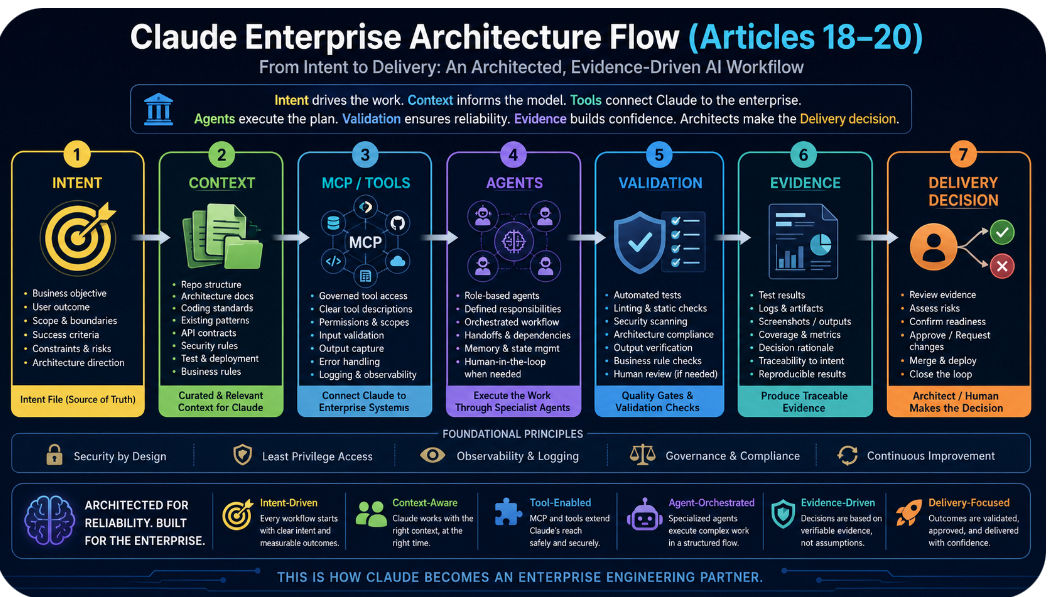
The Enterprise Pattern: Intent → Context → Tools → Agents → Evidence
If I had to summarize Articles 18 through 20 into one certification pattern, it would be this:
Intent drives the work.
Context informs the model.
Tools connect Claude to the enterprise.
Agents divide the work into roles.
Evidence proves the result.
That is the pattern.
And that pattern is bigger than Claude alone.
It is the foundation of enterprise AI engineering.
A weak AI workflow starts with a vague request and ends with unverified output.
A strong AI workflow starts with intent and ends with evidence.
That is the difference.
The weak version says:
“Generate some code.”
The strong version says:
“Given this intent, this architecture, this repo, this context, and this tool boundary, produce an implementation, validate it, generate evidence, and recommend whether it is ready for delivery.”
That is what an AI architect should be designing.
What I Should Know By Article 20
By this point in the certification journey, I should be able to explain the following clearly:
Claude needs high-quality context to perform enterprise work.
Context should be curated, structured, and tied to the business and technical intent.
MCP allows Claude to connect with external systems in a governed way.
Tools must be designed with boundaries, permissions, validation, and observability.
Agents should have specific responsibilities inside a workflow.
Agentic systems require orchestration, not just automation.
Claude Code becomes more powerful when it operates inside a repo-aware, evidence-driven workflow.
Structured output matters because enterprise systems need predictable results.
Reliability comes from validation, tests, review gates, and human approval where needed.
Intent-Driven Engineering is a natural operating model for Claude architecture because it turns enterprise context into executable direction.
That is the halfway-to-serious point.
At Article 20, I should not just understand Claude as a model.
I should understand Claude as part of an enterprise delivery architecture.
The Certification Takeaway
The Claude Architect certification is not really asking:
“Can you use Claude?”
It is asking:
“Can you design with Claude?”
That is a much more important question.
Because in the enterprise, the value is not in one prompt.
The value is in repeatable systems.
The value is in governed workflows.
The value is in architecture.
The value is in turning intent into working software, validated evidence, and confident delivery decisions.
That is where Claude becomes powerful.
And that is where the architect becomes essential.
Articles 18 through 20 are the bridge from feature knowledge to architecture thinking.
Context gives Claude understanding.
Tools give Claude reach.
Agents give Claude structure.
Evidence gives the enterprise confidence.
That is the system.
And that is exactly the way I want to study this certification:
Not as a prompt engineer.
Not as a tool user.
As an architect.This one is a good “mid-series architecture consolidation” article. Next we can do the custom image for 18–20 with the flow: Intent → Context → MCP/Tools → Agents → Validation → Evidence → Delivery Decision.
Comments