

Enterprise AI Does Not Need More Data. It Needs Enterprise Context.
- Mark Kendall
- 1 day ago
- 7 min read

Enterprise AI Does Not Need More Data. It Needs Enterprise Context.
There is a dangerous misunderstanding happening in enterprise AI right now.
Many companies still believe the next breakthrough will come from giving AI more data.
More documents.
More tickets.
More dashboards.
More repositories.
More PDFs.
More SharePoint folders.
More Confluence pages.
More Jira history.
More database access.
But enterprise AI does not fail because it lacks data.
Enterprise AI fails because it lacks context.
It does not know why something matters.
It does not know which business outcome is being protected.
It does not know which systems are critical.
It does not know which constraints are non-negotiable.
It does not know which architecture decision was already made two years ago.
It does not know who owns the process, what risk exists, or what evidence is required before a team should move forward.
That is the real enterprise AI problem.
Not data.
Context.
And this is where the future of enterprise architecture, AI engineering, and delivery automation begins to come together.
The path looks like this:
Architecture context → intent file → Claude Code / agents → evidence → simulation → delivery decision.
That is the new operating model.
And the punchline is simple:
Intent-Driven Engineering is how enterprise context becomes executable.
The Enterprise AI Problem: AI Sees Content, But Not the Enterprise
Most AI systems are very good at reading.
They can read a document.
They can summarize a meeting.
They can explain a code file.
They can generate a test.
They can write a user story.
They can produce a diagram.
They can answer questions from a knowledge base.
That is useful.
But in the enterprise, reading is not enough.
Enterprise work is not just content. It is a living system of decisions, constraints, dependencies, ownership, standards, risk, funding, delivery pressure, and operational reality.
An AI model may read a Jira story, but it may not know the business capability behind it.
It may read an API spec, but it may not know which value stream depends on that API.
It may read a code repository, but it may not know why the architecture was designed that way.
It may read a Confluence page, but it may not know whether that page is current, obsolete, political, aspirational, or actually enforced.
It may read a compliance document, but it may not know how that compliance requirement affects delivery decisions.
So the enterprise does not just need AI connected to content.
The enterprise needs AI connected to context.
What Is Enterprise Context?
Enterprise context is the meaning layer around the work.
It answers questions like:
What business outcome are we trying to achieve?
What capability does this support?
Which systems are involved?
What data is needed?
What APIs, integrations, and platforms are affected?
What standards must be followed?
What risks must be controlled?
What evidence proves this is working?
What operational metrics matter after deployment?
Who owns the decision?
What constraints cannot be violated?
This is much bigger than a prompt.
This is architecture.
Enterprise context includes business context, information context, technology context, governance context, integration context, operational context, and people context.
That means AI has to understand more than the task.
It has to understand the environment around the task.
Why More Data Alone Does Not Fix the Problem
Giving AI access to more enterprise data can make the problem worse if the context layer is missing.
Without context, AI can retrieve the wrong document confidently.
Without context, AI can generate code that works technically but violates enterprise standards.
Without context, AI can recommend a solution that ignores compliance, funding, team structure, security, deployment windows, or operational SLAs.
Without context, AI can produce more output but not more trustworthy decisions.
That is why some teams say, “We are using AI, but we are not seeing the productivity gains.”
They may have better code generation.
They may have faster summaries.
They may have quicker prototypes.
But they do not yet have an AI operating model that connects architecture, delivery, evidence, and decisions.
That is the gap.
Architecture Context Comes First
Before AI should generate code, automate work, or recommend a delivery path, it needs architectural grounding.
Architecture context defines the world the AI is operating inside.
For example:
Business Capability: Customer Onboarding
Outcome: Reduce onboarding time from 5 days to 1 day
Systems: CRM, Identity, Billing, Notification Service
APIs: Customer Profile API, Account Setup API, KYC Verification API
Data: Customer profile, identity status, billing account
Constraints: PII protection, audit logging, retry handling
Standards: REST conventions, OpenTelemetry, centralized error handling
Risks: Duplicate account creation, failed identity verification
Evidence Required: API tests, contract tests, deployment logs, trace visibility
Decision Needed: Is this ready for controlled rollout?
That is context.
Without it, AI is just guessing from fragments.
With it, AI can reason like part of the enterprise delivery system.
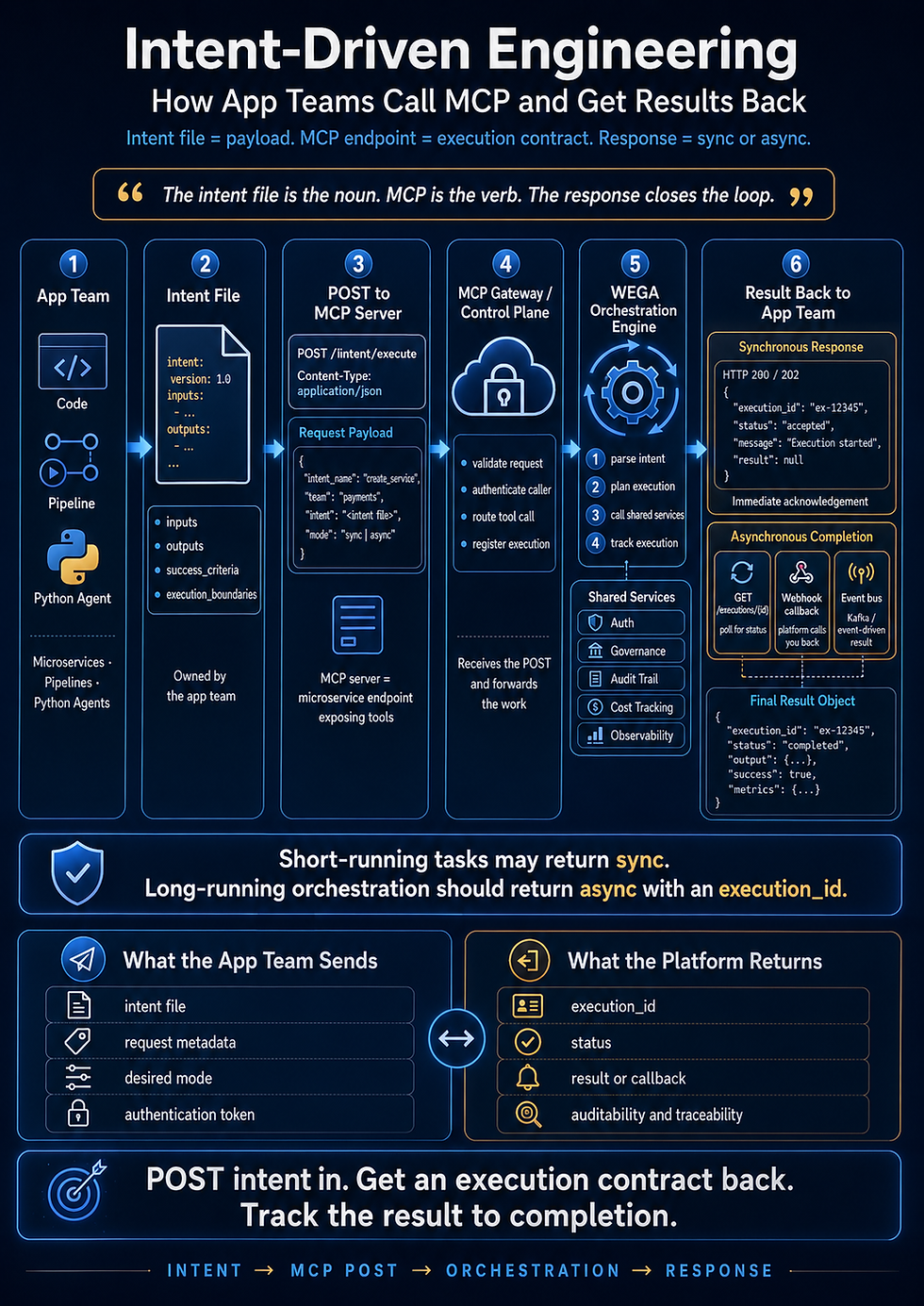
The Intent File: Where Context Becomes Executable
This is where the intent file becomes powerful.
An intent file is not just a prompt.
It is not just a requirements document.
It is not just a user story.
It is a structured bridge between enterprise architecture and AI execution.
The intent file captures what matters before work begins:
Business Intent
Target Outcome
Systems Involved
Architecture Constraints
Data and Integration Needs
Security and Compliance Requirements
Operational Expectations
Success Metrics
Evidence Required
Delivery Steps
Validation Criteria
That means the AI does not start with a vague instruction like:
“Build the feature.”
It starts with a structured enterprise command:
“Build this feature within this architecture, for this business outcome, using these systems, respecting these constraints, and produce this evidence so we can make a delivery decision.”
That is a completely different level of AI usage.
That is not prompt engineering.
That is Intent-Driven Engineering.
Claude Code and Agents Need Context to Be Enterprise-Ready
Claude Code, agents, sub-agents, MCP servers, skills, hooks, and automation workflows are extremely powerful.
But they need direction.
An agent without enterprise context is just automation with confidence.
A coding assistant without context is just a fast developer who may not understand the business.
A workflow without evidence is just activity.
A generated solution without architecture is just code.
The intent file gives Claude Code and agents the operating instructions they need.
The workflow becomes:
1. Capture architecture context
2. Write the intent file
3. Load the repo and enterprise context
4. Let Claude Code or agents analyze the work
5. Generate implementation steps
6. Produce code, tests, docs, and evidence
7. Validate the result
8. Simulate risk and impact
9. Make the delivery decision
This is how AI becomes useful beyond the individual developer.
It becomes part of enterprise delivery.
Evidence Is the Missing Middle Layer
One of the biggest mistakes in enterprise AI is treating output as success.
AI generated the code.
AI wrote the story.
AI created the test.
AI summarized the meeting.
That is not enough.
Enterprise delivery requires evidence.
Evidence answers:
Did the build pass?
Did the tests run?
Did the architecture rules hold?
Did the API contract remain stable?
Did the security scan pass?
Did the observability requirement get implemented?
Did the code follow the repo pattern?
Did the feature meet the intent?
Did the delivery reduce risk or increase risk?
This is where AI must move from content generation to evidence generation.
The enterprise needs to know not only what AI produced, but whether the work is safe, aligned, testable, and ready.
That evidence layer is what turns AI from a productivity toy into an enterprise operating capability.
Simulation Turns Evidence Into Better Decisions
Once we have architecture context, intent files, agent execution, and evidence, we can do something even more valuable.
We can simulate.
Simulation asks:
What is likely to happen if we release this?
Where are the risks?
What dependencies could fail?
What is the confidence level?
What is the expected business impact?
What is the cost of delay?
What is the probability this delivery will miss the sprint?
What is the probability the integration will fail?
What is the best rollout strategy?
This is where enterprise AI becomes decision intelligence.
Not just:
“Can AI build this?”
But:
“Should we build this now?”
“Are we ready to release?”
“What is the risk?”
“What is the value?”
“What does the evidence say?”
That is the next level.
That is where enterprise architecture, AI engineering, and executive decision-making start to merge.
The New Enterprise AI Flow
The future enterprise AI flow will not be a random chat window.
It will look more like this:
Architecture Context
↓
Intent File
↓
Claude Code / Agents / MCP / Skills
↓
Generated Code, Tests, Docs, Workflows
↓
Evidence Package
↓
Simulation and Risk Scoring
↓
Delivery Decision
This is the operating model companies need.
AI should not just help teams move faster.
AI should help teams move faster with more confidence.
That confidence comes from context, evidence, and simulation.
Why This Matters for Enterprise Architects
Enterprise architects have a major role to play in this shift.
For years, architecture has often been trapped in diagrams, review boards, standards documents, and governance meetings.
But AI changes the opportunity.
Architecture can now become executable.
The architecture does not have to sit on a slide.
It can become part of the AI workflow.
It can shape the intent file.
It can guide the agent.
It can define the validation rules.
It can determine what evidence is required.
It can influence simulation.
It can inform the final delivery decision.
That means enterprise architecture moves from advisory to operational.
From documentation to execution.
From governance after the fact to guidance during the work.
That is a major shift.
Intent-Driven Engineering Makes Context Executable
Intent-Driven Engineering is about giving AI the right work to do in the right structure.
It starts with intent.
Not just requirements.
Not just prompts.
Not just tickets.
Intent includes business purpose, architectural direction, system context, constraints, evidence, and success criteria.
That is why it matters.
The enterprise does not need thousands of disconnected AI prompts.
It needs a repeatable way to convert enterprise context into executable work.
That is what the intent file provides.
And that is why Intent-Driven Engineering is not just a developer productivity idea.
It is an enterprise AI architecture pattern.
Final Thought
The next wave of enterprise AI will not be won by the company with the most data.
It will be won by the company that can organize its context.
The company that can connect business intent to architecture.
The company that can connect architecture to delivery.
The company that can connect delivery to evidence.
The company that can connect evidence to simulation.
And the company that can connect simulation to better decisions.
That is the future.
Enterprise AI does not need more data. It needs enterprise context.
And the way we make that context executable is through Intent-Driven Engineering.
Comments