

Forbes Is Talking About The Intent-Driven Enterprise — Now Engineering Needs Its Operating Model
- Mark Kendall
- 2 days ago
- 5 min read

Forbes Is Talking About The Intent-Driven Enterprise — Now Engineering Needs Its Operating Model
The phrase Intent-Driven Enterprise is no longer just an emerging idea. It is now showing up in mainstream enterprise technology conversation.
Forbes recently published an article titled “The Rise Of The Intent-Driven Enterprise” by Manish Garg, Co-Founder and CPO of Skan.ai, in Forbes Technology Council.
Forbes article:
That matters.
When Forbes is writing about the rise of the intent-driven enterprise, it is a signal that the market is beginning to recognize a major shift in how organizations will operate in the AI era.
For years, enterprise teams have talked about automation, digital transformation, AI, copilots, agents, process mining, workflow optimization, and productivity. But underneath all of those ideas is a more fundamental question:
Can the enterprise understand intent clearly enough to act on it faster, smarter, and with less human translation?
That is the real breakthrough.
And that is why this Forbes article is important validation for the work many of us have been doing around intent, AI, enterprise architecture, and engineering execution.
The Enterprise Is Moving From Manual Interpretation To Intent-Based Execution
Most enterprises still operate through layers of interpretation.
Executives define outcomes.
Product teams write epics.
Business analysts create requirements.
Architects draw diagrams.
Developers interpret tickets.
QA teams test assumptions.
DevOps teams deploy what finally makes it through the pipeline.
Every handoff creates delay.
Every translation creates risk.
Every unclear requirement creates rework.
The intent-driven enterprise changes the model.
Instead of forcing people to manually translate business goals into dozens of disconnected tasks, the organization begins capturing intent in a way that AI systems, automation platforms, agents, and engineering teams can actually use.
That is the power behind the phrase Intent-Driven Enterprise.
The Forbes article, “The Rise Of The Intent-Driven Enterprise,” helps validate that this is becoming a serious enterprise conversation, not just a niche AI idea.
Forbes article link again:
But Engineering Needs Its Own Intent Model
The broader intent-driven enterprise is about how companies operate.
It includes business processes, enterprise automation, process intelligence, operational telemetry, decision-making, and agentic AI across the organization.
But there is a specific layer inside the enterprise that needs its own operating model:
Engineering.
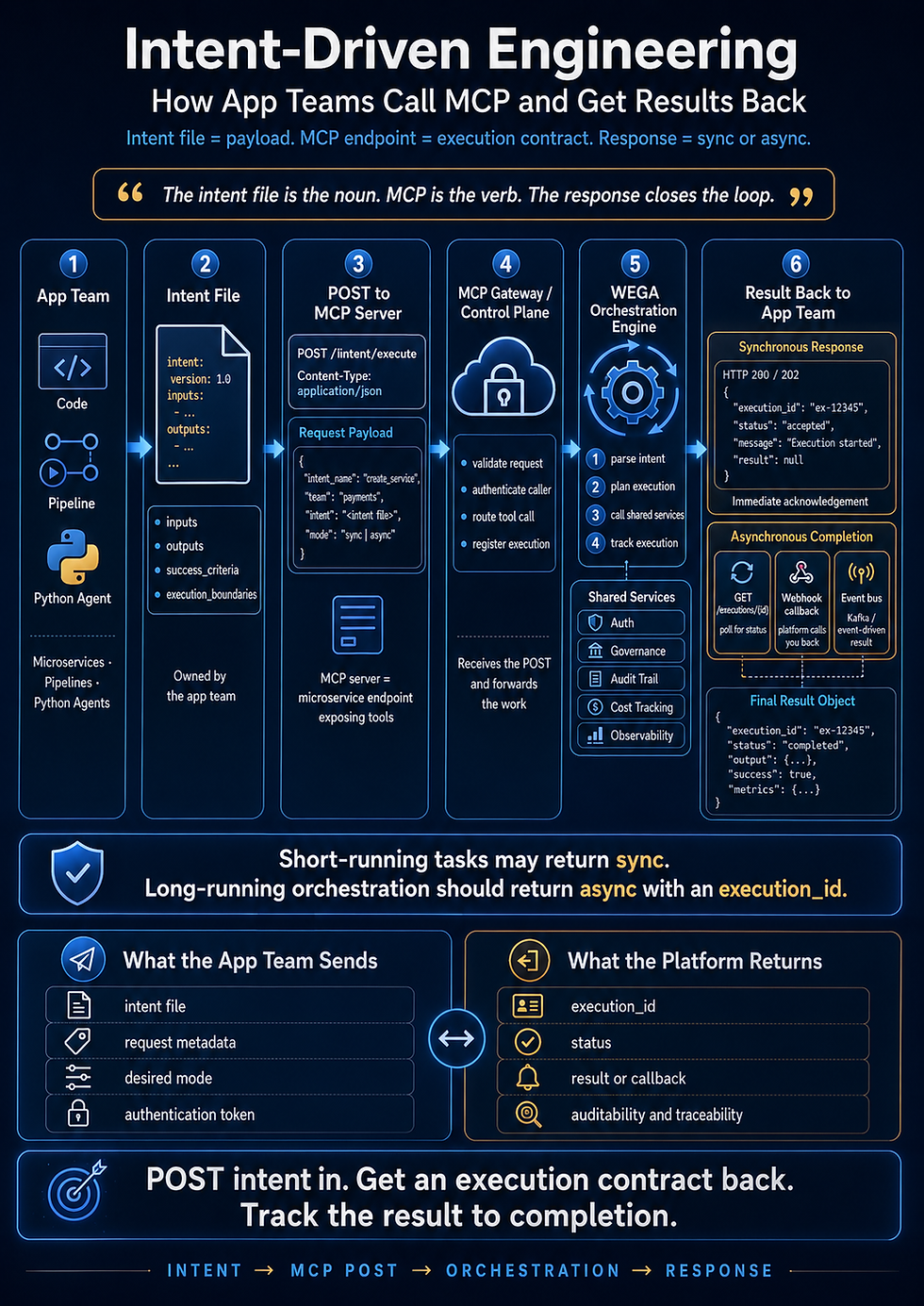
That is where Intent-Driven Engineering comes in.
Intent-Driven Engineering is the software delivery and enterprise architecture layer of the intent-driven enterprise.
It answers a practical question:
How do we turn business intent into working software, tested systems, deployed applications, measurable outcomes, and validated enterprise impact?
That is not just a prompt engineering problem.
That is an operating model problem.
Intent-Driven Engineering Turns Intent Into Execution
Intent-Driven Engineering is about creating a structured path from business intent to technical execution.
That path includes:
Business outcome
User goal
Functional behavior
Architecture context
API impacts
Data requirements
Security requirements
Deployment expectations
Testing expectations
Observability requirements
Edge cases
Acceptance evidence
Validation criteria
This is where intent becomes executable.
In the old world, requirements were often buried in documents, Jira tickets, email threads, meetings, and tribal knowledge.
In the new world, the intent file becomes one of the most important engineering artifacts.
An intent file is not just a prompt.
It is not just a user story.
It is not just a specification.
It is a structured expression of what the business wants, what the system must do, what constraints must be honored, and what evidence will prove the work is complete.
That is the missing layer between business language and code.
Why Forbes Validation Matters
The Forbes article matters because it shows that enterprise leaders are now talking about intent as a serious business and technology concept.
That gives those of us working in Intent-Driven Engineering a stronger position.
We are not trying to convince the market that intent matters from scratch anymore.
The broader market is already moving in that direction.
The stronger question now is:
If the enterprise is becoming intent-driven, how will engineering teams actually deliver against that intent?
That is where Intent-Driven Engineering becomes essential.
Forbes is validating the broader movement. Engineering leaders now need to build the execution layer.
Forbes article:
Claude Code And The Engineering Execution Layer
Tools like Claude Code make this shift practical.
Claude Code is not just another code assistant when used properly. It can become part of an AI-native engineering workflow.
With the right structure, Claude Code can help teams:
Read and understand repositories
Analyze architecture
Generate implementation plans
Create or modify code
Build tests
Review impact areas
Support refactoring
Update documentation
Prepare pull requests
Work from structured intent files
Coordinate with skills, hooks, subagents, and MCP-connected context
But the key phrase is with the right structure.
AI does not fix unclear intent.
If the business intent is vague, the output will be vague.
If the architecture context is missing, the implementation will drift.
If the acceptance evidence is weak, the team will not know whether the work is truly complete.
That is why Intent-Driven Engineering matters.
It gives AI systems and human engineers a shared operating model.
The Intent File Becomes The Control Point
In an AI-native engineering organization, the intent file becomes a control point.
It connects business strategy to delivery execution.
A strong intent file can tell the AI system and the engineering team:
What outcome matters
What user problem is being solved
What systems are involved
What constraints apply
What APIs or integrations are required
What security rules must be followed
What tests must pass
What evidence must be produced
What deployment conditions must be met
What success looks like
That is much stronger than simply asking an AI tool to “build this feature.”
The intent file creates alignment.
It gives the human architect something to review.
It gives the developer something to execute.
It gives Claude Code something precise to reason over.
It gives QA something to validate.
It gives leadership a clearer line of sight from intent to outcome.
From Intent To Simulation
The next stage is even more powerful.
Once intent is captured clearly, engineering teams can begin to simulate the work before building it.
That means asking:
What systems will this impact?
What dependencies exist?
What risks are likely?
What is the estimated effort?
What could fail?
What test coverage is needed?
What is the expected business value?
What evidence would prove success?
This connects Intent-Driven Engineering to Simulation-Driven Engineering.
The future enterprise will not simply build and hope.
It will define intent, simulate options, predict risk, validate assumptions, execute with AI-assisted workflows, and measure impact.
That is the next level.
The Big Opportunity
The Forbes article is a signal that the market is moving.
The Intent-Driven Enterprise is becoming a real conversation.
But most organizations still do not have a practical engineering model for it.
That is the opportunity.
Intent-Driven Engineering can become the execution layer of the intent-driven enterprise.
It can help companies move from:
Requirements to intent
Tickets to structured execution
Manual handoffs to AI-assisted workflows
Unclear acceptance criteria to measurable evidence
Code generation to full delivery acceleration
Agile ceremonies to outcome-driven engineering
AI experimentation to enterprise operating models
This is bigger than productivity.
This is about changing how engineering work flows through the enterprise.
Final Thought
Forbes writing about “The Rise Of The Intent-Driven Enterprise” is validation.
It confirms that intent is becoming a serious enterprise AI concept.
But recognition is only the first step.
The next step is execution.
Enterprises need a way to turn intent into architecture, code, tests, deployment, evidence, simulation, and measurable business impact.
That is the role of Intent-Driven Engineering.
The intent-driven enterprise is the destination.
Intent-Driven Engineering is how software teams help build it.
And for those of us already working in this space, the message is clear:Intent is becoming the new control layer of the enterprise — and engineering is where it becomes real.*
:::I’d post this with a short LinkedIn caption like: “Forbes is now writing about the Intent-Driven Enterprise. That validates the broader market direction. My focus is the next layer: Intent-Driven Engineering — the operating model that turns enterprise intent into architecture, code, tests, deployment, and measurable impact.”
Comments