

Mastering Enterprise AI Architecture A Repeatable Workflow for Turning Business Intent into Production Software
- Mark Kendall
- 12 minutes ago
- 4 min read

Mastering Enterprise AI Architecture
A Repeatable Workflow for Turning Business Intent into Production Software
Prompt engineering is no longer enough.
As AI becomes a standard part of enterprise software delivery, the question has shifted from “How do I write better prompts?” to “How do I build a repeatable engineering workflow that consistently delivers production-ready results?”
That distinction matters.
Many developers still think of AI as a chatbot that answers questions or generates snippets of code. Enterprise architects see something very different: AI is a collaborative engineering platform capable of planning, designing, implementing, validating, documenting, and even preparing pull requests—when given the right operating model.
Over the past year, I’ve found that the highest-performing teams don’t rely on clever prompts. They rely on a repeatable workflow that transforms business intent into deployable software.
The New Starting Point: Business Intent
Every successful project begins with a business problem—not with code.
Instead of asking an AI to “write a REST API,” begin with the business outcome:
Reduce order processing time by 40%
Integrate Salesforce with multiple billing systems
Add a new TMF API endpoint
Automate customer onboarding
This business objective becomes the foundation for everything that follows.
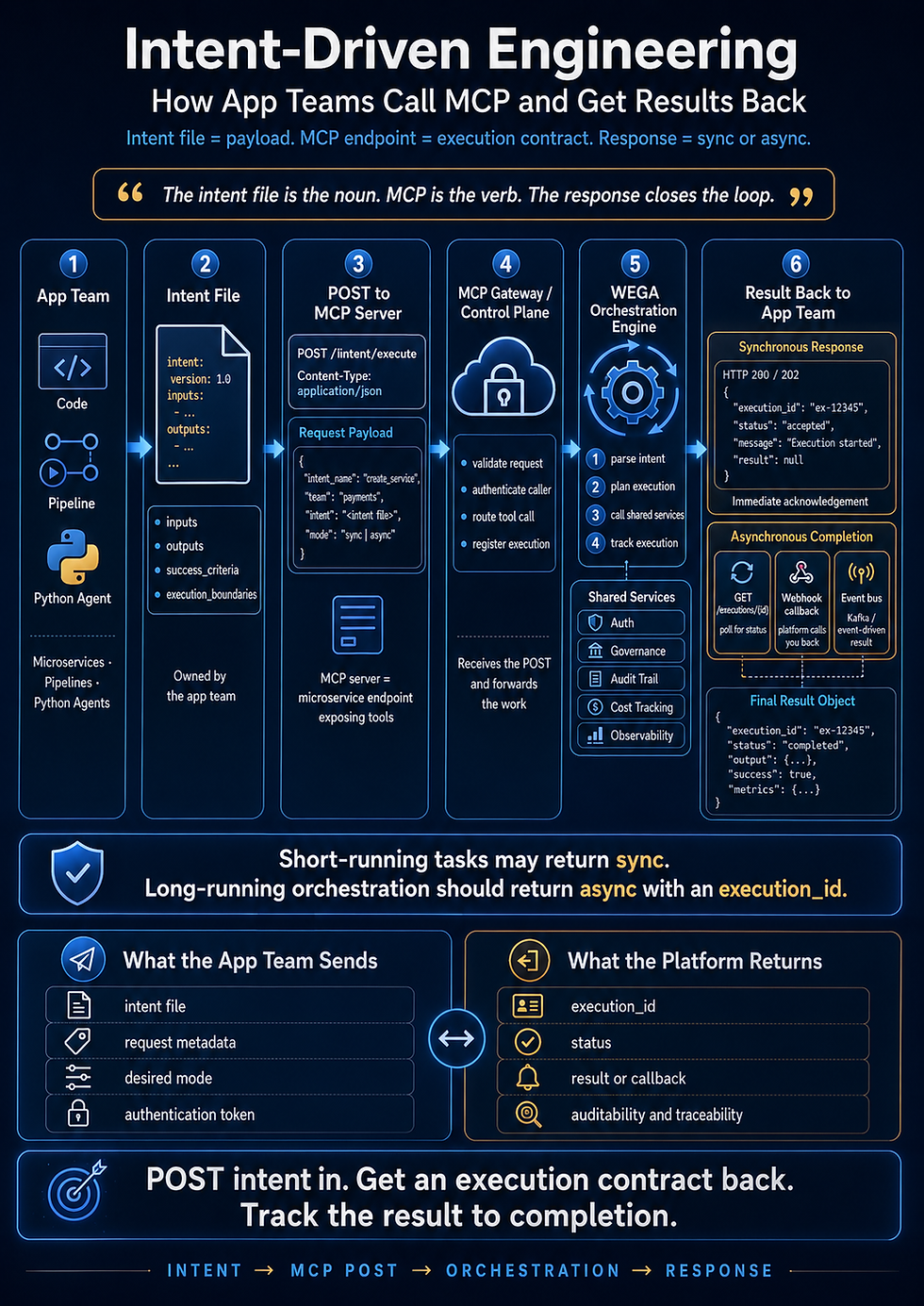
The Enterprise AI Workflow
Business Intent
↓
Intent File (Feature.md)
↓
MCP Retrieval
↓
Planning Agent
↓
Specialist Agents
↓
Implementation
↓
Validation
↓
Testing
↓
PR Creation
↓
Deployment
↓
Observability
Let’s walk through each stage.
1. Business Intent
Everything starts with a clearly defined objective.
Rather than telling AI what to build, explain why it needs to exist.
Good intent includes:
Business goals
Success criteria
Constraints
Stakeholders
Expected outcome
The clearer the intent, the better every downstream decision becomes.
2. Intent File (Feature.md)
Instead of relying on a massive prompt, convert the business intent into a structured engineering artifact.
An Intent File becomes the project’s contract.
Typical sections include:
Business objective
Functional requirements
Technical constraints
Acceptance criteria
Dependencies
Security requirements
Testing expectations
Unlike prompts, Intent Files evolve with the project and become reusable organizational knowledge.
3. MCP Retrieval
Enterprise AI should never operate in isolation.
Before generating code, retrieve the latest context from enterprise systems, such as:
Jira
Confluence
GitHub
Figma
Internal APIs
Architecture documentation
Coding standards
Knowledge bases
This ensures decisions are based on current organizational knowledge rather than assumptions.
4. Planning Agent
Planning comes before implementation.
The planning agent determines:
Scope
Architecture
Required repositories
Interfaces
Dependencies
Risks
Sequence of work
At this stage, AI is acting like a senior technical lead—not a code generator.
5. Specialist Agents
Large tasks become smaller specialized responsibilities.
Examples include:
API Agent
Database Agent
Security Agent
Test Agent
Documentation Agent
UI Agent
DevOps Agent
Each agent focuses on a narrow area while sharing the same business intent and planning context.
This specialization improves quality, consistency, and maintainability.
6. Implementation
Only after planning is complete should implementation begin.
AI can now generate:
Production-ready code
Configuration
Infrastructure
Documentation
Migration scripts
API contracts
Because the implementation is grounded in enterprise context, it aligns much more closely with organizational standards.
7. Validation
Enterprise AI should continuously validate its work.
Examples include:
Coding standards
Security rules
Architectural patterns
Static analysis
Design compliance
Acceptance criteria
Validation ensures AI doesn’t simply produce code—it produces acceptable code.
8. Testing
Testing should be treated as a first-class activity.
AI can generate:
Unit tests
Integration tests
API tests
Regression tests
Performance scenarios
Edge-case validation
Testing is no longer an afterthought—it’s built into the workflow.
9. Pull Request Creation
AI can now assemble a complete pull request containing:
Code changes
Documentation updates
Test evidence
Architectural rationale
Release notes
Instead of manually collecting these artifacts, they’re produced as part of the delivery pipeline.
10. Deployment
Modern AI workflows can support deployment by:
Generating deployment plans
Creating release checklists
Producing infrastructure changes
Updating configuration
Coordinating rollout strategies
Deployment becomes a managed engineering activity rather than a manual handoff.
11. Observability
Deployment isn’t the end.
Enterprise systems require continuous visibility.
Monitor:
Performance
Errors
Logs
Business metrics
Customer impact
Operational health
Observability closes the loop, providing feedback that informs future enhancements.
Beyond Prompt Engineering
Notice what’s missing from this workflow.
There is no stage called “Write the perfect prompt.”
Prompting still matters—but it’s one capability within a much larger engineering lifecycle.
The real differentiators today are:
Clear business intent
Structured engineering artifacts
Enterprise knowledge retrieval
Planning before coding
Specialized AI agents
Automated validation
Continuous testing
Production-ready delivery
That’s what separates experimentation from enterprise-scale AI adoption.
A Repeatable Enterprise Workflow
The goal isn’t to master one AI model.
The goal is to develop a repeatable workflow that works across AI platforms and evolves as new models emerge.
A model may change.
A workflow scales.
That distinction is what enables organizations to adopt AI consistently, securely, and effectively.
Final Thoughts
The future of enterprise software development won’t belong to the teams with the most creative prompts.
It will belong to the teams with the most disciplined workflows.
A repeatable AI architecture transforms business intent into planning, planning into implementation, implementation into validation, and validation into production-ready software.
That’s how organizations move beyond using AI as a tool—and begin using it as an integral part of their engineering operating model.
Key Takeaway
Develop a repeatable enterprise workflow for using AI to accelerate architecture, software delivery, technical writing, and organizational AI adoption. Focus on business intent, structured planning, enterprise context, validation, and continuous improvement—not just prompts.
Comments