

Prompt Chaining: The Enterprise Architect’s Guide to Building Reliable AI Workflows
- Mark Kendall
- 2 minutes ago
- 3 min read

Prompt Chaining: The Enterprise Architect’s Guide to Building Reliable AI Workflows
One of the biggest misconceptions in
enterprise AI is that better results come from writing bigger prompts.
They don’t.
The most successful AI architects rarely rely on one massive prompt containing hundreds of lines of instructions. Instead, they decompose complex work into a series of focused, deterministic steps. This approach is called Prompt Chaining, and it’s one of the most valuable techniques for building reliable, scalable AI solutions.
If you’re preparing for the Claude Certified Architect exam—or designing enterprise AI workflows—mastering Prompt Chaining is essential.
What Is Prompt Chaining?
Prompt Chaining is the practice of breaking a complex task into smaller prompts where the output of one step becomes the input to the next.
Instead of asking Claude to perform every task at once, each prompt has a single responsibility.
Think of it like a software pipeline.
Requirements
↓
Analysis
↓
Planning
↓
Implementation
↓
Testing
↓
Documentation
↓
Pull Request
Each stage improves the quality of the next.
Why One Giant Prompt Usually Fails
Large prompts often suffer from predictable problems:
Too many competing objectives
Mixed priorities
Loss of focus
Inconsistent output
Difficult debugging
Higher token consumption
Lower repeatability
When Claude receives a focused prompt, it can dedicate its reasoning to one well-defined objective.
The result is higher-quality output with fewer surprises.
The Enterprise Pattern
Rather than asking:
“Build my feature, update the documentation, create tests, fix bugs, optimize performance, and prepare the pull request.”
Break the work into distinct phases.
Step 1 – Understand the Request
Goal:
Understand exactly what the business needs.
Prompt:
Analyze this Jira story. Summarize the business goal, identify assumptions, highlight missing information, and list any risks before implementation.
Output:
Business summary
Questions
Risks
Acceptance criteria
Step 2 – Gather Context
Goal:
Retrieve supporting information.
Prompt:
Using the project’s MCP servers, retrieve related Confluence documentation, architecture diagrams, coding standards, and similar completed work.
Output:
Design documents
Coding standards
Existing implementations
Repository guidance
Step 3 – Create the Plan
Goal:
Build the implementation strategy.
Prompt:
Create a detailed implementation plan. Identify affected files, required changes, dependencies, testing strategy, and rollback considerations.
Output:
File list
Architecture decisions
Task breakdown
Risks
Step 4 – Implement
Goal:
Generate production-quality code.
Prompt:
Implement only the approved plan. Follow the repository’s CLAUDE.md guidance, coding standards, and architectural conventions.
Output:
Source code
Comments
Error handling
Step 5 – Validate
Goal:
Verify correctness.
Prompt:
Execute validation. Review coding standards, run tests, identify regressions, and recommend improvements before creating a pull request.
Output:
Test results
Findings
Recommendations
Step 6 – Deliver
Goal:
Prepare the deployment package.
Prompt:
Generate release notes, update documentation, summarize implementation decisions, and prepare a pull request description.
Output:
PR description
Documentation updates
Release notes
Prompt Chaining + Claude Code
Claude Code becomes even more powerful when Prompt Chaining is combined with enterprise features.
CLAUDE.md provides repository standards.
MCP Servers retrieve live enterprise knowledge.
Plan Mode analyzes before implementation.
Slash Commands package reusable workflows.
Hooks automatically enforce quality.
Prompt Chaining orchestrates all of these capabilities into a repeatable engineering process.
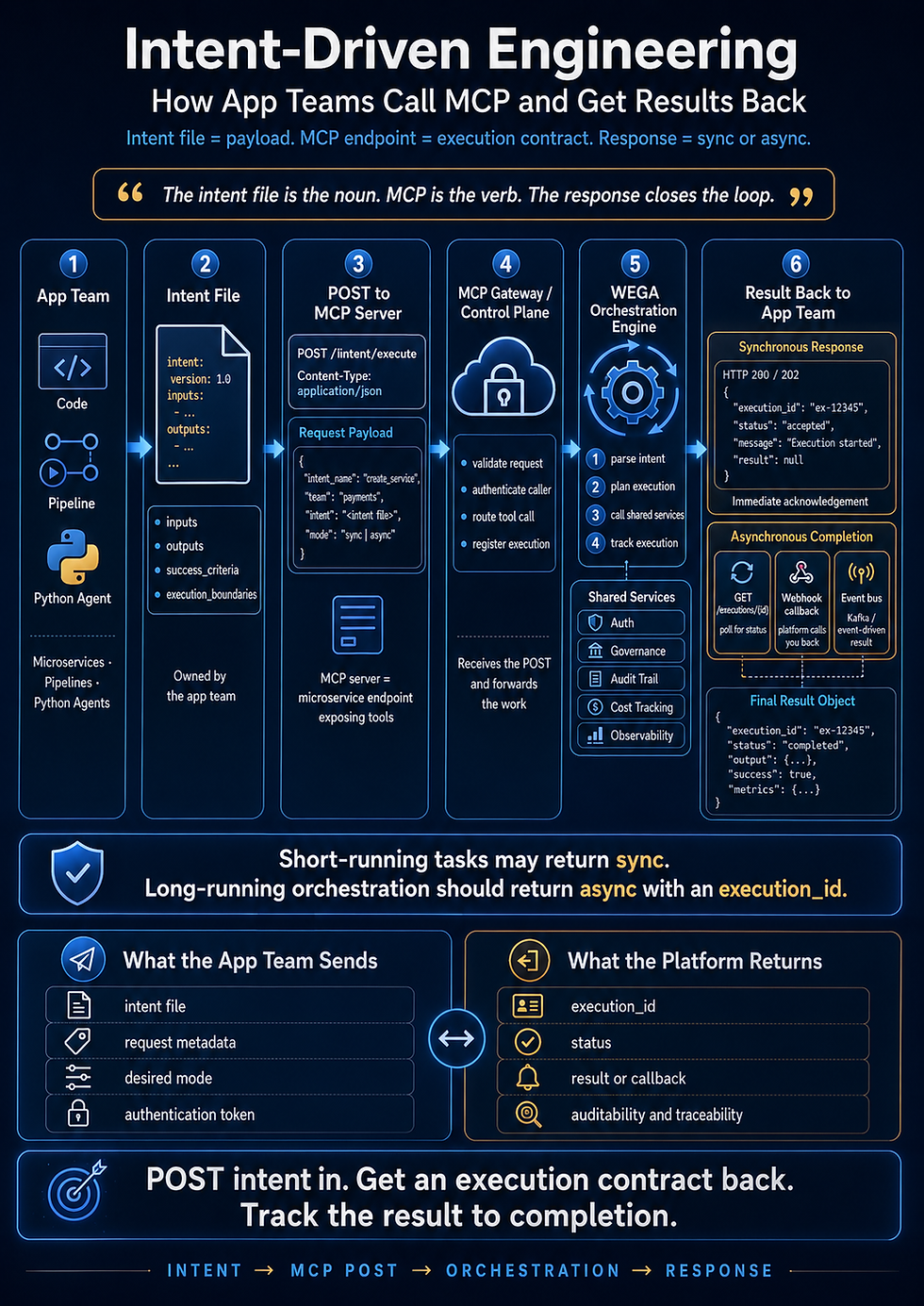
Prompt Chaining vs. Intent-Driven Engineering
Prompt Chaining answers the question:
“What logical step comes next?”
Intent-Driven Engineering answers the larger question:
“What outcome are we trying to achieve?”
In Intent-Driven Engineering, the intent acts as the blueprint, while Prompt Chaining becomes the execution engine.
For example:
Intent
“Implement customer login with multi-factor authentication.”
The chain then executes:
Understand the intent.
Retrieve enterprise context.
Build the implementation plan.
Generate code.
Validate quality.
Produce documentation.
Create the pull request.
Notice that every step remains focused on delivering the original business intent.
Best Practices
The strongest Prompt Chains follow a few simple principles:
One objective per prompt.
Keep outputs structured.
Validate before moving forward.
Save important artifacts between stages.
Use enterprise context instead of repeating instructions.
Let automation handle repetitive tasks.
Review plans before implementation.
Final Thoughts
Prompt Chaining isn’t about writing longer prompts—it’s about designing better workflows.
The best enterprise AI systems behave much like experienced engineering teams. They analyze first, gather context, create a plan, implement carefully, validate automatically, and document everything before delivery.
When combined with Claude Code, MCP Servers, Plan Mode, Hooks, and Intent-Driven Engineering, Prompt Chaining transforms AI from a coding assistant into a dependable software delivery pipeline.
That’s the difference between asking AI for answers and engineering AI-powered solutions.
For your Claude Architect exam, I’d give Prompt Chaining extra emphasis. It’s not just a prompt engineering technique—it connects planning, context retrieval, implementation, testing, and delivery into a deterministic workflow, which aligns closely with enterprise AI architecture and your Intent-Driven Engineering approach.
Comments