

Spec-Driven Development vs. Intent-Driven Engineering
- Mark Kendall
- 3 minutes ago
- 3 min read

Spec-Driven Development vs. Intent-Driven Engineering
Why It’s Time to Move Beyond Prompts
Introduction
For decades, software engineering has followed a familiar rhythm: define requirements, write specifications, build, review, and ship. It’s structured, it’s repeatable, and it works—up to a point.
But in a world of AI-assisted development, multi-agent systems, and enterprise-scale automation, that model is starting to show its limits.
A new approach is emerging—Intent-Driven Engineering—and it doesn’t just improve the process. It redefines it.
What Is Spec-Driven Development?
Spec-Driven Development is the traditional model where teams:
Define requirements and goals
Create specifications (docs, tickets, user stories)
Build based on those specs
Iterate through review and feedback cycles
At its core:
Specs describe what should be built. Humans and tools figure out how.
This approach relies heavily on:
human interpretation
manual consistency
iterative correction
It’s process-driven, not system-driven.
What Is Intent-Driven Engineering?
Intent-Driven Engineering takes a fundamentally different approach.
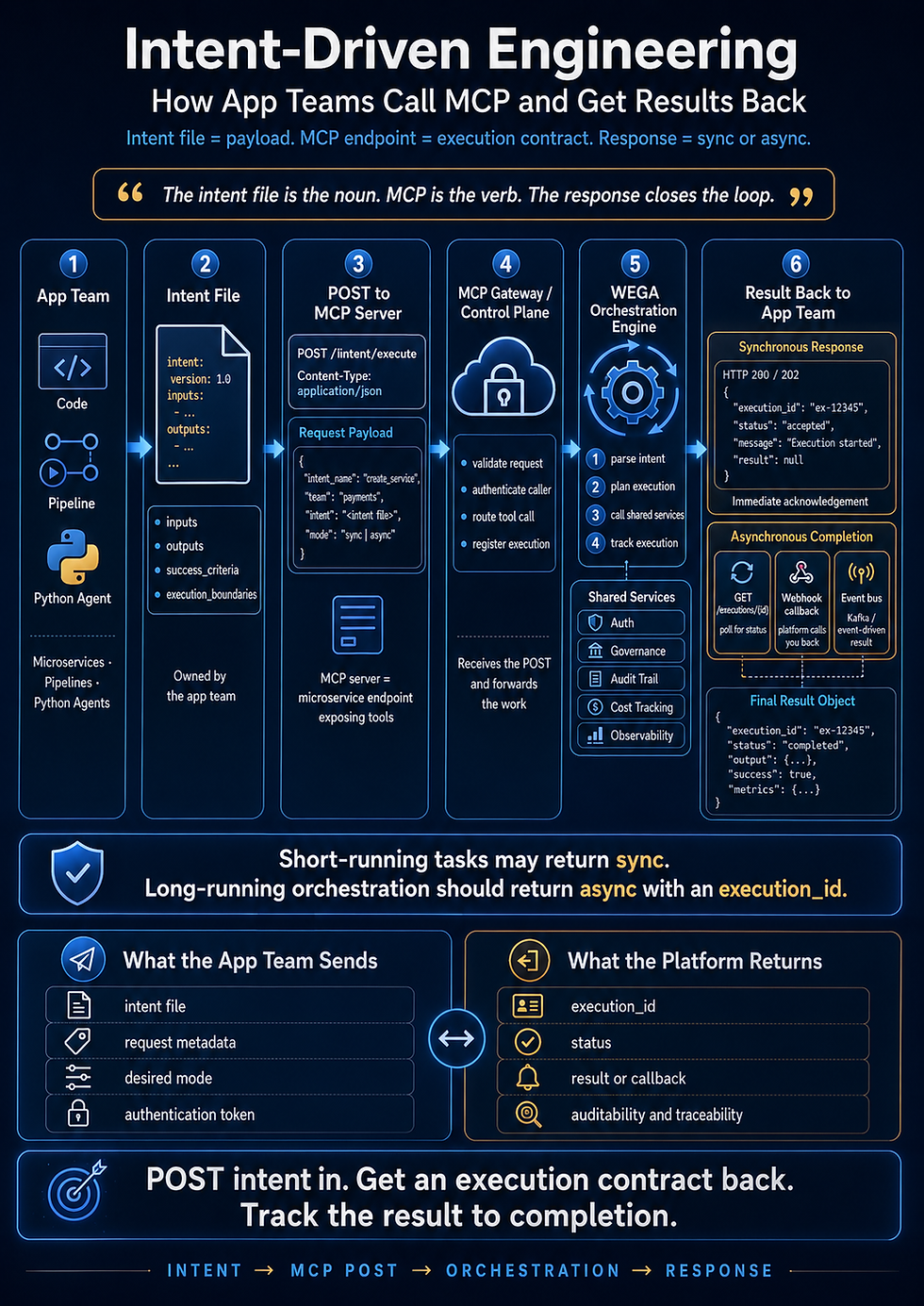
Instead of writing specs as documentation, teams define intent files—structured, machine-readable artifacts that include:
Inputs
Outputs
Success criteria
Execution boundaries
These are not just descriptions.
The intent file is not documentation. It is the system.
From that intent, platforms can:
validate constraints
compile execution plans
orchestrate agents or services
measure outcomes automatically
This shifts the model from:
👉 Describing work → to → Driving execution
The Core Difference
Spec-driven development is a workflow.
Intent-driven engineering is a programmable system.
Here’s how they differ in practice:
1. Passive vs. Active Artifacts
Specs are passive—they require interpretation
Intent files are active—they drive execution
In spec-driven systems, the document sits beside the work.
In intent-driven systems, the document becomes the work.
2. Iteration vs. Compilation
Spec-driven development relies on loops:
Draft → Review → Build → Fix → Repeat
Intent-driven engineering moves upstream:
Define → Validate → Compile → Execute
Ambiguity is resolved before execution, not after failure.
3. Human-Dependent vs. System-Enforced Consistency
Spec-driven success depends on:
team discipline
engineering maturity
process adherence
Intent-driven systems encode:
constraints
validation rules
measurable success criteria
Consistency becomes enforced by the system, not left to chance.
4. Broken Flow vs. End-to-End Continuity
Traditional workflows separate:
design
implementation
validation
operations
Intent-driven engineering connects them:
one artifact governs everything from definition to runtime
There’s no translation loss between phases.
5. Project Scaling vs. System Scaling
Spec-driven development scales by adding:
more engineers
more processes
more coordination
Intent-driven engineering scales by:
reusing intent patterns
automating execution
leveraging shared services
Spec-driven scales people. Intent-driven scales systems.
6. Shipping vs. Operating
Spec-driven workflows end at:
🚀 Ship
Intent-driven systems continue with:
observability
success measurement
retry and failure handling
continuous evaluation
You don’t just deliver software.
You deliver controlled outcomes.
Why This Shift Matters
As systems become more complex—especially with AI and agent-based architectures—the cost of ambiguity increases.
Spec-driven development:
tolerates ambiguity
resolves it through iteration
Intent-driven engineering:
eliminates ambiguity through structure
enforces correctness through execution
This is critical for:
enterprise platforms
multi-agent orchestration
cost-controlled AI systems
shared services architectures
Key Takeaways
Spec-driven development improves how we write requirements
Intent-driven engineering redefines what a requirement is
Specs guide humans
Intent guides systems
Spec-driven is a process
Intent-driven is a programmable execution model
Final Thought
Spec-driven development tells engineers what to build.
Intent-driven engineering tells systems how to execute.
The industry isn’t just evolving its workflows.
It’s redefining the role of the artifact itself.
If you’re building modern systems—especially those involving AI, automation, or shared services—
👉 It’s time to move beyond prompts.
Comments