

The Future of Software Engineering Is Not More Code. It Is Executable Intent.
- Mark Kendall
- 3 hours ago
- 9 min read

The Future of Software Engineering Is Not More Code. It Is Executable Intent.
Software engineering is entering a strange and important phase.
For the past several years, the industry has been flooded with increasingly powerful ways to generate code.
We have seen prompt engineering, AI pair programming, vibe coding, specification-driven development, autonomous agents, repository-aware assistants, code generators, copilots, orchestration frameworks, and entire digital development teams.
The tools keep improving.
The models keep getting smarter.
The investment keeps getting larger.
And yet, inside many enterprises, one question is becoming impossible to avoid:
When does all of this begin producing measurable business results?
Executives are asking.
Customers are asking.
Boards are asking.
Investors are asking.
Engineering leaders are asking too.
Because generating code was never the complete problem.
The real challenge has always been turning an incomplete business idea into a secure, reliable, maintainable production outcome.
AI has not eliminated that challenge.
It has revealed it.
The First AI Engineering Era Was About Speed
The first wave of AI-assisted development focused primarily on acceleration.
Developers could write functions faster.
Tests could be generated automatically.
Documentation could appear instantly.
Boilerplate could be produced in seconds.
Existing code could be explained, translated, refactored, and repaired through natural language.
This was extraordinary progress.
But most organizations initially treated AI as an enhancement to the existing software factory.
They inserted a faster coding tool into the same delivery system and expected the entire organization to accelerate.
That rarely happened.
Code generation improved, but requirements remained unclear.
Architecture decisions remained fragmented.
Business context remained scattered across documents, meetings, tickets, designs, and individual experience.
Security reviews still happened late.
Testing remained inconsistent.
Release processes remained complicated.
Approval chains remained slow.
The developer became faster, but the system surrounding the developer did not.
That is why many companies experienced an increase in code production without a comparable increase in valuable software delivery.
The bottleneck simply moved.
The Bottleneck Is Moving Upstream
As AI becomes better at implementation, the most difficult work moves earlier in the lifecycle.
The central questions are no longer simply:
How quickly can we write the code?
Which model produces the best implementation?
Which assistant generates the cleanest pull request?
The more important questions are becoming:
Why are we building this?
What business outcome are we trying to create?
Which enterprise systems contain the required context?
What constraints must never be violated?
How should the work be decomposed?
Which decisions require human judgment?
What evidence will prove that the result is correct?
How will the organization know that the original intent was fulfilled?
This is the transition now taking place.
Software engineering is moving from code-centered delivery to intent-centered execution.
Coding Tools Are Becoming Infrastructure
Today, companies still compare individual AI tools.
They debate which coding assistant is better.
They compare model benchmarks.
They evaluate prompt quality, context windows, agent capabilities, tool integrations, and code-generation accuracy.
Those comparisons still matter.
But over the next several years, many of these capabilities will become expected infrastructure.
Every serious engineering platform will be able to:
understand a repository,
generate and modify code,
create tests,
inspect dependencies,
call external tools,
execute development workflows,
open pull requests,
analyze failures,
and respond to review feedback.
The differentiator will no longer be whether an organization has access to an intelligent coding model.
Nearly everyone will.
The differentiator will be whether the organization has built a reliable system around it.
The future advantage will come from the quality of the enterprise context, operating model, validation process, and governance surrounding the model.
The Engineer Becomes the Director of an Execution System
The role of the software engineer is not disappearing.
It is expanding.
The engineer of the future will still write code, but manual code creation will become only one part of the job.
More of the engineer’s time will be spent directing, evaluating, refining, and governing automated execution.
The engineer will increasingly act as:
an intent translator,
an architectural decision-maker,
a context curator,
an agent orchestrator,
a validation designer,
a risk manager,
and an owner of production outcomes.
Instead of personally creating every artifact, the engineer will supervise a system that creates many of them.
That system may generate implementation plans, code changes, tests, documentation, infrastructure configurations, deployment evidence, security findings, and operational telemetry.
The human remains responsible for judgment.
The machine assumes more responsibility for execution.
This changes the definition of engineering excellence.
The best engineer will not necessarily be the person who produces the most code.
It will be the person who can consistently turn unclear business needs into precise, governed, testable, and executable work.
The Repository Becomes an Intelligent Operating Environment
The software repository of the future will be more than a collection of source files.
It will become a partially executable representation of how the organization wants software to be built.
A mature repository will communicate:
the purpose of the system,
its architectural principles,
the business rules it must preserve,
the commands available to agents,
the tools they may use,
the standards they must follow,
the tests they must execute,
the evidence they must produce,
and the conditions under which they must stop and request human guidance.
The repository will contain not only code, but institutional knowledge.
It may include intent files, architecture decisions, reusable skills, agent definitions, validation rules, security policies, operational requirements, and links to authoritative enterprise context.
In this environment, the repository itself becomes a delivery platform.
A well-prepared repository will allow an AI engineering system to operate safely and productively.
A poorly prepared repository will continue to produce uncertainty, rework, and inconsistent results regardless of which model is used.
The Rise of the Intent Layer
Prompt engineering helped people communicate with models.
Specification-driven development introduced more structure around what software should do.
Context engineering improved the information available to the model.
Agentic engineering allowed work to be delegated across specialized autonomous processes.
Platform engineering created reusable pathways for delivering software safely.
All of these disciplines matter.
But enterprises are beginning to need a layer above them.
They need a mechanism that connects business purpose to technical execution.
That mechanism is the intent layer.
Intent explains why the work exists.
It defines the desired outcome.
It identifies the constraints.
It connects the work to enterprise context.
It guides decomposition and execution.
It establishes the evidence required for completion.
And it maintains traceability from the original business objective to the production result.
This is where intent-driven engineering becomes important.
Intent-driven engineering is not simply another method for generating code.
It is an operating model for turning human purpose into governed machine execution.
Intent-Driven Engineering as the Control Plane
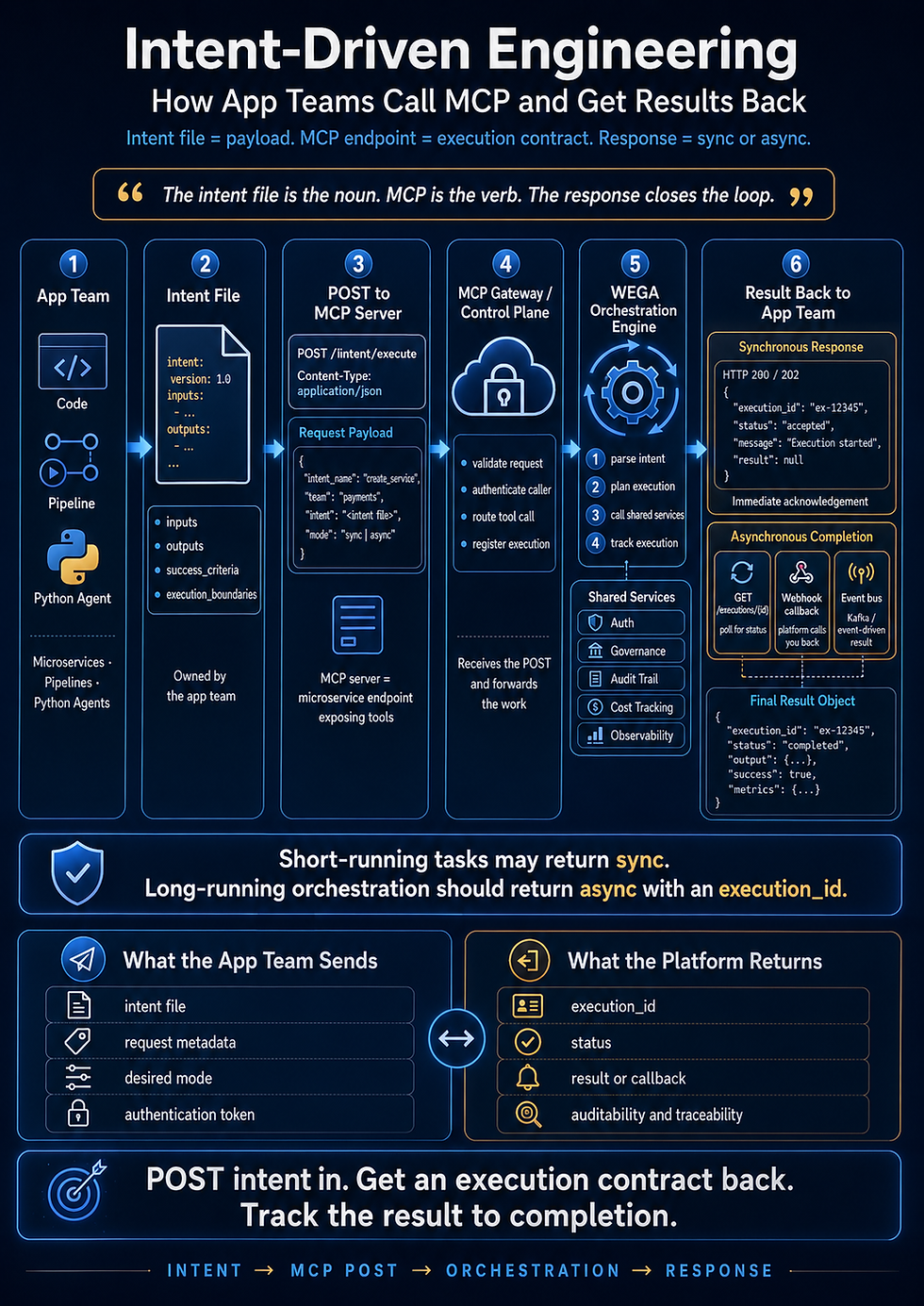
In its mature form, intent-driven engineering can become the control plane for AI-assisted software delivery.
The process begins with an outcome rather than a prompt.
That outcome is captured as structured intent.
The intent is enriched with enterprise context from product systems, architecture repositories, design platforms, documentation, policies, APIs, databases, and operational environments.
The work is then decomposed into executable units.
Specialized agents plan, implement, test, inspect, and validate the change.
Automated controls enforce architecture, quality, security, and compliance requirements.
Human experts make the decisions that require judgment, accountability, or business interpretation.
The result is not merely generated code.
The result is a validated production outcome with evidence connecting it back to the original intent.
The future workflow may look like this:
Business Intent → Enterprise Context → Executable Plan → Agentic Delivery → Automated Validation → Human Judgment → Production Evidence
This is much larger than a coding workflow.
It is a new enterprise delivery model.
The Digital Engineering Workforce
Over the next several years, software teams will begin working with increasingly sophisticated digital workforces.
These will not be single agents attempting to complete an entire feature.
They will be coordinated systems of specialized capabilities.
One agent may gather requirements.
Another may inspect the repository.
Another may identify architectural constraints.
Another may create the implementation plan.
Others may generate code, build tests, inspect security risks, validate accessibility, review infrastructure changes, analyze costs, and prepare deployment evidence.
The human team will direct the system, resolve ambiguity, approve critical decisions, and remain accountable for the outcome.
This creates a new organizational structure.
Companies will no longer think only in terms of how many developers are assigned to a project.
They will think about the combined capacity of the human and digital engineering workforce.
The key management questions will become:
Which work should remain human-led?
Which work can be delegated?
Which agents are approved?
What context can they access?
What decisions can they make?
What validations must they pass?
What is the cost of each execution path?
Who is accountable when the system is wrong?
These questions will define the next generation of engineering leadership.
Smaller Teams, Larger Outcomes
Engineering organizations are likely to become smaller, more capable, and more outcome-oriented.
This does not mean one engineer will simply replace an entire delivery organization.
The transition will be more structural than that.
Traditional delivery models are filled with handoffs.
A business team creates a request.
An analyst interprets it.
An architect translates it.
Developers implement it.
Testers validate it.
Security reviews it.
Operations deploys it.
Support teams maintain it.
At every handoff, context can be lost.
Future teams will be designed around ownership of the complete outcome.
A compact team may be responsible for an intent from its initial definition through production operation.
The team will use agents and automation to perform much of the repeatable work, but it will retain end-to-end accountability.
Success will be measured less by activity and more by results.
The important measurements will become:
time from intent to production,
cost per validated outcome,
defect escape rate,
rework caused by misunderstood intent,
production reliability,
customer impact,
and the operating cost of the delivered capability.
Story points, lines of code, pull-request counts, and prompt volume will become increasingly weak indicators of actual performance.
The New Apprenticeship Problem
There is also a serious challenge ahead.
Many of the tasks traditionally assigned to junior developers are becoming easier to automate.
Simple fixes, boilerplate generation, basic tests, routine documentation, straightforward integrations, and common refactoring work can increasingly be performed by AI systems.
But those tasks have historically been how engineers learned.
They developed judgment by making small changes, receiving feedback, observing failures, and gradually taking responsibility for larger systems.
The industry cannot eliminate the entry-level learning path and still expect experienced engineers to appear later.
Companies will need to create a new apprenticeship model.
Junior engineers will need to learn how to:
inspect AI-generated work,
understand system behavior,
reason about tradeoffs,
validate assumptions,
design tests,
investigate failures,
manage context,
and make increasingly complex decisions.
The new junior engineer may write less code manually, but will need to understand more of the delivery system earlier.
The apprenticeship of the future will be built around supervised judgment rather than repetitive implementation.
Enterprise Context Becomes a Strategic Asset
Models will continue to improve.
Prices will change.
Vendors will compete.
New coding environments will appear.
Agent platforms will evolve quickly.
But the most durable advantage may not come from owning a particular model.
It may come from owning the best structured enterprise context.
Every organization contains enormous amounts of knowledge:
why systems were built,
how business rules evolved,
which architectural decisions were made,
which customer commitments exist,
which regulations apply,
which dependencies are fragile,
which operational patterns cause failure,
and which exceptions matter.
Today, much of that knowledge is fragmented across documents, meetings, tickets, messages, and individual memory.
The organization that turns that knowledge into governed, accessible, executable context will have a major advantage.
Its agents will make better decisions.
Its engineers will spend less time rediscovering information.
Its systems will be easier to modify.
Its delivery outcomes will become more predictable.
Enterprise context will become part of the engineering platform itself.
The Delivery System Becomes the Real Product
By the end of this transition, leading companies will stop thinking about AI engineering as a collection of tools.
They will operate an integrated delivery system.
That system will include:
approved models,
structured intent,
enterprise context,
reusable skills,
specialized agents,
repository instructions,
architecture controls,
automated evaluations,
security policies,
cost governance,
observability,
deployment pathways,
and human decision points.
The quality of this system will determine the productivity of the organization.
Two companies may use the same model and the same coding assistant.
One will produce unreliable output, expensive rework, and frustrated teams.
The other will deliver quickly, safely, and predictably.
The difference will be the operating system surrounding the AI.
The Most Important Artifact May No Longer Be the Code
Code will remain essential.
But code is becoming easier to generate, transform, migrate, test, and replace.
The more code becomes machine-generated, the more important the artifacts surrounding it become.
The durable assets will be:
why the system exists,
what outcomes it must produce,
which rules it must obey,
what decisions shaped it,
how correctness is evaluated,
what evidence proves it works,
and who remains accountable.
The most important engineering artifact of the future may not be the source code itself.
It may be the governed intent system that allows the code to be safely recreated, modified, and operated.
That is a profound change.
Software has traditionally been treated as the primary expression of the system.
In the future, software may increasingly become one generated implementation of a deeper and more durable intent model.
Where This Is Going
Vibe coding demonstrated that software could be created conversationally.
Prompt engineering demonstrated that instructions matter.
Specification-driven development demonstrated that structure matters.
Context engineering demonstrated that knowledge matters.
Agentic engineering demonstrated that execution can be delegated.
Platform engineering demonstrated that safe delivery pathways matter.
Intent-driven engineering brings these ideas together by ensuring that the enterprise remains connected to—and in control of—the outcome.
That is where the industry appears to be heading.
Not toward a world with no engineers.
Not toward a world where every company simply generates applications instantly.
But toward a world where software engineering becomes the discipline of directing intelligent execution systems toward meaningful, governed, and measurable outcomes.
The next era will not be defined by who generates the most code.
It will be defined by who can most reliably convert intent into value.
And that future is much closer than it appears.This version positions intent-driven engineering as the future enterprise control plane rather than simply another coding methodology.
Comments