
The hottest job of the next five to ten years may not be what people expect.
- Mark Kendall
- 1 day ago
- 10 min read

The Next Great Enterprise Role: The Intent Operator
The hottest job of the next five to ten years may not be what people expect.
It may not be “prompt engineer.”
It may not even be traditional “AI engineer.”
The real role enterprises will need is something more durable, more practical, and much closer to how real work gets done:
The Intent Operator
The Intent Operator is the person who can walk into a business function — marketing, legal, finance, healthcare, operations, software delivery, supply chain, customer service — and translate a desired business outcome into a governed, executable workflow for agents.
Not just a prompt.
Not just a chatbot.
Not just a clever automation.
A real operating model.
That distinction matters.
Because the future of AI in the enterprise will not be won by the people who know how to ask a model a slightly better question.
It will be won by the people who know how to design the system around the question.
What Is an Intent Operator?
An Intent Operator is a new kind of enterprise role that sits between business, technology, process design, governance, and AI execution.
They do not need to be the deepest software engineer in the room.
They do not necessarily need to build every API, write every microservice, or tune every model.
But they do need to understand how work actually moves through an organization.
They need to know what a business team is trying to accomplish. They need to know what information is required. They need to know what systems are involved. They need to know what rules cannot be broken. They need to know when automation is safe, when a human must approve, and how success will be measured.
That is the difference between a prompt user and an Intent Operator.
A prompt user asks:
“Can AI help me do this?”
An Intent Operator asks:
“What is the outcome, what are the inputs, what are the constraints, what does success look like, what systems are involved, and how should the work execute safely?”
That is a completely different level of thinking.
And it is the level enterprises will require.
Why Prompt Engineering Is Not Enough
Prompt engineering had its moment because it taught people a valuable lesson:
Language can become an interface.
That was important.
For the first time, non-technical users could interact with powerful systems through natural language. They could summarize documents, generate ideas, draft emails, explain code, and accelerate knowledge work.
But prompting alone does not create an enterprise operating model.
A prompt is usually temporary.
A prompt is often personal.
A prompt is frequently ungoverned.
A prompt may produce a good answer once, but that does not mean the organization has a repeatable system.
Enterprises do not run on one-off cleverness.
They run on repeatability, accountability, controls, measurement, escalation paths, ownership, and integration.
That is where prompt engineering begins to break down.
A business cannot depend on hundreds of people writing slightly different prompts into slightly different tools with no common structure, no audit trail, no success criteria, and no shared execution pattern.
That is not transformation.
That is AI-assisted improvisation.
Useful, yes.
Scalable, no.
The next phase requires something more structured.
It requires intent.
From Prompting to Intent-Driven Engineering
Intent-Driven Engineering starts with a simple but powerful idea:
The intent is not just a request.
The intent is the system.
A well-formed intent defines what needs to happen, why it matters, what information is allowed, what output is expected, what boundaries exist, how success is measured, and what should happen when the system cannot complete the work safely.
That moves AI from conversation into execution.
A prompt might say:
“Summarize these customer complaints and suggest next steps.”
An intent-driven workflow says:
“Given this approved customer complaint data set, identify the top three root causes, classify each by severity, create recommended actions, flag regulatory risk, route high-risk items to human review, produce an audit trail, and fail safely if confidence drops below the required threshold.”
Those are not the same thing.
One is a request.
The other is an executable business process.
That is where the Intent Operator becomes essential.
The Skills the Market Will Actually Need
The future market will need people who can operate at the intersection of business goals and agentic execution.
The required skills will look different from the traditional computer science curriculum.
They will include:
Intent files
MCPs
CLIs
Workflow design
Agent orchestration
Business context
Governance thinking
Success criteria
Failure-path design
Human-in-the-loop judgment
But the real skill underneath all of those is translation.
The Intent Operator must translate messy business language into structured execution.
When a leader says:
“We need AI to help with onboarding.”
The Intent Operator does not run off and build a chatbot.
They ask better questions.
What kind of onboarding?
For which role?
What documents are authoritative?
What systems contain the source of truth?
What should the agent be allowed to do?
What should it never do?
What does a successful onboarding outcome look like?
How will we know if the employee is actually ready?
When should the manager be notified?
When should HR be involved?
What must be logged?
What approvals are required?
That is intent work.
It is not glamorous in the hype-cycle sense.
But it is exactly what makes AI useful inside a real enterprise.
Why Enterprises Need Intent Operators
Enterprises are complex.
They have legacy systems, compliance obligations, security rules, vendor contracts, internal politics, approval chains, data quality issues, and decades of process history.
That means AI cannot simply be dropped into the middle of the organization and told to “go be useful.”
Random agents running loose will create risk.
They will access the wrong data.
They will produce inconsistent outputs.
They will make decisions without context.
They will bypass controls.
They will automate broken processes faster.
They will create more work for humans instead of less.
This is why the enterprise does not need more AI demos.
It needs operating discipline.
The Intent Operator brings that discipline.
They help answer the questions every serious agentic system must answer before it runs:
What inputs are allowed?
What outputs must be produced?
What business rules apply?
What systems can be touched?
What systems are read-only?
What requires human approval?
What happens when confidence is low?
What happens when data is missing?
What gets logged?
What gets measured?
Who owns the result?
Without those answers, an agent is not an enterprise capability.
It is an experiment.
The Intent File Becomes the New Unit of Work
In traditional software delivery, the unit of work might be a ticket, a user story, a requirement, or a technical task.
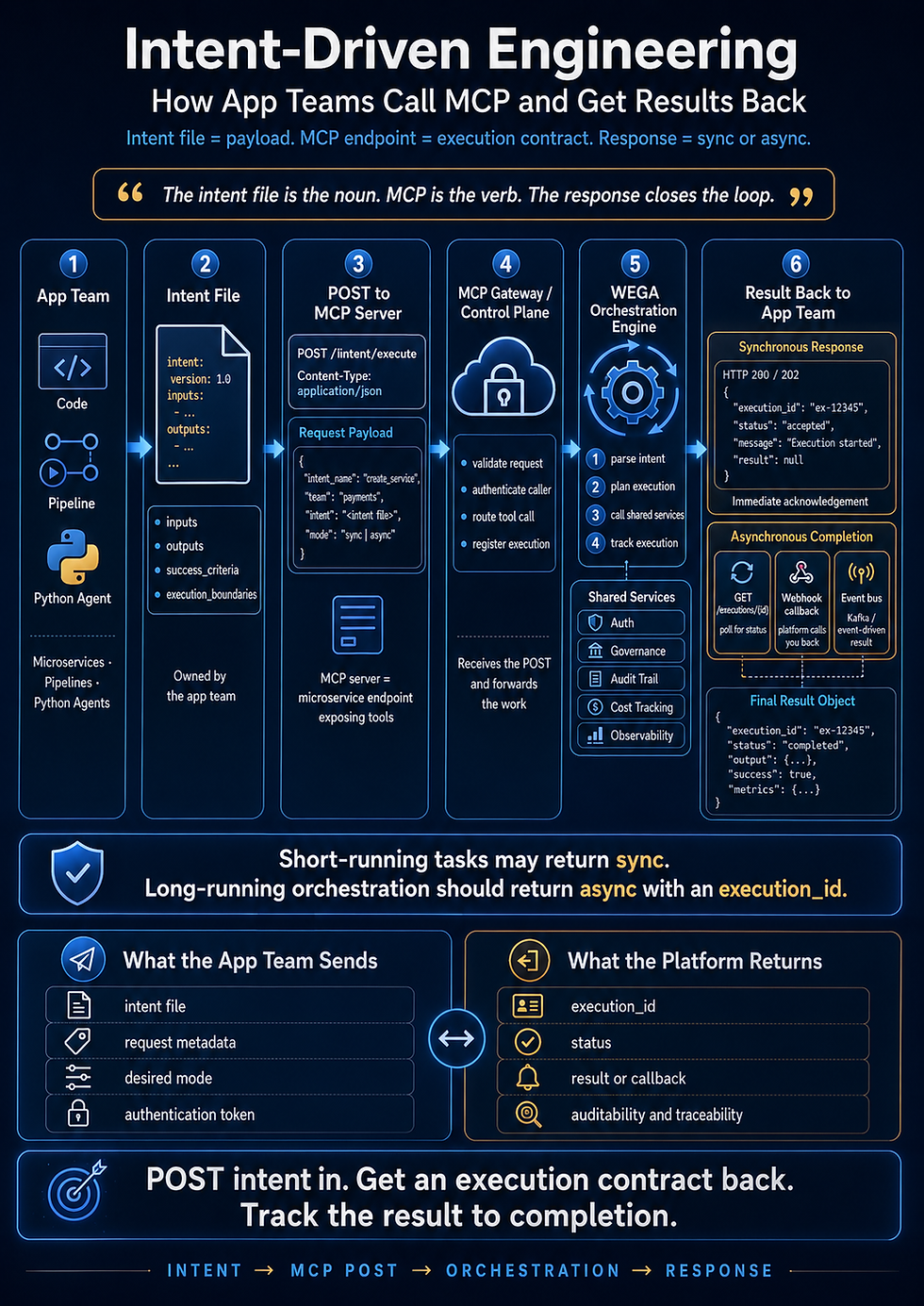
In Intent-Driven Engineering, the new unit of work is the intent file.
The intent file defines the shape of execution.
It gives agents, tools, APIs, workflows, and humans a shared contract.
A simple intent file might define:
intent:
name: customer_complaint_triage
version: 1.0.0
inputs:
- complaint_records
- customer_profile
- policy_rules
outputs:
- severity_classification
- recommended_action
- audit_trail
success_criteria:
- all_complaints_classified
- high_risk_items_flagged
- confidence_score_above_threshold
execution_boundaries:
- do_not_modify_customer_record
- do_not_send_customer_response_without_approval
- use_approved_policy_sources_only
on_failure:
- route_to_human_reviewer
- log_failure_reason
- preserve_input_context
executor:
type: agentic_workflow
requires_human_approval: true
That file is more than documentation.
It is a contract.
It tells the system what it is allowed to do, what it must produce, what success means, and how to behave when things go wrong.
This is where enterprise AI becomes manageable.
Not because the model got smarter.
But because the work became structured.
The Intent Operator Is Not Replacing Engineers
This is important.
The Intent Operator does not eliminate software engineers, architects, product owners, business analysts, or operations teams.
Instead, the role connects them.
Engineers will still build platforms, APIs, services, integrations, infrastructure, security models, and observability layers.
Architects will still define system boundaries, patterns, reference architectures, and enterprise guardrails.
Product owners will still define priorities and business outcomes.
Business teams will still own domain knowledge.
But the Intent Operator becomes the person who turns all of that into executable workflow design.
They make sure the business goal is not lost when it becomes automation.
They make sure the agent does not ignore enterprise reality.
They make sure the workflow respects the client’s stack, culture, constraints, and governance model.
That point matters especially in consulting.
As consultants, we do not create solutions in a fantasy environment.
We create solutions inside the reality of the client’s environment.
That means intent must encode context.
It must encode constraints.
It must encode goals.
It must respect the systems the client already has, the teams they already operate, the compliance rules they already live under, and the maturity level they are actually ready for.
That is the difference between selling AI hype and delivering enterprise value.
The Shift From “Using AI” to Redesigning Work
Most companies are still asking the first-generation AI question:
“How do we use AI?”
That question is too small.
The better question is:
“How should work be redesigned when humans, agents, APIs, tools, documents, approvals, and systems can operate together?”
That is the real transformation.
AI is not just another productivity tool.
It changes the shape of work.
But only if the organization knows how to redesign the workflow around it.
For example, consider a legal team reviewing vendor contracts.
The old process might be:
A lawyer reads the contract.
They compare it to policy.
They mark risks.
They email stakeholders.
They request revisions.
They track status manually.
A naive AI approach says:
“Upload the contract and ask AI to summarize it.”
That helps, but it does not transform the workflow.
An intent-driven approach says:
Identify approved policy sources.
Extract clauses.
Compare clauses against risk patterns.
Classify deviations.
Generate a risk summary.
Route high-risk clauses to legal.
Route commercial issues to procurement.
Create an audit trail.
Track unresolved items.
Require human approval before any external response.
Now AI is not just answering a question.
It is participating in a governed workflow.
That is the future.
And someone has to design, operate, and improve those workflows.
That someone is the Intent Operator.
Why This Role Will Exist Across Every Business Function
The Intent Operator will not be limited to software development.
That is one of the most important parts of this shift.
Every function will need this capability.
Marketing will need people who can turn campaign goals into agentic workflows for research, content creation, brand review, compliance checks, publishing, and performance feedback.
Legal will need people who can structure contract review, policy analysis, regulatory monitoring, and risk escalation.
Finance will need people who can define workflows for reconciliation, forecasting, anomaly detection, reporting, and approval routing.
Healthcare and life sciences will need people who can structure research workflows, documentation review, compliance checks, and human-in-the-loop validation.
Customer service will need people who can define escalation paths, approved knowledge sources, sentiment thresholds, response boundaries, and audit requirements.
Software delivery will need people who can turn architecture intent into code generation, test creation, deployment workflows, documentation, and production readiness checks.
This is why the role is so powerful.
It is not just technical.
It is operational.
It is cross-functional.
It is the bridge between business outcomes and agentic execution.
The New Enterprise Curriculum
Most current education paths are not designed for this role.
Computer science teaches algorithms, data structures, systems, programming languages, databases, and software design.
Business programs teach strategy, operations, finance, management, and organizational behavior.
Process improvement teaches workflows, measurement, bottlenecks, and optimization.
AI education often teaches model usage, prompt patterns, and tool familiarity.
But the Intent Operator needs a blended curriculum.
They need to understand:
How agents use tools.
How MCPs expose capabilities.
How command-line interfaces can become execution surfaces.
How structured files guide behavior.
How workflows are decomposed.
How business rules become constraints.
How success criteria are measured.
How failure paths are designed.
How humans stay in control.
How auditability is preserved.
How enterprise systems are integrated safely.
That is not one discipline.
It is a new operating discipline.
And companies that develop this capability early will move faster than companies that treat AI as a collection of disconnected tools.
The Biggest Mistake Companies Will Make
The biggest mistake companies will make is assuming that more AI tools automatically means more AI capability.
It does not.
A company can buy every major AI platform and still fail to transform work.
Why?
Because tools do not create operating models.
Agents do not automatically understand enterprise context.
Models do not automatically know business boundaries.
Automation does not automatically produce accountability.
The missing layer is intent.
Without intent, AI adoption becomes scattered.
One team builds a chatbot.
Another team creates a document summarizer.
Another team experiments with code generation.
Another team automates email responses.
Each may be useful, but none of them become a shared enterprise capability.
Intent creates the connective tissue.
It gives the organization a way to define, govern, reuse, measure, and improve agentic workflows.
That is why the Intent Operator matters.
They are not just using AI.
They are helping the enterprise build an AI operating system for work.
What This Means for Leaders
For leaders, the message is simple:
Do not just ask who in your organization is using AI.
Ask who is learning to structure work for AI.
That is a different question.
You need people who can sit with a business team and extract the real operating model.
You need people who can define the workflow before the tool is selected.
You need people who understand that not every step needs an LLM.
Some steps need an API.
Some need a rules engine.
Some need a database query.
Some need a human approval.
Some need a queue.
Some need an audit record.
Some need a model.
The best Intent Operators will know when to use each one.
That is how companies will control cost, reduce risk, and create real productivity gains.
The future is not agents everywhere.
The future is the right agent, with the right tools, under the right constraints, producing the right outcome, with the right human oversight.
What This Means for Individuals
For individuals, this is a massive opportunity.
You do not have to wait for a formal job title to appear.
You can start building the skill now.
Learn how to write clear intent files.
Learn how to define inputs and outputs.
Learn how to write success criteria.
Learn how to map workflows.
Learn how MCPs connect tools and capabilities.
Learn how CLIs expose repeatable execution.
Learn how agents use files, APIs, and tools.
Learn how to design failure paths.
Learn how to think like a business operator, not just a tool user.
Most importantly, learn how to move from vague requests to structured execution.
That is the skill.
When someone says:
“Can we use AI for this?”
Train yourself to ask:
What is the outcome?
What are the approved inputs?
What output should exist when this is done?
What are the boundaries?
How do we measure success?
What happens when it fails?
Who approves the result?
What system receives the final output?
Those questions will separate casual AI users from the people who can actually lead the next phase.
The Future Belongs to Intent
The next wave of enterprise AI will not be defined by who writes the cleverest prompt.
It will be defined by who can turn business intent into governed execution.
That is the role.
That is the market.
That is the missing curriculum.
The enterprise will not need thousands of people randomly prompting isolated tools.
It will need people who can design agentic workflows that are structured, measurable, auditable, reusable, and safe.
Those people will become the new bridge between strategy and execution.
They will understand the business.
They will understand the tools.
They will understand the constraints.
They will understand the workflow.
They will understand when to automate and when not to automate.
They will understand that the future of AI is not just better answers.
It is better operating systems for work.
That is why the Intent Operator will matter.
And that is why it is time to move beyond prompts.
Comments