

# The Intelligent Enterprise: How Knowledge, Intent, and Behavior Come Together

# The Intelligent Enterprise: How Knowledge, Intent, and Behavior Come Together
*How companies turn their own data into AI systems that know the business, act with intent, and prove their results.*

-----
Every enterprise now has access to the same frontier models. Anyone with a credit card can call the same LLMs your competitors use. So the models aren’t the advantage anymore.
The advantage is the **system around the model**: how your company’s knowledge gets structured, how work gets defined, how the model is shaped to behave like your organization, and how every result gets verified before it reaches a customer.
When those pieces are connected, you get something much more powerful than a chatbot. You get an intelligent process that knows what your company knows, does what you intend, behaves the way your best people behave, and proves it got the answer right.
This article walks through that process end to end, using a real-world style example: customer service at a national health insurer.
-----
## Three ideas that make everything clear
Before the steps, here’s the mental model that makes the whole system make sense:
> **RAG is what it knows. Intent is what to do. Fine-tuning is how it behaves.**
- **Knowledge (RAG).** Retrieval-Augmented Generation gives the model your company’s facts at the moment it needs them. Think of it as handing an employee the policy binder right when a customer asks a question. The facts live outside the model, so they stay current and citable.
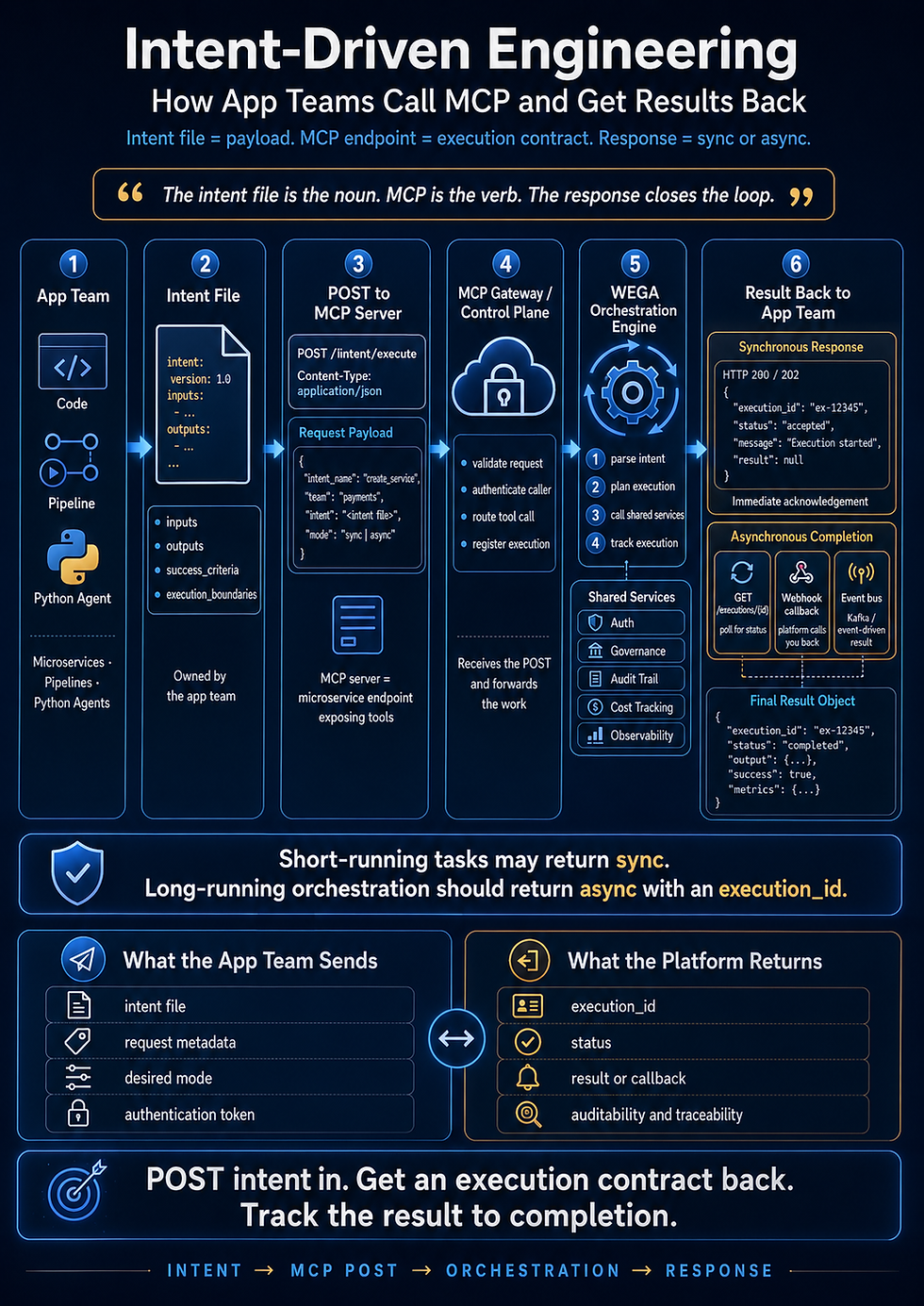
- **Intent.** Most people call it a prompt. An intent file goes further: it defines the outcome, the constraints, and the acceptance criteria. It carries its own definition of done.
- **Behavior (fine-tuning).** Fine-tuning trains a model on examples of how your organization responds, its tone, structure, and judgment, until that behavior becomes instinct.
Most teams blur these together. The intelligent enterprise keeps them separate, so each can be governed, updated, and improved on its own.
-----
## The process, step by step
### 1. Company knowledge
Everything starts with what the organization already knows: policies, standard operating procedures, plan documents, product guides, call transcripts, and wikis. In most companies this knowledge is scattered, duplicated, and partly out of date. Getting clean, approved, owned source content is the first real piece of work.
### 2. Ingest and structure
Raw content is turned into structured, searchable data:
- **Extract** clean text from websites, PDFs, and documents.
- **Chunk** it into meaningful sections, usually split by headings.
- **Tag metadata** such as source, section, effective date, product line, and audience.
- **Embed** each chunk as a vector, a numerical representation of its meaning.
The output is a set of JSON records, each holding the text, its metadata, and its vector. Metadata is the most important design decision here, because it controls what can be filtered, secured, and audited later.
### 3. Vector knowledge base (Know)
The vectors are loaded into a vector database. Now the system can search by meaning, not just keywords. A question about “getting an MRI approved” finds the prior authorization policy even if it never uses those words.
When a policy changes, only the changed chunks are re-embedded. That takes seconds and costs fractions of a cent, compared with retraining a model.
### 4. Intent file (Define)
The request arrives as an intent: what outcome is wanted, what constraints apply, and how success will be judged. This turns “answer this question” into “answer this question using only approved policy, verify the member’s plan, and escalate anything involving a denial appeal.”
### 5. Retrieve and augment
The system searches the knowledge base for the most relevant chunks, filtered by metadata such as plan type, state, or entitlement. It then assembles the intent and the retrieved knowledge into the context the model will reason over.
### 6. Orchestrator and agents
An orchestrator breaks the intent into steps and routes them to agents. Agents call tools, look up records, retrieve more knowledge when needed, and hand results back. This is a loop, not a single pass. The orchestrator and agents live in your application layer; the LLM is the reasoning engine they call.
### 7. Fine-tuned model (Behave)
The agents call a model that has been fine-tuned on examples of ideal behavior: how to explain a coverage decision clearly, when to show empathy, how to structure a response, when to escalate. The model supplies the professionalism. The facts still come from retrieval.
### 8. Validate (Verify)
Before anything reaches the customer, the output is checked against the intent’s acceptance criteria. Did it cite an approved source? Did it stay within scope? Did it follow the escalation rules? If not, it retries or routes to a human.
### 9. Outcome
The result is governed, auditable, and traceable to its sources. Every answer can be explained.
### The loop that makes it intelligent
The process doesn’t end at the outcome. New and changed content is continuously re-embedded, so knowledge stays current. Reviewed outcomes, the best responses as judged by humans and evaluations, become training data that improves behavior over time. The system gets better the more it’s used.
-----
## Enterprise example: customer service at a national health insurer
Picture a health insurer with millions of members, thousands of customer service agents, and a constant flow of calls about coverage, claims, and prior authorizations.
**The knowledge problem.** Plan benefits, formularies, and prior authorization rules change constantly and vary by plan, state, and line of business. Agents juggle dozens of systems to find the right answer.
**Why RAG comes first.** The insurer indexes its approved policies, SOPs, and plan documents into a vector knowledge base, with metadata for plan, state, and effective date. When a member asks whether an MRI is covered, the system retrieves only the policy that applies to that member’s plan. Every answer points back to its source document, which is exactly what compliance teams need.
**Why fine-tuning comes second.** Once retrieval is working, the insurer notices the answers are accurate but inconsistent in tone and structure. So it fine-tunes a model on de-identified examples of its best agents’ responses, each example showing the question, the retrieved policy, and the ideal answer. The model learns to read retrieved context and respond the way the insurer’s best people do. It does not memorize the policies.
**Why not just train everything into the model?** Three reasons:
1. **Change.** Retraining every time a policy updates is slow and expensive. Re-embedding a changed document is nearly instant.
1. **Auditability.** A fine-tuned model can’t show where an answer came from. Retrieval can.
1. **Privacy.** Training on raw transcripts containing member health information would bake that data into the model permanently. Retrieval with access controls keeps sensitive data governed.
**The result.** Agents, or self-service assistants, get answers that are current, specific to the member’s plan, consistently well delivered, and traceable. Handle times drop, accuracy rises, and every response can stand up to an audit.
-----
## Why this is so powerful
- **It turns your data into an advantage.** Everyone has the same models. Only you have your knowledge, your processes, and your way of serving customers.
- **It stays current.** Knowledge updates in minutes, not model-training cycles.
- **It’s governable.** Each layer, knowledge, intent, and behavior, can be versioned, reviewed, and controlled independently.
- **It’s provable.** Validation against acceptance criteria means you can show the system is right, not just hope it is.
- **It compounds.** Every reviewed outcome makes the next one better.
-----
## Why so few companies have it
If this is so powerful, why is it rare? Because the models aren’t the bottleneck. Everything around them is:
- **Data isn’t ready.** Knowledge is scattered, unowned, and missing metadata.
- **There are no evaluations.** Teams build impressive demos but can’t prove accuracy, so nothing ships.
- **Governance stalls.** Security, legal, compliance, and privacy each hold a veto, and no one owns getting to yes.
- **Pilot purgatory.** Many disconnected proofs of concept, none built as production systems.
- **Skills gaps.** Few people understand the full chain from retrieval to orchestration to evaluation to business outcome.
- **No definition of done.** Projects start with “let’s use AI” instead of “here is the outcome and how we’ll verify it.”
That last gap is the one that matters most, and it’s the one Intent-Driven Engineering was built to close.
-----
## Where to start
You don’t need to build all nine steps at once. A practical sequence:
1. **Pick one high-value outcome**, such as answering coverage questions accurately.
1. **Write the intent**: the outcome, the constraints, and the acceptance criteria.
1. **Curate the knowledge** that outcome depends on, with clear owners and metadata.
1. **Stand up retrieval** and prove it with evaluations.
1. **Add orchestration and agents** as the workflow demands.
1. **Fine-tune only when there’s a measured behavior gap** that better prompts and skills can’t close.
It’s real overhead. But the payoff is an AI system built on your own knowledge, shaped to your own standards, and able to prove its own results.
-----
## The bottom line
The intelligent enterprise isn’t about choosing the right model. It’s about connecting knowledge, intent, behavior, and verification into one governed process that keeps improving.
**RAG is what it knows. Intent is what to do. Fine-tuning is how it behaves. Validation is how you know it worked.**
-----
*Learn more about Intent-Driven Engineering at [LearnTeachMaster.org](https://learnteachmaster.org), a free and open-source platform for building AI systems with intent.*
Comments