

The Rise of Governed Agentic Engineering Why Claude Code Plugins, Enterprise Governance, and Intent-Driven Engineering Are Converging
- Mark Kendall
- 2 days ago
- 4 min read

The Rise of Governed Agentic Engineering
Why Claude Code Plugins, Enterprise Governance, and Intent-Driven Engineering Are Converging
The software industry is quietly entering a new phase.
For years, developers worked with:
IDEs
source control
CI/CD pipelines
architecture standards
documentation
manual code reviews
Then AI arrived.
At first, it looked simple:
“Ask AI to write code.”
But enterprises are quickly discovering something important:
AI without governance does not scale.
And that realization is leading the industry toward something much bigger:
Governed Agentic Engineering.
What Is a Claude Code Plugin?
A Claude Code plugin is more than a script or extension.
It is a packaged engineering runtime that can include:
hooks
skills
commands
agents
MCP integrations
policy enforcement
security controls
workflow orchestration
architecture governance
In simple terms:
A plugin tells Claude Code how to behave inside an organization.
Instead of every developer independently prompting AI however they want, enterprises can now create controlled development environments that:
enforce standards
protect repositories
validate architecture
automate workflows
constrain unsafe behavior
integrate with enterprise systems
This changes AI from:
“a chatbot helping developers”
to:
“a governed engineering execution environment.”
Why This Matters
Most enterprises cannot allow unrestricted AI coding.
Why?
Because enterprise software contains:
security requirements
architectural standards
compliance obligations
regulated workflows
operational guardrails
internal APIs
protected secrets
shared infrastructure
Without governance, AI becomes risky.
That is why modern Claude Code environments are beginning to include:
branch protection hooks
secret scanning
architecture validation
test enforcement
Jira integration
Confluence integration
logging and audit trails
controlled MCP tool access
The industry is moving from:
“prompt engineering”
to:
“governed execution systems.”
The New Enterprise Development Stack
Modern agentic development environments are beginning to look like this:
Developer
↓
Claude Code
↓
Plugin Runtime
↓
Hooks / Skills / Agents / MCP
↓
Enterprise Services
↓
GitHub / Jira / Confluence / Security / CI-CD
This is important because the plugin becomes the enforcement layer between the AI and the enterprise.
The plugin can:
deny unsafe bash execution
protect production branches
validate repo standards
enforce testing
inject architecture context
provide reusable organizational knowledge
route requests to approved services
This is no longer “AI autocomplete.”
This is infrastructure.
What Should Enterprise Plugins Actually Do?
A mature enterprise plugin should provide:
1. Governance
security enforcement
policy validation
architecture standards
approved workflow controls
2. Reusable Skills
remediation workflows
code review standards
project templates
testing guidance
API standards
3. Organizational Knowledge
coding standards
approved patterns
architecture decisions
operational practices
4. Controlled Integrations
Jira
Confluence
GitHub
ServiceNow
SonarQube
internal APIs
enterprise MCP servers
5. Observability
audit logs
execution tracking
policy violations
evidence collection
Who Should Control These Plugins?
This is one of the most important questions enterprises now face.
Should every application team create their own AI runtime?
Or should governance be centralized?
The answer is usually:
both.
The best model is a layered model.
Central Platform / Architecture Teams
These teams should define:
enterprise policies
approved hooks
shared agents
MCP integrations
security rules
reusable governance patterns
Application Teams
These teams should:
customize workflows
extend approved capabilities
own business logic
review remediation recommendations
manage local development velocity
The goal is balance.
Too much centralization slows developers down.
Too much decentralization creates chaos.
The WEGA Question
Many organizations are now building plugin systems that resemble internal orchestration platforms.
This creates an important architectural question:
If plugins can orchestrate workflows, why do we need enterprise platforms like WEGA?
The answer is scale.
A repo-level plugin can govern a repository.
But enterprise platforms govern organizations.
There is a major difference between:
local workflow automation
and
enterprise-wide orchestration.
A true enterprise platform handles:
shared governance
cross-team orchestration
centralized observability
organization-wide policies
reusable enterprise agents
runtime routing
cost governance
operational controls
intent orchestration across systems
The plugin is often the local runtime layer.
The enterprise platform becomes the centralized control plane.
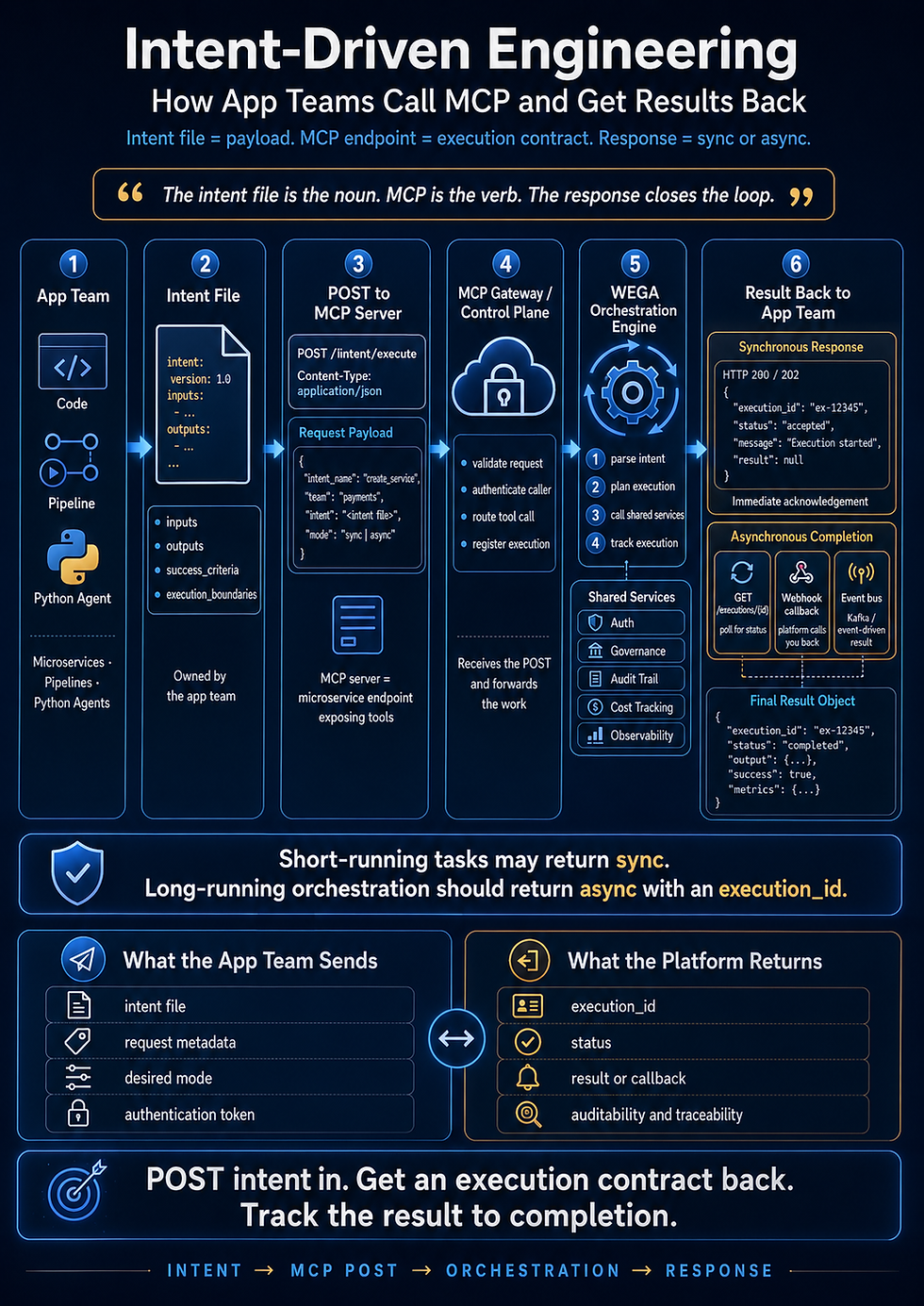
The Emerging Hybrid Model
The future likely looks like this:
Claude Code Plugin
↓
Enterprise MCP Layer
↓
WEGA Shared Services
↓
Enterprise Agents / Governance / Orchestration
In this model:
plugins provide developer experience
MCP provides controlled connectivity
enterprise platforms provide governance and orchestration
intent files provide desired outcomes and constraints
This is where Intent-Driven Engineering begins to emerge.
From Prompts to Intent
The industry is slowly learning that prompts are not enough.
Enterprises need:
constraints
governance
repeatability
measurable outcomes
reusable execution models
This is why Intent-Driven Engineering matters.
The future is not:
“AI magically writes software.”
The future is:
“Organizations define governed intent, and execution systems safely implement it.”
The intent defines:
what should happen
what constraints exist
what success looks like
what boundaries must be respected
The runtime enforces it.
The agents execute it.
The governance validates it.
Final Thoughts
Claude Code plugins are not just productivity tools.
They are the beginning of a new enterprise architecture pattern:
governed agentic engineering.
Organizations that understand this early will gain enormous advantages:
faster onboarding
scalable remediation
reusable engineering intelligence
continuous architecture governance
safer AI adoption
enterprise-wide execution consistency
The future of software engineering will not be built on isolated prompts.
It will be built on:
governed runtimes
reusable execution systems
shared organizational intelligence
intent-driven orchestration
And the companies that learn how to balance:
developer freedom
with
enterprise governance
will define the next generation of engineering platforms.
Time to move beyond prompts.
Comments